The Best Museums in Madrid
Eleven collections ranked by what they actually hold — from the Prado's Bosch triptych to the world's finest Manises lustreware, kept behind an appointment.
Madrid's museum district is not a metaphor. In 2021 UNESCO inscribed the Paseo del Prado and the Buen Retiro on the World Heritage List as a 200-hectare cultural landscape of 109 listed elements — 41 monuments, 48 buildings and 20 individual trees — among them the Prado, the Thyssen-Bornemisza and the Reina Sofía [30]. The three stand within a fifteen-minute walk of one another, and between them they cover Western painting from the late thirteenth century to Picasso with very few gaps.
That density has a specific cause. Spain's Habsburg and Bourbon kings bought pictures for four centuries and hung them in palaces in and around Madrid. When the royal holdings opened to the public in November 1819, the city inherited a collection assembled by dynastic taste rather than by conquest or committee — which is why the Prado is thin on some schools and overwhelming on others [1]. It drew 3,513,402 visitors in 2025, the first year it has passed 3.5 million [2].
But the case for a museum trip to Madrid is not really the big three. It is what sits behind them: a run of collectors' houses left to the state largely intact, an art academy that Goya ran as Director of Painting and that still keeps thirteen of his paintings [9], and a research institute in Chamberí holding what it calls the world's most important and complete collection of Manises lustreware, which you have to book ahead to see [18][19]. These are quiet museums, and several of them hold work that exists nowhere else.
Eleven are ranked below — not because eleven is a good number, but because that is how many museums in Caleido's Madrid catalogue hold a permanent collection worth the journey. Several essential Madrid museums are not yet in the catalogue and so could not be ranked or given an id: the Museo Arqueológico Nacional, which set an all-time record of 864,201 visitors in 2025, the Real Monasterio de las Descalzas Reales, the Museo Nacional de Artes Decorativas, the Museo de América and the Galería de las Colecciones Reales [2]. The Museo Sorolla, which would otherwise rank high, is temporarily closed to the public for expansion and refurbishment works [31].
The Paseo del Prado triangle

Madrid | Opened 1819 | National art museum | 4.7★ (141,461 Google reviews)
The royal collection of Spain, public since November 1819 in Juan de Villanueva's 1785 building: roughly 7,600 paintings, 8,200 drawings, 4,800 prints and 1,000 sculptures [1]. What ranks it first is concentration rather than size — Velázquez's Las Meninas, Bosch's Garden of Earthly Delights, Goya's Third of May 1808 and the Black Paintings, Titian's equestrian Charles V, El Greco's Nobleman with his Hand on his Chest, Rubens's Three Graces [1]. Habsburg and Bourbon taste built it, which is why the Venetian and Flemish schools run so deep here. It took 3,513,402 visitors in 2025, the first year it has passed 3.5 million [2].
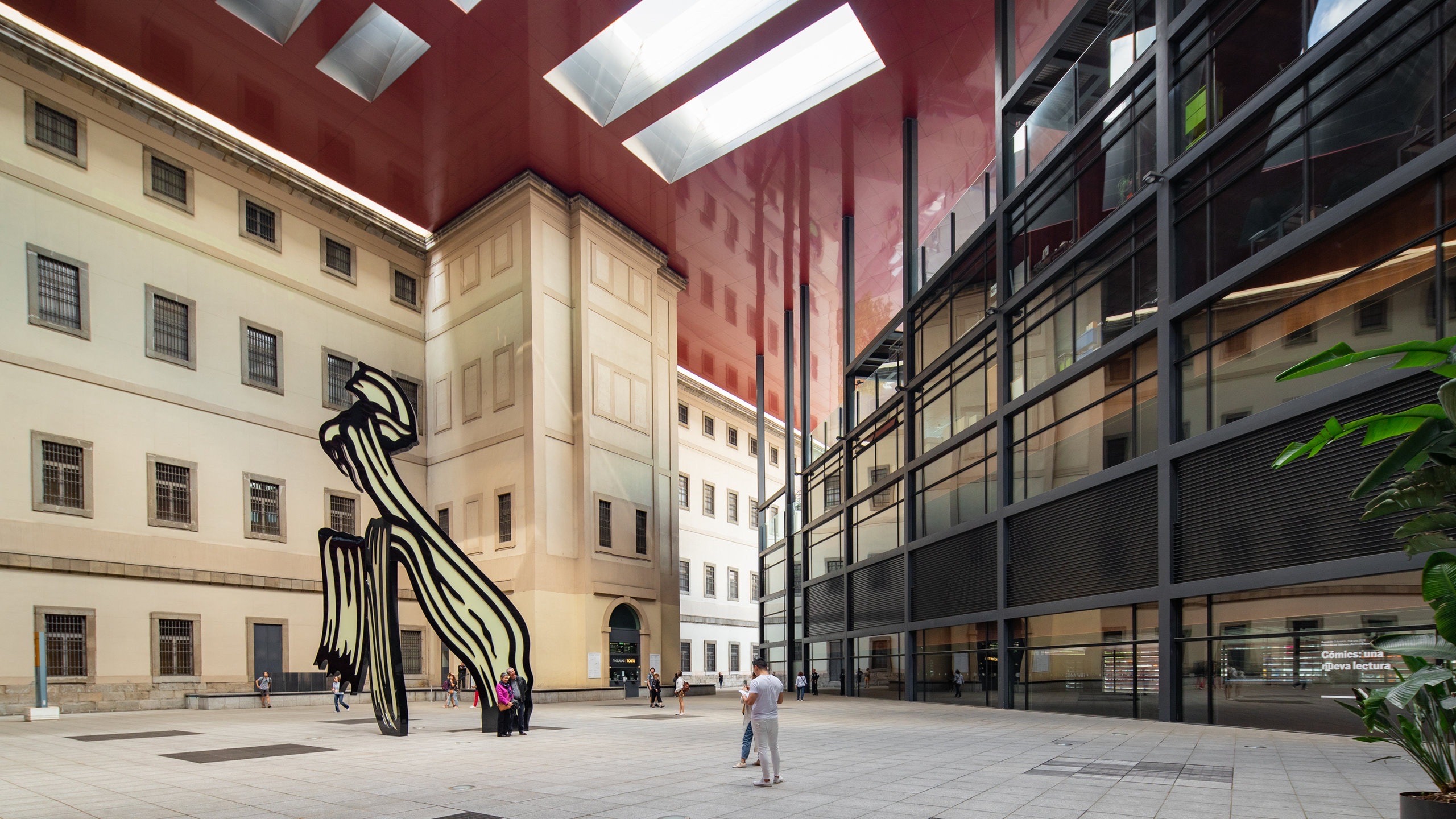
Madrid | National museum of modern art | 4.5★ (65,463 Google reviews)
Spain's national museum of modern and contemporary art holds 17,045 works, weighted towards Spain and Latin America [3]. Guernica is why most people come: 349.3 by 776.6 cm, painted between 1 May and 4 June 1937 for the Spanish Pavilion in Paris, held in New York until 1981, entering this collection in 1992 [4]. The museum notes that the room now holding it treated survivors of Condor Legion bombing raids during the Civil War [4]. The collection is being wholly rehung in a process due to conclude in 2028, so rooms move [3]. 1,601,732 visitors to its main site in 2025 [2].

Madrid | Opened 1992 | National art museum | 4.7★ (44,003 Google reviews)
Assembled over two generations by Barons Heinrich and Hans Heinrich Thyssen-Bornemisza and bought by the Spanish state in 1993, this is the survey the Prado never had: almost a thousand paintings running from the late thirteenth century to the twentieth [5][6]. Ghirlandaio's Portrait of Giovanna degli Albizzi Tornabuoni (1489–90) hangs in Room 5 [8]; with it Van Eyck, Holbein's Henry VIII, Caravaggio's Saint Catherine, Degas, Hopper and Mondrian [7]. It opened in 1992 in the neoclassical Villahermosa Palace, converted by Rafael Moneo [7]. Run through a foundation rather than directly by the ministry, it is absent from the state attendance count [2][7].
The academy and the collectors' houses

Madrid | Founded 1752 | Academy museum | 4.6★ (4,096 Google reviews)
Founded by royal decree in 1752 in the Palacio de Goyeneche, built by José Benito de Churriguera [11], the academy Goya ran as Director of Painting from 1795 to 1797 keeps thirteen of his paintings, framed by two self-portraits — the young Goya at the easel, and a bust made when he was near seventy [9]. With them The Burial of the Sardine, The Madhouse, Corrida de toros, The Inquisition Tribunal, La Tirana and portraits of Godoy and Fernando VII; the Calcografía Nacional holds his copper plates [9]. Wider holdings exceed 1,500 paintings and 15,300 drawings, including Arcimboldo's Spring [10][11].

Madrid | Opened 1951 | House museum | 4.7★ (1,399 Google reviews)
José Lázaro Galdiano left the state more than 12,000 objects and the neo-Renaissance palace he built in 1903; the museum opened on 27 January 1951 [13]. It calls itself one of the most outstanding public collections of private origin in Spain, and the pictures carry the claim: Goya's Witches' Sabbath of 1798 [13], Bosch's Meditations of Saint John the Baptist, the workshop Vision of Tondal, and a Salvador adolescente given to Boltraffio [12]. Around them sit ivories, enamels, arms, silver and jewellery, under baroque painted ceilings Lázaro commissioned for the house [13].

Madrid | Bequest accepted 1924 | House museum | 4.6★ (8,692 Google reviews)
The 17th Marquis of Cerralbo began this palace in 1883, opened it in 1893, and his family lived there until 1927; on his death in 1922 he left the state his collections, part of the building and an endowment, accepted in 1924 [14]. The interiors survive largely as the family left them [17], so the house is itself the exhibit. Fine art runs to some 1,100 paintings and sculptures — El Greco's Saint Francis in Ecstasy [17], plus Zurbarán, Alonso Cano, Pereda, Tintoretto, Bronzino and Van Dyck [15] — with an armoury of nearly 700 pieces [16]. 109,747 visitors in 2025 [2].

Madrid | Founded 1916 | Research institute and collection | 4.8★ (35 Google reviews)
Founded in 1916 by Guillermo de Osma and Adelaida Crooke, 24th Countess of Valencia de Don Juan, this Chamberí research institute holds more than 9,000 objects and is visited by prior appointment [19]. It owns what it calls the world's most important and complete collection of fifteenth- to eighteenth-century Manises lustreware, with Nasrid work including an Alhambra vase of about 1300 and the Jarro de los Donceles [18]. Also here: the late thirteenth-century Sword of Santa Casilda, a tenth-century caliphal ivory casket from Medina Azahara, Andalusi silks, and 120 paintings among them an El Greco [18].
Madrid about itself

Madrid | Opened 1929 | City history museum | 4.5★ (9,834 Google reviews)
The former Hospicio de San Fernando, one of the great buildings of Madrid Baroque, whose portal Pedro de Ribera built between 1721 and 1726 and which was listed a national artistic monument in 1919 [20]. Behind it more than 60,000 objects trace the city since it was chosen as capital in 1561, among them Goya's Allegory of the City of Madrid of 1810 [20][21], Luca Giordano's Virgen con San Fernando and Buen Retiro porcelain [20]. León Gil de Palacio's scale model of nineteenth-century Madrid returned to display on 15 August 2025 after restoration [20]. It opened as the Museo Municipal in 1929 [21].

Madrid | Opened 1924 | State house museum | 4.5★ (8,510 Google reviews)
A house-museum of Spain between 1833 and 1868, opened on 1 June 1924 under the patronage of the Marqués de la Vega-Inclán in a late eighteenth-century building on Calle de San Mateo [22][23]. Its 17,000-odd holdings mix painting, drawing, prints, sculpture, furniture, photography and decorative arts, with a historical archive of more than 4,000 documents [22]. The set pieces are Goya's San Gregorio Magno and Leonardo Alenza's Sátira del suicidio romántico, alongside Esquivel and the Madrazos [23]; the Alenza was among two works given by the Marqués de Cerralbo, and deposits from the Prado fill the gaps [22]. 115,472 visitors in 2025 [2].
In situ, and after

Madrid | Basilica completed 1784 | Basilica museum | 4.7★ (7,842 Google reviews)
Here because the visit is a curated museum route through what Madrid's tourism authority calls one of the most outstanding sacred-art collections in the city, rather than a church tour [24]. Goya's San Bernardino de Siena predicando ante Alfonso V de Aragón (1781–83, 480 by 300 cm) still hangs where it was painted to hang, and Goya put himself in it as the young man at the far right [25]. Zurbarán and Alonso Cano are here too [24]. Sabatini completed the building in 1784 [24], beneath a dome 33 metres across and 58 high [24][26].

Madrid | Museum opened 2001 | Municipal contemporary art museum | 4.5★ (1,558 Google reviews)
Pedro de Ribera's Cuartel del Conde-Duque of 1717–1736, now a municipal arts centre, houses the Museo de Arte Contemporáneo de Madrid, opened here in November 2001 [28]. It ranks last because most of it is not up: closed for renovation in April 2010, it reopened only partially in February 2015 [28], and the permanent display is two rooms — El Museo portátil — pairing a reconstruction of Ramón Gómez de la Serna's study with a thematic selection [27][29]. Roughly 200 works by more than 175 artists, Bores, Palencia, Arroyo and Genovés among them [28].
How this list was made
Ranking weighted three things, in that order.
First, what the permanent collection holds, and whether it can be seen anywhere else. This is why the Instituto Valencia de Don Juan, with 35 Google reviews, ranks above museums with more than 8,000: its Manises lustreware and Nasrid ceramics are, on the institute's own account, the most important and complete such collection in the world [18].
Second, the art-historical weight of the building and the site. Work still hanging in the room it was painted for counts heavily — Goya's San Bernardino at San Francisco el Grande [25], the Cerralbo interiors preserved largely as the family left them [17], and the Reina Sofía's Sabatini building, where survivors of Condor Legion bombing raids were treated during the Civil War and where Guernica now hangs [4].
Third, corroborated visitor evidence. Spain publishes real attendance for its state museums, and those figures — Prado 3,513,402, Reina Sofía 1,601,732 at its main site, Romanticismo 115,472, Cerralbo 109,747 in 2025 — carry far more weight here than star ratings [2]. Google review counts served only as a secondary check; they measure footfall, not collections. Two cautions on those numbers: the Prado's figure is for the Madrid building and excludes the 140,336 people who saw Prado exhibitions in Palma and Barcelona, and the Thyssen-Bornemisza is run through a foundation rather than directly by the Ministry of Culture, so it does not appear in that count at all [2][7].
Some categories were excluded on principle. Replica-and-experience attractions — illusion museums, immersive projection venues, machine-model shows — are absent however well they review: they hold no collection, and ranking them beside the Prado measures ticket sales rather than art. Archaeological parks, ruins and underground tours were left out even where Google files them as museums. Churches were excluded too, with one deliberate exception: San Francisco el Grande is admitted because the visit is a curated route through a picture collection that the city's tourism authority describes as one of the most outstanding sacred-art collections in Madrid — a museum in all but name [24].
Two catalogue entries were dropped for holding no permanent collection to show. Galería Guillermo de Osma, founded in 1991, is a commercial dealer in the historic European and Latin American avant-garde, working through rotating exhibitions rather than a standing display [32]. Fundación Banco Santander presents the bank's collection through temporary exhibitions and cultural programmes rather than a permanently installed public gallery [33]. Being small or quiet disqualifies nothing here; having nothing on the walls does.
One live caveat for planning: the Reina Sofía is reconstructing and rehanging its entire collection in a process the museum says will conclude in 2028, so specific rooms and works may have moved [3].
Opening hours, ticket prices and current temporary exhibitions are deliberately absent from this guide. They change faster than any list can track, and every museum here publishes them on its own site.
References
- 1.Museo del Prado. Wikipedia ↗
- 2.The museums managed by the Ministry of Culture register more than 7.9 million visitors in 2025. La Moncloa, Government of Spain, 2026 ↗
- 3.Collections. Museo Nacional Centro de Arte Reina Sofía ↗
- 4.Guernica — Pablo Picasso. Museo Nacional Centro de Arte Reina Sofía ↗
- 5.The Collection. Museo Nacional Thyssen-Bornemisza ↗
- 6.History of the Collection I. Museo Nacional Thyssen-Bornemisza ↗
- 7.Thyssen-Bornemisza Museum. Wikipedia ↗
- 8.Domenico Ghirlandaio, Portrait of Giovanna degli Albizzi Tornabuoni, 1489–1490. Museo Nacional Thyssen-Bornemisza ↗
- 9.La Academia y Goya. Real Academia de Bellas Artes de San Fernando ↗
- 10.Colecciones de la Real Academia de Bellas Artes de San Fernando. Real Academia de Bellas Artes de San Fernando ↗
- 11.Real Academia de Bellas Artes de San Fernando. Wikipedia ↗
- 12.Colección. Museo Lázaro Galdiano ↗
- 13.Museo Lázaro Galdiano. Wikipedia ↗
- 14.Historia del Museo y de la familia Cerralbo Villa-Huerta. Museo Cerralbo / Ministerio de Cultura ↗
- 15.Colección: Bellas artes. Museo Cerralbo / Ministerio de Cultura ↗
- 16.Colección: Armería. Museo Cerralbo / Ministerio de Cultura ↗
- 17.Museo Cerralbo. Wikipedia ↗
- 18.Colecciones del Instituto Valencia de Don Juan. Instituto Valencia de Don Juan ↗
- 19.Instituto Valencia de Don Juan. Instituto Valencia de Don Juan ↗
- 20.Museo de Historia de Madrid. esMADRID — Ayuntamiento de Madrid ↗
- 21.Madrid History Museum. Wikipedia ↗
- 22.Colecciones. Museo Nacional del Romanticismo / Ministerio de Cultura ↗
- 23.Museum of Romanticism (Madrid). Wikipedia ↗
- 24.San Francisco el Grande. esMADRID — Ayuntamiento de Madrid ↗
- 25.San Bernardino de Siena predicando ante Alfonso V de Aragón. Wikipedia ↗
- 26.Basilica of San Francisco el Grande. Wikipedia ↗
- 27.Museo de Arte Contemporáneo. Contemporánea Condeduque — Ayuntamiento de Madrid ↗
- 28.Museo de Arte Contemporáneo de Madrid. Wikipedia ↗
- 29.Museo de Arte Contemporáneo. esMADRID — Ayuntamiento de Madrid ↗
- 30.Paseo del Prado y el Buen Retiro, paisaje de las artes y las ciencias. Wikipedia ↗
- 31.Visita: cierre del museo. Museo Sorolla / Ministerio de Cultura ↗
- 32.Guillermo de Osma Galería. Guillermo de Osma Galería ↗
- 33.Fundación Banco Santander. Fundación Banco Santander ↗
No comments yet — be the first.