The Best Museums in Spain
Twenty collections across five cities — from the royal hoard that became the Prado to the church walls Catalonia refused to sell
Spain has 50 UNESCO World Heritage sites, the fifth-highest total of any country.[1] But the more useful fact for a museum trip is a historical accident: the Spanish crown collected on an enormous scale for three centuries, and the bulk of that hoard passed intact into a public museum in 1819.[3] The Habsburgs bought Titian and Bosch by the wall — Philip II sent the Garden of Earthly Delights to El Escorial in 1593, and it did not reach the Prado until 1939.[4] Velázquez and Goya were court employees rather than acquisitions. Which is why the Prado can show you Spanish painting as one continuous argument rather than a set of highlights.
The rest of the country is not a footnote to Madrid. Barcelona holds the Romanesque church murals that Catalan authorities had lifted off Pyrenean walls between 1919 and 1923, to stop an American dealer shipping any more of them abroad; the museum itself calls its medieval holding its most emblematic collection.[14][15] Seville kept the Baroque that Seville made. Valencia has a national ceramics collection behind an alabaster doorway worth the walk on its own. Bilbao has a building that changed how cities think about buildings.
Twenty museums follow, grouped by city. The numbering runs within cities rather than as a single national ranking, because the honest answer to "the best museum in Spain" depends on whether you want Velázquez, Romanesque fresco or Richard Serra — and those are in Madrid, Barcelona and Bilbao respectively. The Guggenheim at thirteen and Seville's Museo de Bellas Artes at fourteen would both sit inside a national top five.
One limit is worth stating at the top. This guide ranks only museums the Caleido catalogue holds, which at present means five cities, and it has gaps even inside them. Madrid's Museo Arqueológico Nacional, Museo Sorolla and Museo Lázaro Galdiano are not in the catalogue, nor is the Museo de Bellas Artes de Bilbao, the Dalí Theatre-Museum at Figueres, the Museo Nacional de Escultura in Valladolid, or anything in Granada, Córdoba, Toledo or Málaga. Their absence here is a catalogue fact, not a verdict.
Madrid

Madrid | 1819 | National museum | 4.7★ (141,461 Google reviews)
The Prado is not a survey museum but a royal collection that never had to buy taste. Some 7,600 paintings, hung in Juan de Villanueva's 1785 building and open to the public since November 1819.[3] Velázquez's Las Meninas holds a room to itself; Bosch's Garden of Earthly Delights reached the Prado in 1939 from El Escorial, where Philip II sent it in 1593.[4] Goya runs from the tapestry cartoons to the Black Paintings, murals cut from the walls of his own villa and transferred to canvas from 1874.[5] It drew 3,457,057 visitors in 2024, more than any other art museum in Spain.[2]
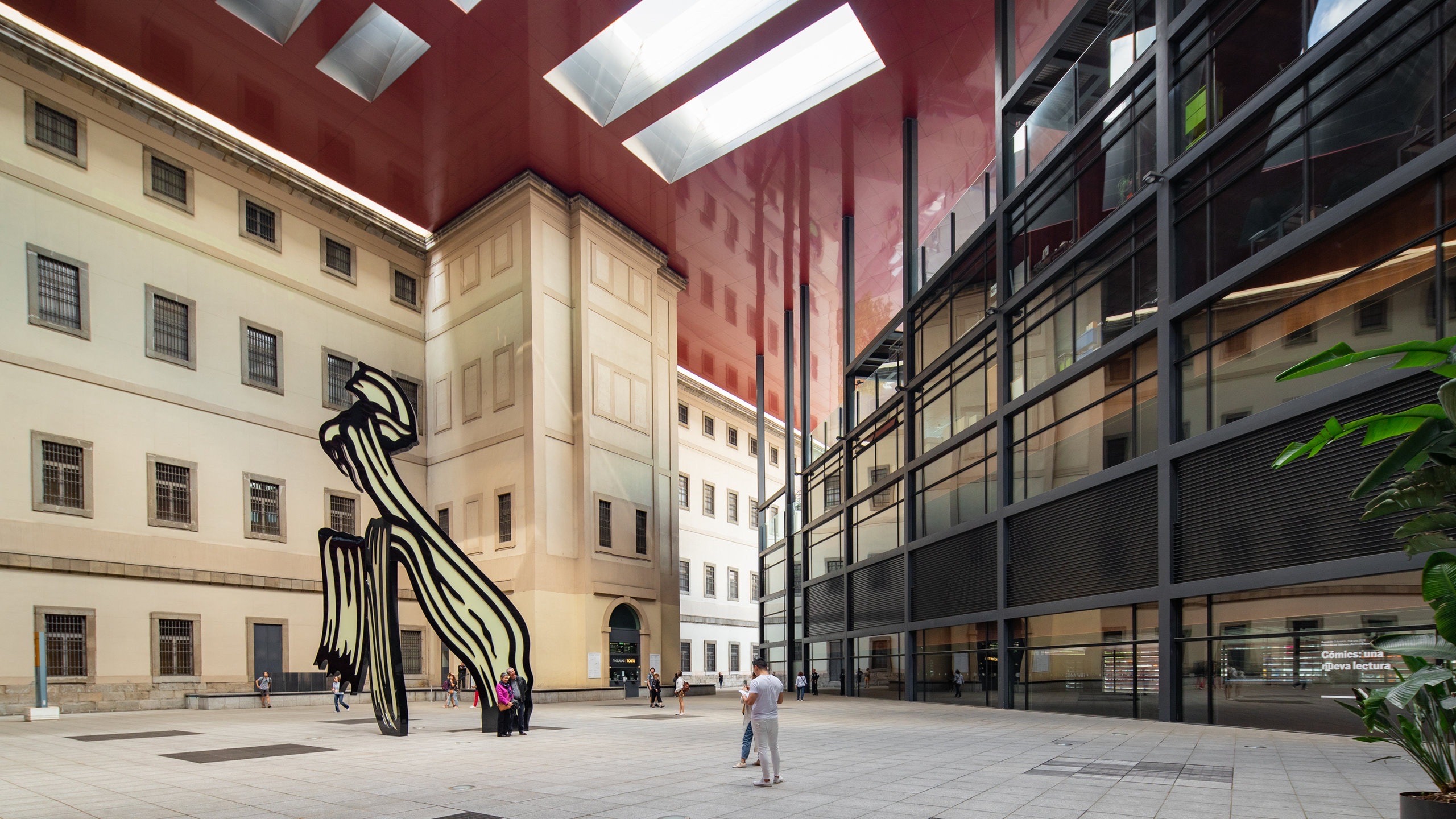
Madrid | 1992 | National museum | 4.5★ (65,463 Google reviews)
Spain's national museum of twentieth-century art fills the eighteenth-century General Hospital begun by José de Hermosilla and largely built by Francisco Sabatini, with a red-finned extension by Jean Nouvel that opened in October 2005.[6] Guernica is why most people come — shown at the Spanish Pavilion of the 1937 Paris exposition, then for decades at MoMA in New York, and moved here from the Casón del Buen Retiro in 1992, the year the museum was inaugurated.[6][7] Around it: Dalí, Miró, Juan Gris and a deep postwar Spanish holding most visitors walk straight past. 1,537,105 visitors in 2024.[2]

Madrid | 1992 | National museum | 4.7★ (44,003 Google reviews)
The Thyssen exists to fill the Prado's gaps, and its range is the point: Italian primitives, German Renaissance, Dutch painting, Impressionism, Russian constructivism, American realism. It opened in 1992, and a year later the Spanish state bought 775 works for €300 million.[8] Van Eyck's Annunciation diptych, Ghirlandaio's Portrait of Giovanna Tornabuoni and Holbein's Portrait of Henry VIII are the pictures people cross the Paseo del Prado for. Rafael Moneo converted the Palace of Villahermosa to hold it.[8] 951,821 visitors in 2024.[2]

Madrid | 1752 | Academy collection | 4.6★ (4,096 Google reviews)
Ten minutes from the Prado, in the Palacio de Goyeneche — built by José de Churriguera, later given a neoclassical face by Diego de Villanueva.[9] The academy, founded in 1752, is where Goya taught as professor of painting and served as one of its directors, and it holds thirteen of his canvases, the best Goya collection in Madrid after the Prado's: The Burial of the Sardine and three self-portraits among them.[9][10] Also here: Arcimboldo's Spring, the only Arcimboldo in a Spanish museum, Zurbarán's friars, two large Rubens and a Bellini.[9] Picasso and Dalí were both students.[10] The Calcografía Nacional is here too, its holdings centred on Goya.[11]

Madrid | 1944 | House museum | 4.6★ (8,692 Google reviews)
The Marquis of Cerralbo's palace, with everything in it. He had opened it as a private gallery in 1893; the Spanish State accepted the collection in 1924, let students and researchers in, and constituted it as a museum in 1944.[12] More than 24,900 objects — armour, clocks, coins, tapestries — fill the rooms of the house rather than galleries, with El Greco's Saint Francis in Ecstasy and a Zurbarán Immaculate Conception hung among the furnishings.[12] Few house museums show a nineteenth-century collector's rooms at this density.

Madrid | 1929 | City museum | 4.5★ (9,834 Google reviews)
Worth the walk for the doorway alone: Pedro de Ribera's eighteenth-century baroque portal on the former Royal Hospice of San Fernando, its figure of St Ferdinand carved by Juan Alonso Villabrille y Ron.[13] The museum was inaugurated on 10 June 1929. Two things to find. Goya's Allegory of the City of Madrid, whose central oval held Joseph Bonaparte, was scraped out for Ferdinand VII and repainted with each change of regime until it ended up carrying no portrait at all, only the words Dos de Mayo; and León Gil de Palacio's scale model of Madrid, built between 1828 and 1830 and among the oldest and most important historic city models in Europe.[13]
Barcelona

Barcelona | 1934; reopened 2004 | National museum | 4.7★ (39,359 Google reviews)
The Romanesque galleries are the reason to come. After an American dealer bought frescoes off Pyrenean church walls in 1919 and shipped them to Boston, Catalan authorities hired the same Italian restorers, from 1919 to 1923, to lift the remaining murals by strappo and bring them to Barcelona.[14] The Pantocrator of Sant Climent de Taüll is the one that stops people mid-room. Beyond it: Gothic altarpieces, the Cambó bequest, Velázquez's St Paul, a Fra Angelico and Gaudí furniture from Casa Batlló.[14] The museum calls its medieval holding its most emblematic collection.[15] An expansion, the New MNAC, centres on restoring the neighbouring Palau Victòria Eugènia.[16]

Barcelona | 1963 | Artist museum | 4.4★ (40,124 Google reviews)
Not a greatest-hits museum, and better for it: 4,251 works, weighted heavily towards the beginning.[17] It opened on 9 March 1963 on the initiative of Jaume Sabartés, Picasso's secretary, across five Gothic palaces on Carrer Montcada, and is the only Picasso museum created in the artist's lifetime.[17] Science and Charity, painted in 1897 when he was fifteen, shows what he could already do. The 58 canvases of the Las Meninas series, painted in 1957 and given by Picasso himself in May 1968 in memory of Sabartés, show what he then did to Velázquez.[18][19] 1,128,140 visitors in 2024.[2]

Barcelona | 1975 | Artist foundation | 4.5★ (14,939 Google reviews)
Miró began planning the foundation in 1968 and had his friend Josep Lluís Sert design the building, which opened on Montjuïc on 10 June 1975: white, top-lit, arranged around courtyards and terraces so that visitors follow a natural path through it.[20] Around 10,000 items across the collection and library, many of them given by the artist himself.[20] Alexander Calder's Mercury Fountain, made in 1937 for the Spanish Republic's pavilion at the same Paris exposition that showed Guernica, still runs here — behind glass, because mercury vapour is poisonous.[21]

Barcelona | Built 1906–1912 | Architectural monument | 4.6★ (113,829 Google reviews)
The building is the exhibit. Gaudí built Casa Milà between 1906 and 1912 with a self-supporting stone façade, free of load-bearing walls, which is why its floor plans could be redrawn at will; UNESCO listed it in 1984.[22][23] The attic's 270 parabolic vaults now hold the Espai Gaudí display of his structural thinking, and El Pis de la Pedrera, the fourth-floor apartment, is furnished as an early-1900s Barcelona flat.[22] The chimney stacks on the roof terrace are what most people came to photograph.

Barcelona | 1995 | Contemporary art museum | 4.3★ (15,286 Google reviews)
Richard Meier's white ramped box opened on Plaça dels Àngels in the Raval on 28 November 1995, built to revitalise the neighbourhood as much as to hold art.[24] The collection is deliberately narrow — around 5,000 works, up from about 1,100 at opening — covering Catalan and Spanish art since 1945, with unusual depth in conceptual practice after an 800-work Art & Language loan in 2011 and the Rafael Tous collection in 2020.[24] It is shown in themed rehangs rather than a fixed circuit, so two visits a year apart rarely overlap.[25]

Barcelona | 1936 | Maritime museum | 4.4★ (13,164 Google reviews)
The Drassanes Reials, the Gothic royal shipyards first recorded in 1243 and built out in two campaigns between 1283 and 1390, are the point: standing under those stone bays is most of the visit.[26] The museum was founded on 23 October 1936 and reopened in 2014 once the restoration finished; it holds portolan charts, navigation instruments and a full-size replica of the Royal Galley.[26][27] The schooner Santa Eulàlia, acquired and restored by the museum between 1997 and 2001, is moored a few minutes away at the Moll de la Fusta in Port Vell.[28]
Bilbao

Bilbao | 1997 | Contemporary art museum | 4.5★ (97,472 Google reviews)
The building that turned urban regeneration into a verb. Gehry's titanium hull — 33,000 plates, each 0.4 mm thick — opened on 18 October 1997 and pulled nearly four million visitors in three years, generating around €100 million in regional taxes, more than the building had cost.[29] The permanent holding is small but not incidental: Richard Serra's The Matter of Time fills the 130-metre Arcelor Gallery, and the museum bought Rothkos of its own at the inaugural exhibition.[29] Koons's Puppy guards the entrance. 1,301,343 visitors in 2024.[2]
Seville

Seville | 1835 | Provincial fine arts museum | 4.7★ (16,760 Google reviews)
The setting is half the argument: a Mercedarian convent of 1594, remodelled in the early 1600s by Juan de Oviedo y de la Bandera, whose former church is now a gallery.[30] The museum was established on 16 September 1835, and its strength is seventeenth-century Sevillian Baroque — Murillo above all, with Zurbarán, Valdés Leal at his most morbid, El Greco's portrait of his son Jorge Manuel and a Velázquez.[30] These pictures were painted a few streets away, for buildings much like this one, and most of them never left the city.

Seville | Begun 1483 | Palace museum | 4.4★ (14,820 Google reviews)
Begun in 1483 by Pedro Enríquez de Quiñones and finished by his son Fadrique, first Marquis of Tarifa, whose 1519 pilgrimage to Jerusalem gave the house its name.[31] Gothic-Mudéjar and Renaissance at once, it is the clearest surviving statement of what Andalusian nobility built when Italian taste arrived.[32] Around 150 azulejo designs made by the brothers Diego and Juan Pulido in the 1530s line the walls — one of the largest early-modern tile ensembles anywhere — and twenty-four busts gathered from the Roman ruins at Itálica stand in the main courtyard.[31] The Medinaceli ducal foundation still runs it.[32]
Seville | 1990; at the Cartuja since 1997 | Contemporary art centre | 4.4★ (3,702 Google reviews)
Andalusia's contemporary art centre, created in February 1990, occupies the Carthusian monastery of Santa María de las Cuevas, where Columbus was a guest of the monks and where his remains lay from 1509 until they crossed the Atlantic.[33][34] In 1838 Charles Pickman bought the place and opened a china factory in it three years later; the bottle-shaped kiln chimneys still stand, and the galleries thread through cloisters and industrial sheds.[33] The site was restored for Expo 92, when it served as the Royal Pavilion; the centre moved in in 1997.[33][34] Few buildings hold four centuries in plainer view.
Valencia

Valencia | 1913 | Fine arts museum | 4.6★ (10,138 Google reviews)
Founded on 24 July 1913 and holding some 2,000 works, mostly from the fourteenth to the seventeenth centuries.[35] The fifteenth-century Valencian Gothic panels are the core — gold-ground altarpieces made when Valencia was a Mediterranean trading power, and there is a great deal of them. A few rooms apart hang Velázquez's self-portrait, El Greco's Saint John the Baptist and Goya's portrait of his brother-in-law Francisco Bayeu, with Sorolla beyond.[35] The building is the Colegio de San Pío V, the St Pius V Palace of the seventeenth and eighteenth centuries.[35]
Valencia | 1947 | National museum | 4.5★ (11,629 Google reviews)
The alabaster doorway alone justifies the walk — designed by Hipólito Rovira and carved by the Valencian sculptor Ignacio Vergara in the mid-eighteenth century, when the Gothic palace was reshaped into a baroque one.[36] The museum was created on 7 February 1947 around Manuel González Martí's donation of about 6,000 pieces and opened to the public in 1954: Manises and Paterna ceramics, Alcora porcelain, a Valencian tiled kitchen González Martí designed himself, the Nymphs' coach of 1753, and twentieth-century ceramics given by Picasso.[36] Valencia made tiles for the Mediterranean, and this is where the evidence is.
Valencia | 1989 | Modern art museum | 4.4★ (2,006 Google reviews)
Spain's first modern art centre, opened in February 1989 and built around the work of the sculptor Julio González (1876–1942), acquired by donation and purchase before the doors opened, alongside a donation from Ignacio Pinazo.[37][38] The permanent collection now runs to around 10,000 works.[37] The González holding is the reason to go, and the reason IVAM is not simply a regional kunsthalle: it is the spine of the museum rather than one room in it, and the collection displays are built outward from it.[38]
Valencia | Opened 2023 | Private collection | 4.8★ (4,072 Google reviews)
The newest entry here and the most unexpected: a private collection opened to the public on 11 November 2023 inside the restored Palacio de Valeriola, a building of medieval origin standing over Roman Valentia, with 3,500 square metres of gallery.[39] Anselm Kiefer, Georg Baselitz, Andreas Gursky, Anish Kapoor and Mat Collishaw hang alongside works made for particular rooms — Olafur Eliasson's Tunnel for unfolding time, Cristina Iglesias's Tránsito mineral, Jaume Plensa's Tempesta, Tomás Saraceno's Corona Australis 38.89 and Sean Scully's Chapel.[39][40] Rare among new museums in having had building and collection designed for one another.
How this list was made
Twenty museums across five cities, ranked on three things in this order. First, what the permanent collection holds and whether it can be seen anywhere else. Second, the art-historical weight of the building and the site, with work still standing where it was made counting heavily — which is why a Mudéjar palace in Seville and a medieval shipyard in Barcelona outrank several larger institutions. Third, corroborated visitor evidence: published attendance figures where they exist, then Google rating and review volume read together.[2]
Review count is a footfall measure, not a quality measure, and it is used last. The most-reviewed museum entry in the Spanish catalogue, with more than 155,000 reviews, is not on this list at all.
Four kinds of exclusion, all deliberate.
Science centres and non-collecting exhibition halls. The Ciudad de las Artes y las Ciencias and the Museo de las Ciencias Príncipe Felipe in Valencia, CosmoCaixa in Barcelona and the CaixaForum venues are good at what they do, but they are judged on programming and interactives rather than on holdings. The same applies to the CCCB and the Centre del Carme, which borrow rather than own.
Replica and experience attractions. Illusion museums, immersive projection venues and reproduction-based shows out-review several museums on this page and hold no original work between them. They are the reason a format like this one exists.
Archaeological sites. Itálica and the Antiquarium in Seville are remarkable and are not museums; ranking sites would push out the collections this list exists to cover.
Churches. Valencia Cathedral and the Basilica of San Francisco el Grande both sell tickets and both hold real paintings — there is a Goya in the second, alongside a Zurbarán[41] — but they are working churches whose art serves the liturgy rather than a curatorial argument.
Two catalogue notes. "Montjuïc National Palace" and "Museu Nacional d'Art de Catalunya" are the same building; it is ranked once, as the museum. The Archivo de Indias in Seville is a working state archive rather than a museum, however extraordinary its holdings.
Being small or quiet disqualifies nothing. The Real Academia de Bellas Artes de San Fernando and the Museo Cerralbo carry the two smallest review counts on this page and are two of the most rewarding entries on it.
Closures were checked one by one, because Google reports a museum shut for rebuilding as operational. No multi-year closure or rebuild was found for any of the twenty. Where an institution's own site could not be reached — the Prado's, the Guggenheim's and the Fundació Miró's block automated requests, and the Spanish culture ministry and Junta de Andalucía domains currently fail certificate validation — the check fell back to encyclopedia records and published attendance rather than a first-party notice. Two ongoing building projects are worth knowing about and neither closes a museum: the MNAC's expansion centres on restoring the neighbouring Palau Victòria Eugènia,[16] and the Prado's Hall of Realms is a separate building alongside the main galleries.[3]
Founding dates, holdings and attributions come from the institutions' own publications, from national and regional culture ministries, and from major encyclopedias, cited inline and listed below. Every URL in that list was fetched and confirmed to resolve. Opening hours, ticket prices and temporary exhibitions are deliberately absent: they change faster than any article can track, and the museum's own site is the only source worth trusting for them.
References
- 1.List of World Heritage Sites in Spain. Wikipedia ↗
- 2.List of most-visited art museums (2024 attendance, after The Art Newspaper, April 2025). Wikipedia ↗
- 3.Museo del Prado. Wikipedia ↗
- 4.The Garden of Earthly Delights. Wikipedia ↗
- 5.Black Paintings. Wikipedia ↗
- 6.Museo Nacional Centro de Arte Reina Sofía. Wikipedia ↗
- 7.Guernica — Pablo Picasso. Museo Nacional Centro de Arte Reina Sofía ↗
- 8.Museo Thyssen-Bornemisza. Wikipedia ↗
- 9.Real Academia de Bellas Artes de San Fernando. Wikipedia (Spanish) ↗
- 10.Royal Academy of Fine Arts of San Fernando. Wikipedia ↗
- 11.Real Academia de Bellas Artes de San Fernando. Real Academia de Bellas Artes de San Fernando ↗
- 12.Museo Cerralbo. Wikipedia ↗
- 13.Museo de Historia de Madrid. Wikipedia (Spanish) ↗
- 14.Museu Nacional d'Art de Catalunya. Wikipedia ↗
- 15.The Collection. Museu Nacional d'Art de Catalunya ↗
- 16.New MNAC — the museum in transformation. Museu Nacional d'Art de Catalunya ↗
- 17.Museu Picasso. Wikipedia ↗
- 18.Las Meninas (Picasso). Wikipedia ↗
- 19.Museu Picasso de Barcelona. Museu Picasso de Barcelona ↗
- 20.Joan Miró Foundation. Wikipedia ↗
- 21.Mercury Fountain. Wikipedia ↗
- 22.Casa Milà (La Pedrera). Wikipedia ↗
- 23.La Pedrera – Casa Milà. Fundació Catalunya La Pedrera ↗
- 24.Barcelona Museum of Contemporary Art (MACBA). Wikipedia ↗
- 25.MACBA Collection. Museu d'Art Contemporani de Barcelona ↗
- 26.Maritime Museum of Barcelona. Wikipedia ↗
- 27.Shipyards and galleys — permanent exhibition. Museu Marítim de Barcelona ↗
- 28.Schooner Santa Eulàlia. Museu Marítim de Barcelona ↗
- 29.Guggenheim Museum Bilbao. Wikipedia ↗
- 30.Museum of Fine Arts of Seville. Wikipedia ↗
- 31.Casa de Pilatos. Wikipedia ↗
- 32.Casa de Pilatos. Fundación Casa Ducal de Medinaceli ↗
- 33.Monasterio de Santa María de las Cuevas (La Cartuja). Wikipedia (Spanish) ↗
- 34.Centro Andaluz de Arte Contemporáneo. Wikipedia ↗
- 35.Museu de Belles Arts de València. Wikipedia ↗
- 36.González Martí National Museum of Ceramics and Decorative Arts. Wikipedia ↗
- 37.Institut Valencià d'Art Modern (IVAM). Wikipedia ↗
- 38.IVAM — Institut Valencià d'Art Modern. IVAM ↗
- 39.Centro de Arte Hortensia Herrero. Wikipedia (Spanish) ↗
- 40.Collection — Hortensia Herrero Art Centre. Centro de Arte Hortensia Herrero ↗
- 41.Royal Basilica of Saint Francis the Great, Madrid. Wikipedia ↗
No comments yet — be the first.