30 works that blurred the line between high art and popular culture
CE
Caleido Editorial TeamJune 9, 202622 min read0 views
Pop Art exploded onto the scene in the late 1950s and 1960s as a brash, colorful challenge to the seriousness of Abstract Expressionism. Drawing imagery from advertising, comic books, consumer products, and celebrity culture, Pop artists asked provocative questions about the nature of art, mass production, and the boundary between 'high' and 'low' culture.
From Warhol's silk-screened Marilyns and soup cans to Lichtenstein's comic-strip paintings, from Hockney's California swimming pools to Oldenburg's giant soft sculptures, Pop Art transformed the art world with its wit, accessibility, and bold embrace of the everyday.
Use the checklist below to track which Pop Art icons you've seen in person.
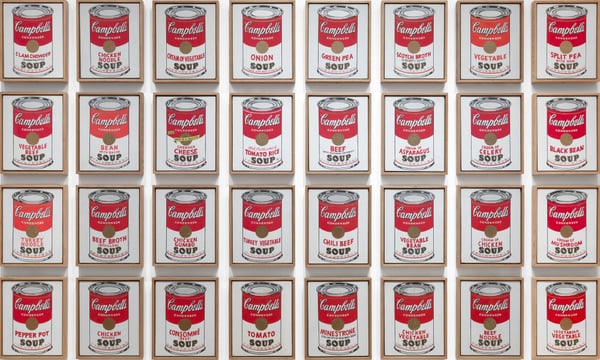
Campbell's Soup Cans is a series of 32 paintings produced by American artist Andy Warhol between 1961 and 1962. Each painting depicts a different variety of Campbell's soup cans in a uniform 20-by-16-inch format. First exhibited in July 1962 at the Ferus Gallery in Los Angeles, the works marked a breakthrough for Pop art and challenged traditional distinctions between fine art and commercial im...
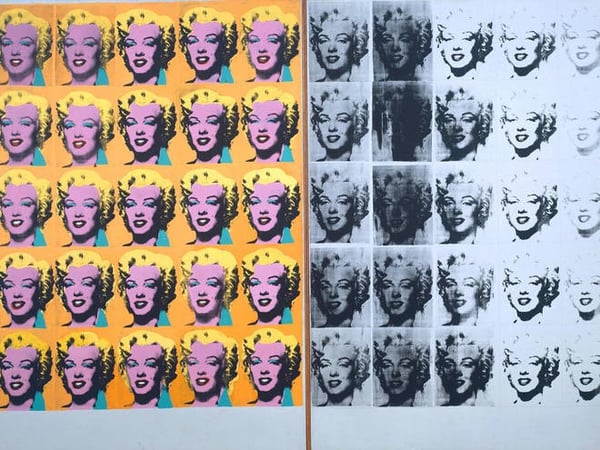
Marilyn Diptych is a 1962 silkscreen print by American pop artist Andy Warhol depicting Marilyn Monroe. The monumental work is one of the artist's most noted of the movie star.
Shot Sage Blue Marilyn is a screenprint by Andy Warhol depicting Marilyn Monroe in shades of sage blue.
04
Eight Elvises
Andy WarholArtwork
Andy Warhol
Eight Elvises is a 1963 silkscreen painting by American pop artist Andy Warhol of Elvis Presley. In 2008, it was sold by Annibale Berlingieri for $100 million to a private buyer, which at the time was the most valuable work by Andy Warhol. The current owner and location of the painting, which has not been seen publicly since the 1960s, are unknown.
Silver Car Crash (Double Disaster) is a 1963 serigraph by the American artist Andy Warhol. In November 2013, it sold for $105 million (£65.5m) at NYC auction, setting a new highest price for a work by Warhol.
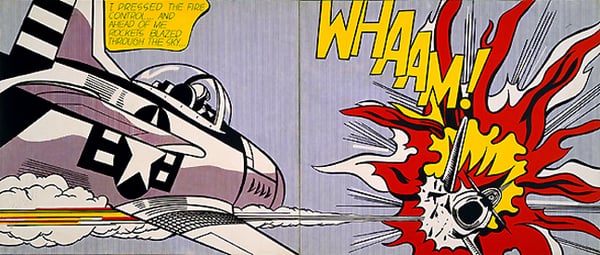
[i]Whaam![/i] (1963) is a two-canvas painting based on an image from the comic book strip [i]All-American Men of War[/i], published by DC Comics in February 1962. The left canvas depicts an American fighter plane firing a missile that hits an approaching enemy plane seen on the right canvas. The bright yellow letters ‘WHAAM!’ blaze out of the exploding airplane, describing the impact of the att...
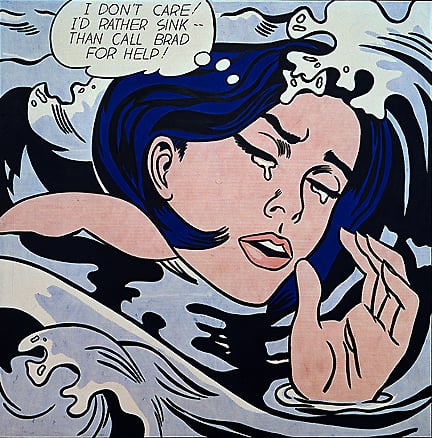
Drowning Girl is a 1963 American painting in oil and synthetic polymer paint on canvas by Roy Lichtenstein, based on original art by Tony Abruzzo. The painting is considered among Lichtenstein's most significant works, perhaps on a par with his acclaimed 1963 diptych Whaam!. One of the most representative paintings of the pop art movement, Drowning Girl was acquired by the Museum of Modern Art ...
Roy Lichtenstein's Oh, Jeff...I Love You, Too...But... uses the artist's characteristic comic-strip aesthetic, featuring bold outlined figures and dialogue rendered in speech balloons.
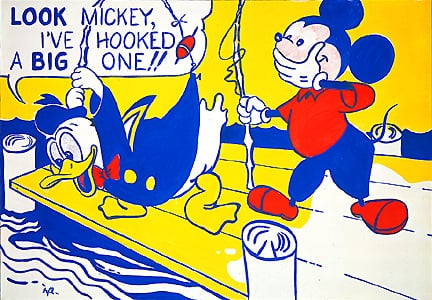
At age 38, Roy Lichtenstein created the breakthrough painting [i]Look Mickey[/i] (1961) that declared the emergence of the [url href=https://www.wikiart.org/en/paintings-by-style/pop-art]Pop Art[/url] style. Lichtenstein appropriated the scene from popular culture, showing two Disney icons, Mickey Mouse and Donald Duck in a humorous situation. In the painting, Mickey and Donald are on a pier: D...
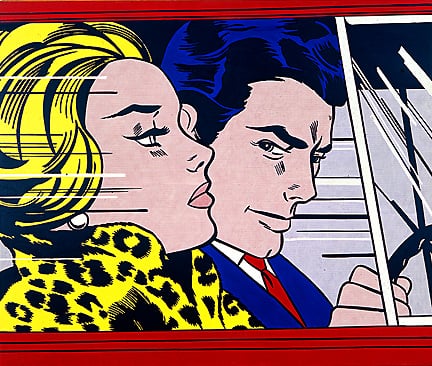
In the Car is a 1963 pop art painting by Roy Lichtenstein. The smaller, older of the two versions of this painting formerly held the record for highest auction price for a Lichtenstein painting. The larger version has been in the collection of the Scottish National Gallery of Modern Art in Edinburgh since 1980.
A Bigger Splash was painted in Califomia in the early summer of 1967. It is a record of a typical warm, sunny, cloudless day; from the position of the shadows cast by the eaves of the building and the chair, it appears to be midday when the sun is highest in the sky and the heat is most intense. The solitary figure, who has just dived into the pool, has been deliberately overwhelmed by the stre...
Portrait of an Artist (Pool with Two Figures) is a large acrylic-on-canvas pop art painting by British artist David Hockney, completed in May 1972. It measures 7 ft × 10 ft (2.1 m × 3.0 m), and depicts two figures: one swimming underwater and one clothed male figure looking down at the swimmer. In November 2018, it sold for US$90.3 million, at that time the highest price ever paid at auction ...
This painting depicts the fashion designer Ossie Clark and the textile designer Celia Birtwell shortly after their wedding at which Hockney was Clark's best man. Hockney and Clark had been friends since the early 1960s. The painting featured in the final 10 of the Greatest Painting in Britain Vote in 2005, the only work by a living artist to do so. Hockney drew on both The Arnolfini Portrait by...
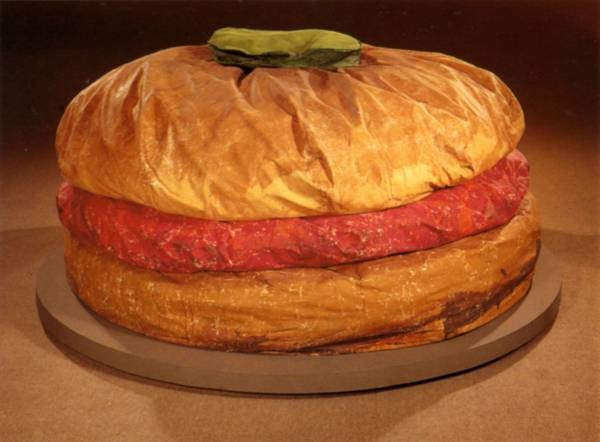
Floor Burger is a soft sculpture by Claes Oldenburg, constructed from canvas, foam, and other materials. The work renders a hamburger at an enormous scale, transforming a commonplace food object into a monumental form that occupies floor space.
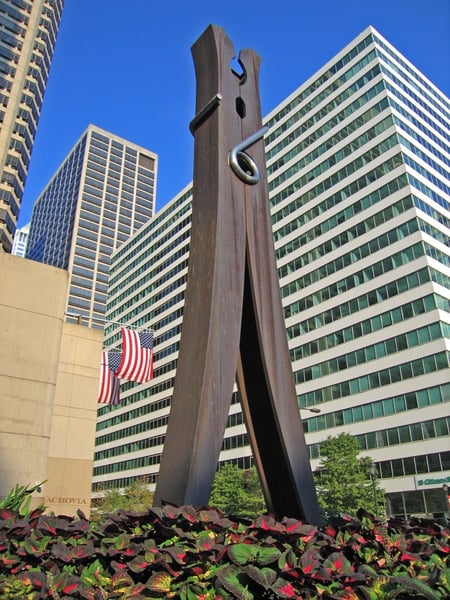
Clothespin is a monumental sculpture by Claes Oldenburg from 1976, depicting a clothespin at a colossal scale. The work translates a utilitarian domestic object into a large-scale public sculpture through exaggeration and displacement.
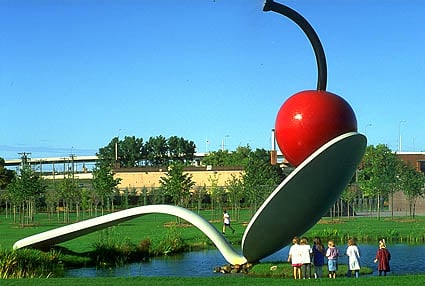
Spoonbridge and Cherry is a sculptural fountain designed by Claes Oldenburg and Coosje van Bruggen. It was funded by a $500,000 donation from art collector Frederick R. Weisman and is permanently located in the Minneapolis Sculpture Garden. The piece was completed and installed in 1988 for the Sculpture Garden's opening and consists of a large cherry resting atop a large spoon partially straddl...
Great American Nude #57 is a work by Tom Wesselmann. Without additional facts about the composition, medium, dimensions, date, or other specifications, I can only confirm that it belongs to Wesselmann's "Great American Nude" series.
30
Still Life #30
Tom WesselmannArtwork
Tom Wesselmann
A still life is a work of art depicting mostly inanimate subject matter, typically commonplace objects which are either natural or human-made.
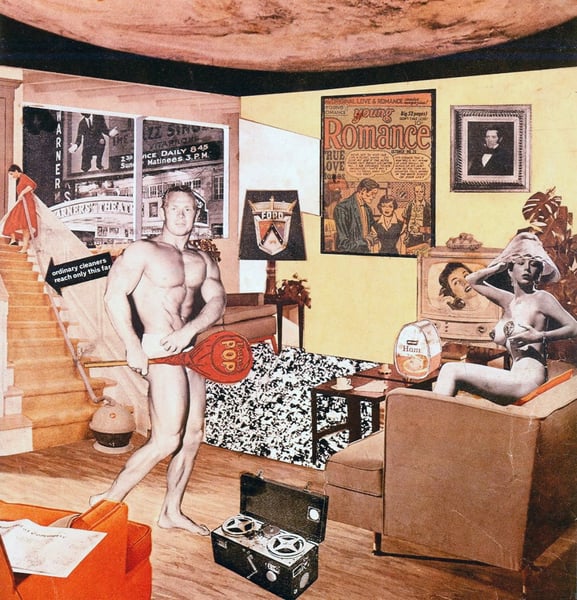
Just what is it that makes today's homes so different, so appealing? is a collage by English artist Richard Hamilton. It measures 10.25 in (260 mm) × 9.75 in (248 mm). The work is now in the collection of the Kunsthalle Tübingen, Tübingen, Germany. It was the first work of pop art to achieve iconic status.
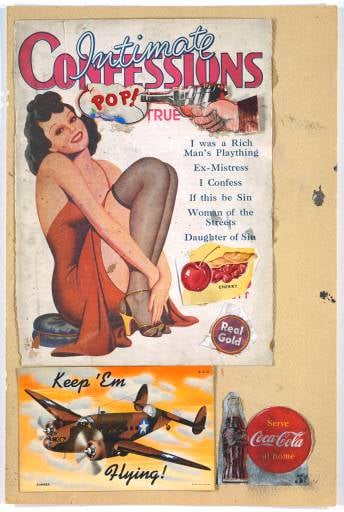
I Was a Rich Man's Plaything is a 1947 work by Eduardo Paolozzi in the Pop Art style. The title names the work's subject as a figure or object positioned as a plaything belonging to a wealthy person.
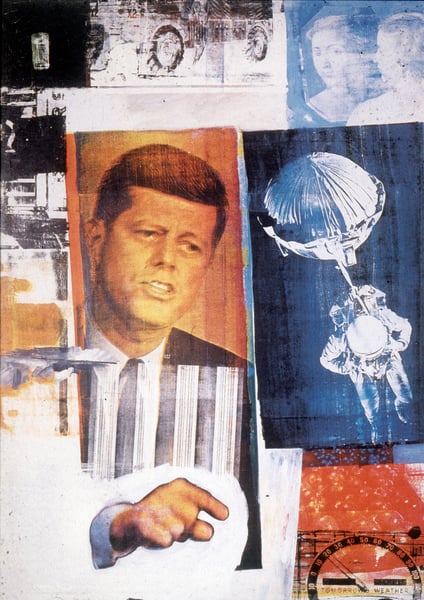
Retroactive II, created by Robert Rauschenberg in 1963, is a Pop Art work that incorporates figurative elements within the artist's characteristic mixed-media approach of the period.
Monogram is a mixed-media work by Robert Rauschenberg that incorporates a stuffed angora goat as its central element, positioned within an assemblage that includes paint, collage materials, and found objects.
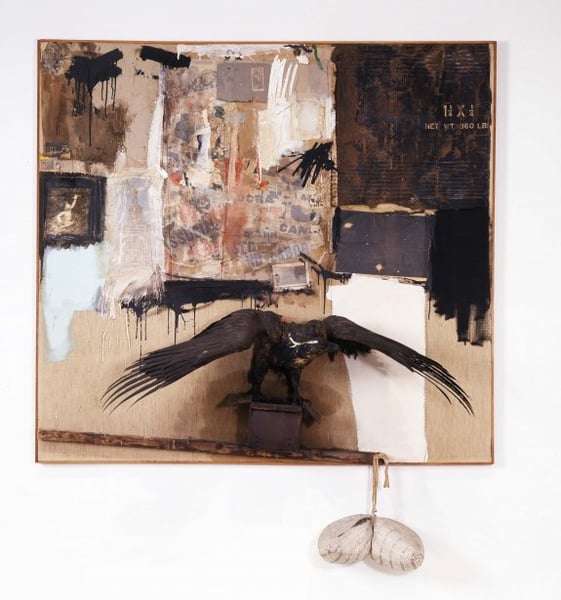
Among Rauschenberg's most iconic and controversial combines, [i]Canyon[/i] features amongst its mixed media; pieces of wood, a pillow, a mirror, and a stuffed bald eagle. The eagle appears to emerge directly from the canvas, perched on top of a cardboard box and peering down on a pillow dangling below the assemblage. A photograph of Rauschenberg's son emerges from the incongruous cacophony of o...
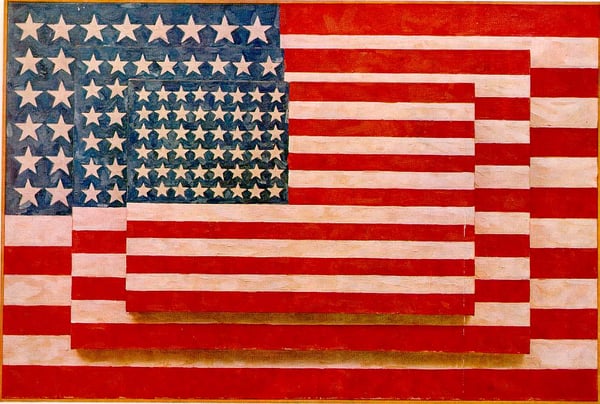
Three Flags is a painting by American artist Jasper Johns, from 1958. Held in the permanent collection of the Whitney Museum of American Art in New York since 1980, Three Flags has been described as a "landmark of 20th-century art".
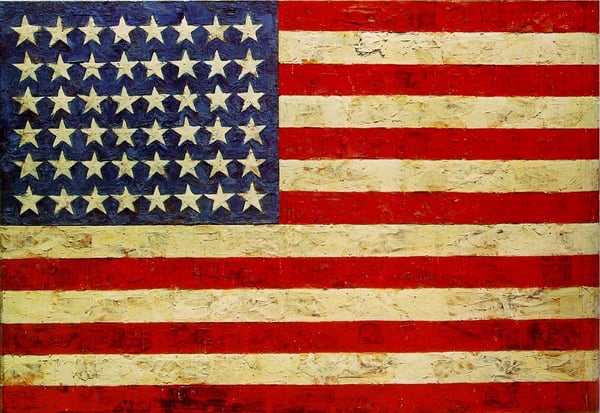
Flag is a symbolic painting by Jasper Johns from 1955, executed in the Pop Art style. The work presents the subject named in its title as a direct, literal image rather than a representational scene.
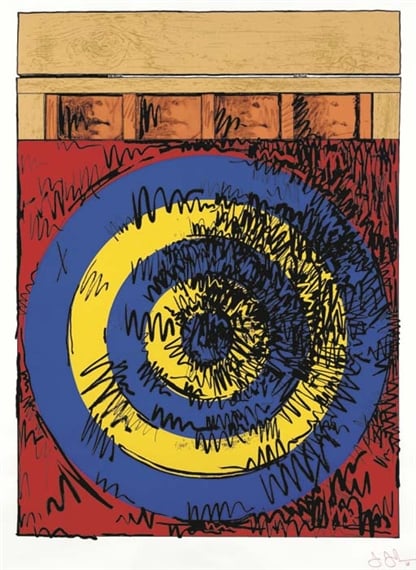
Target with Four Faces is a mixed-media work by Jasper Johns that combines a painted target motif with four three-dimensional plaster casts of a face mounted above it.
Love is an allegorical painting by Gustav Klimt from 1895, executed in the Symbolist style. The work embodies the symbolic vocabulary characteristic of late nineteenth-century allegorical art, wherein abstract concepts are rendered through figurative means rather than direct representation.
James Rosenquist began to paint the 86-foot-long F-111 in 1964, in the middle of one of this country’s most turbulent decades. Inspired by advertising billboards and by earlier mural-scaled paintings, such as Claude Monet’s Water Lilies, he designed its 23 panels to wrap around the four walls of the Leo Castelli Gallery at 4 East 77th Street in Manhattan, where it would be displayed the followi...
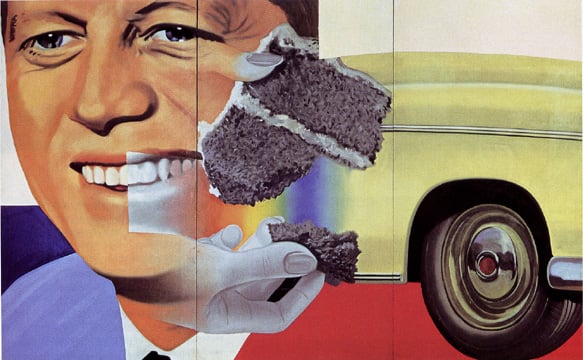
President Elect is a 1964 Pop Art work by James Rosenquist depicting a figurative subject through the lens of the movement's characteristic visual idiom.



No comments yet — be the first.