Analyse experte de Flower of Life (Flame Flower) de Frida Kahlo
Style : Naïve Art (Primitivism), Surrealism · Genre : symbolic painting
Expert Analysis: Flower of Life (Flame Flower) by Frida Kahlo
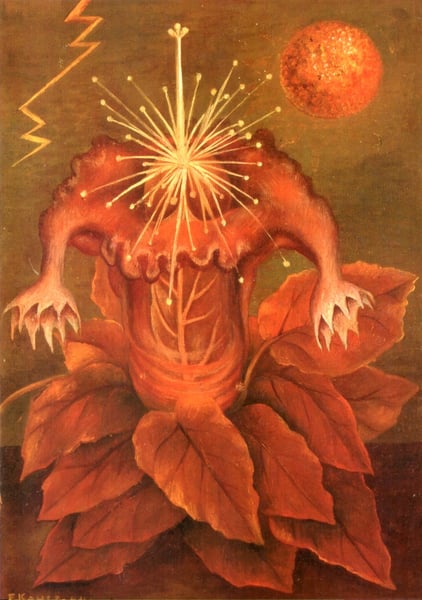
Frida Kahlo’s Flower of Life (Flame Flower) is a striking example of her ability to merge Naïve Art (Primitivism) with Surrealist sensibilities, creating a deeply personal symbolic language that defies easy categorization. Executed in the style of Naïve Art—characterized by flat perspectives, simplified forms, and folk-art influences—the painting channels the raw, unpolished directness often associated with Mexican retablos and votive paintings. At the same time, Kahlo infuses the work with a Surrealist logic of dreamlike, irrational juxtapositions: a giant, phallic flower shoots upward like a living flame, while a human figure or anatomical forms are fused with botanical elements. This fusion of the organic and the symbolic is central to the painting’s significance.
The title itself—Flower of Life (Flame Flower)—points to a dual symbolism: the flower as a source of generative energy (life) and as a consuming, passionate force (flame). Within the context of Kahlo’s oeuvre, such imagery often alludes to her own physical suffering, fertility struggles, and intense emotional life. The Naïve style here is not merely decorative; it grounds the surrealist fantasy in a tangible, folkloric authenticity, making the improbable feel intimate and real. This blending of styles was Kahlo’s signature contribution: she used the flat, emblematic forms of Primitivism to render highly personal, Surrealist symbols without losing their emotional weight.
What makes Flower of Life (Flame Flower) significant within its period is how it challenges the boundaries of Surrealism itself. While European Surrealists often sought the unconscious through automatic drawing or bizarre dreamscapes, Kahlo approached the unconscious through the concrete details of her own biography, filtered through Mexican popular art. The painting stands as a testament to her ability to make the symbolic painting a vehicle for both individual catharsis and cultural identity—a hallmark of her unique place in modernist art history.
Museum / Gallery
Visuellement similaire
20 œuvres à la composition et à la palette proches
Flight-Clock
Jacek Yerka
THE SEDUTIVE FLASH OF MISGRACE
Giancarlo Ponce
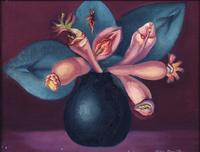
Untitled
Clovis Trouille
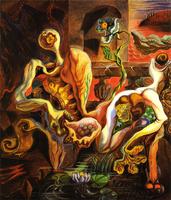
The Metamorphosis of the Lovers
Andre Masson
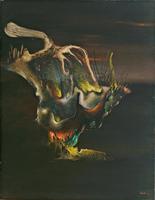
St. Elmo's Fire
Enrico Donati
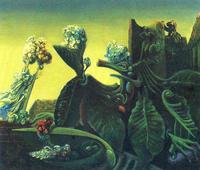
Illustration to "Mainacht in Vienna", Leo Perutz
Max Ernst
Untitled
Max Ernst
Landscape with Wheat Germ
Max Ernst
Gynandrologie
Jaroslav Serpan
Alambradas
Esteban Frances
Landscape with Rocks
Andre Masson
Vuelo De Medianoche
Grace Pailthorpe
Crucified
František Hudeček
The Moon Calf
Franz Sedlacek
May 16, 1941
Grace Pailthorpe
Sunset Garden
Vangel Naumovski
Breath of the Dragon
Jacek Yerka
Flower Piece
Franz Sedlacek
Das Hohe lied der warme
Friedrich Schroder-Sonnenstern
Inside Red Canna
Georgia O'Keeffe