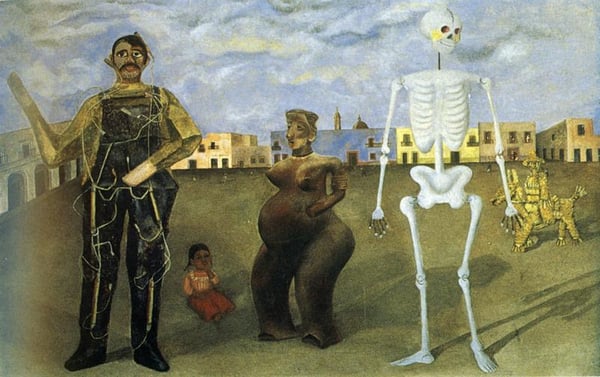
Analyse experte de Four Inhabitants of Mexico de Frida Kahlo
Style : Naïve Art (Primitivism), Surrealism · Genre : symbolic painting
Analysis of "Four Inhabitants of Mexico" by Frida Kahlo
Frida Kahlo’s Four Inhabitants of Mexico is a seminal work that bridges Naïve Art (Primitivism) and Surrealism while operating firmly within the genre of symbolic painting. Its significance lies in how Kahlo harnesses the visual languages of both styles to construct a deeply personal and culturally resonant allegory.
Naïve Art (Primitivism) Significance:
The painting employs flat, unmodulated planes of color, simplified forms, and a deliberate lack of academic perspective—hallmarks of Naïve Art. This choice is not merely aesthetic; it evokes the directness of folk art and pre-Columbian imagery, grounding the work in Mexico’s indigenous visual traditions. By adopting this primitivist approach, Kahlo rejects European artistic conventions in favor of a raw, emotionally immediate mode of expression that aligns with her exploration of national identity.
Surrealism Significance:
Though Kahlo famously stated she painted her own reality, Four Inhabitants of Mexico exhibits core Surrealist devices: dreamlike juxtaposition, symbolic dislocation, and the uncanny. The four figures—often interpreted as a Judas effigy, a pre-Columbian idol, a skeleton, and a peasant—are presented in an inexplicable, timeless space, floating without logical narrative. This irrational arrangement forces viewers to decode meaning through symbols rather than description, a Surrealist strategy that Kahlo continually refined to articulate pain, heritage, and the subconscious.
Symbolic Genre Significance:
As a symbolic painting, the work functions as a compressed national and personal myth. Each “inhabitant” represents a facet of Mexican culture: indigenous ancestry, colonial Catholicism, death (a constant companion in Kahlo’s iconography), and the enduring presence of folk traditions. The painting’s power lies in its ambiguity—no single interpretation is definitive, allowing the symbols to resonate as universal archetypes while remaining tethered to Kahlo’s own fractured biography. This fusion of intimate symbolism with broader cultural critique makes Four Inhabitants of Mexico a key example of how Latin American artists used modernist idioms to claim visual sovereignty.
Visuellement similaire
20 œuvres à la composition et à la palette proches
Skeleton Party
Edward Burra
Man and Woman (Adam and Eve)
Pavel Filonov
The Prodigal Son
Giorgio de Chirico
Kondor Béla, a Képzeleted Megtévesztett Engem
Kondor Béla
Loutkář
Jindrich Styrsky
Phases of the Moon
Paul Delvaux
Suburbs of a Paranoiac Critical Town, Afternoon on the Outskirts of European History
Salvador Dali
The Invisible Harp, Fine and Medium./Harpe invisible fine et moyenne
Salvador Dali
My Grandparents, My Parents, and I (Family Tree)
Frida Kahlo
I Romantici
Carlo Carra
Figures in a Landscape at Ampurdan
Salvador Dali
Os retirantes
Candido Portinari
Girl with Death Mask (She Plays Alone)
Frida Kahlo
Transformations of Flesh
Ernst Fuchs
Lady in Moscow
Wassily Kandinsky
Colonial mannequins
Giorgio de Chirico
Conspiration
Victor Brauner
The Andalusian Reapers
Andre Masson
The Two Balconies
Salvador Dali
L'attesa
Carlo Carra