Description
Style : Naïve Art (Primitivism), Surrealism · Genre : genre painting
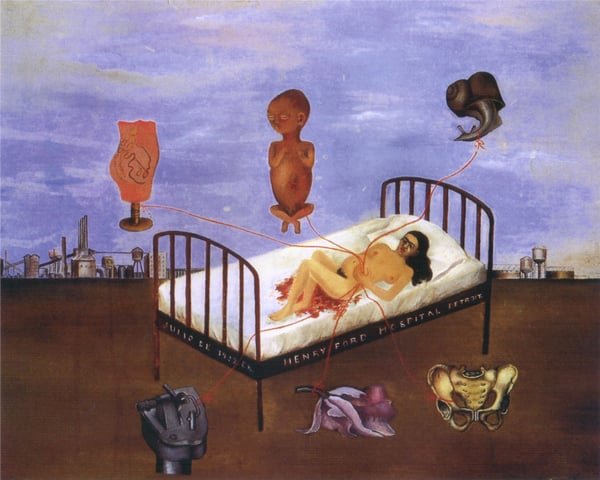
On 4 July 1932, Frida had a miscarriage in Detroit, after being under the supervision of her doctors, who recommended long periods of complete bed rest to bring her pregnancy to term. Her body, however, was unable to resist and she was finally taken to the Henry Ford Hospital, where an abortion was performed to finish the process that had begun at home. Some days later, in a state of deep depression, Frida asked to be brought the fetus of her child so that she could paint it. She was not granted her wish, having to make do with some illustrations provided by Diego and her doctors, with which she began to create this work, named after the hospital in which she was cared for.
Many of Kahlo's paintings from the early 1930s, especially in size, format, architectural setting, and spatial arrangement relate to religious ex-voto paintings of which she and Rivera possessed a large collection ranging in the date over several centuries. Ex-votos are made as a gesture of gratitude for salvation, a granted prayer or disaster averted and left in churches or at shrines. Ex-votos are generally painted on small-scale metal panels and depict the incident along with the Virgin or saint to whom they are offered. Henry Ford Hospital (1932) is a good example where the artist uses the ex-voto format but subverts it by placing herself center stage, rather than recording the miraculous deeds of saints. Kahlo paints her own story, as though she becomes saintly and the work is made not as thanks to the lord but in defiance, questioning why he brings her pain. Henry Ford Hospital is the first painting for which Frida used a metal sheet as a support, in the tradition of Mexican ex-votos, or votive tablets. She continued to use metal in her later works like My Birth (1932), Self-Portrait on the Border of Mexico and The United States (1932), Self-Portrait with Necklace (1933), etc.
In Henry Ford Hospital, Kahlo lies on a bed, bleeding after a miscarriage. From the exposed naked body six vein-like ribbons flow outwards, attached to symbols. One of these six objects is a fetus, suggesting that the ribbons could be a metaphor for umbilical cords. The other five objects that surround Frida are things that she remembers or things that she had seen in the hospital. For example, the snail makes reference to the time it took for the miscarriage to be over, whilst the flower was an actual physical object given to her by Diego. The artist demonstrates her need to be attached to all that surrounds her: to the mundane and metaphorical as much as the physical and actual. Perhaps it is through this reaching out of connectivity that the artist tries to be 'maternal', even though she is not able to have her own child. Tears pour from Frida’s eyes. There is a view of the Ford Motor Company in the industrial city of Detroit on the horizon, where Rivera was painting some murals.
Frida Kahlo produced a number of portraits with the subjects in bed. This includes My Birth (1932), where she captures her own birth, complete with soiled sheets that tell the story of what has just happened. Beyond that, she used a bed in A Few Small Nips (1935), based on newspaper accounts of a brutal murder, related to her feelings of being ‘murdered by life’. It was timed just as Frida became aware of her husband's misdemeanors, which left her emotionally broken. Sometime in the previous year, Rivera had embarked upon an affair with her younger sister Cristina, which wounded Kahlo deeply. Rivera later commented that the paintings Kahlo made in 1932 were ‘much better than those she executed before losing her baby,’ describing her as: ‘The only artist in the history of art who tore open her chest and heart to reveal the biological truth of her feelings.’ Her dramatic scenes of pain and anguish have successfully built a strong following of support, partly due to her consistent role as the woman who was talented but also taken advantage of. Modern society is growing in support for female rights and this has helped to make Frida Kahlo a true icon, almost a martyr for the mistreated gender.
Museum / Gallery
Visuellement similaire
20 œuvres à la composition et à la palette proches
Interior Landscape
Mona Hatoum
Age of anxiety
Ben Shahn
Desnudo
Carlos Alonso
Exlibris of E.Buryakovska
Oleksandr Aksinin
Femme en prière
Tsuguharu Foujita
Internal Inspection
Jacek Yerka
Hospital Bed
Hugh Steers
The Nursery (Christmas Stockings)
Stanley Spencer
The Two Pines
Carol Rama
Spazi. Spazio #03 (The Dreamers)
Gian Maria Tosatti
Bambino sul lettino
Cagnaccio di San Pietro
The Big Bed with Quilt
Louise Bourgeois
The Boy And The Girl In The Beds
Oleg Holosiy
Two Women Making the Bed
Henri de Toulouse-Lautrec
Naked Portait and a Green Chair
Lucian Freud
In the children's chamber
Kuzma Petrov-Vodkin
Study for a Portrait
Francis Bacon
sueños liquidos
Martin Pereira
Evening in the Studio
Lucian Freud
Lovers in the bed II
George Segal