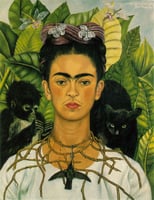
Analisi esperta di Landscape di Frida Kahlo
Stile: Naïve Art (Primitivism) · Genere: landscape
Expert Analysis: "Landscape" by Frida Kahlo
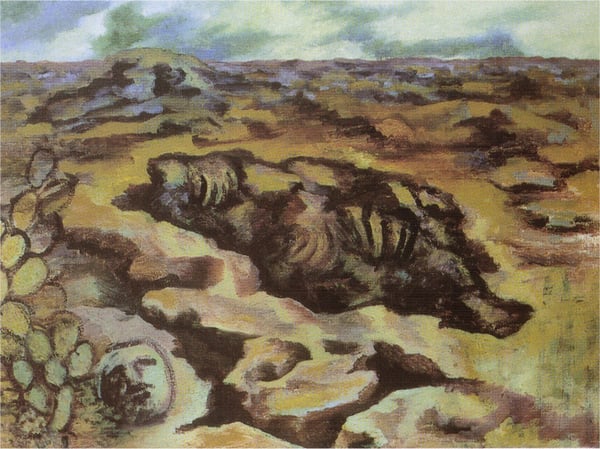
Frida Kahlo is celebrated primarily for her unflinching self-portraits, making any departure into pure landscape a notable event in her oeuvre. This work, executed in the Naïve Art (Primitivism) style, reveals a different facet of her artistic vision—one that is deeply rooted in Mexican folk traditions and an intimate, almost spiritual connection to the natural world.
Significance within Naïve Art / Primitivism:
The painting embodies the core tenets of Naïve Art: a deliberate rejection of academic perspective, flattened spatial depth, and an unpretentious, childlike vibrancy. Kahlo employs bright, often unmixed colors and simplified forms, reminiscent of retablos (ex-voto paintings) and indigenous Mexican crafts. The primitivist approach here is not a simplification born of lack of skill, but a conscious embrace of raw emotional honesty and symbolic directness.
Genre and Thematic Weight:
While categorized as a landscape, Kahlo transforms the genre into an autobiographical and cultural statement. Unlike the serene, picturesque views of European Romanticism, her landscape is charged with personal and political symbolism. The earth may be rendered with bold, almost edible colors; plants and rocks take on anthropomorphic or ritualistic qualities. This reflects Kahlo’s persistent exploration of her own identity intertwined with the Mexican soil—a landscape that is both nurturing and wounded, mirroring her own physical pain.
What Makes It Significant:
- Rarity: Kahlo painted fewer than a dozen pure landscapes. This work demonstrates her versatility and challenges the narrow lens through which her art is often viewed.
- Folkloric Fusion: It seamlessly blends European Naïve painting conventions with pre-Columbian and Mexican folk art motifs, creating a uniquely hybrid visual language that predates and influences later Latin American primitivist movements.
- Emotional Landscape: The scene is not topographical but psychological. Through exaggerated scale, unnatural colors, and a flattened horizon, Kahlo invites the viewer into a dreamlike, introspective space where nature becomes a mirror of inner life.
- Cultural Assertion: By using a “primitive” style, Kahlo aligns herself with Mexican indigeneity, asserting a post-revolutionary national identity that rejects European academic hierarchies in favor of authentic, local expression.
In summary, Landscape is a significant work within Kahlo’s canon because it expands her narrative beyond the self, proving that her primitivist approach could transform even the most traditional genre—the landscape—into a profoundly personal and culturally resonant statement. It stands as a testament to her belief that art, in its most direct and unadorned form, can convey the deepest truths.
Museum / Gallery
Visivamente simili
20 opere con composizione e palette affini
Self-Portrait with mermaid
Koloman Moser
Anchorite (the recluse)
Marià Fortuny
Rond rocks
Nicholas Roerich
Illustration for Vyšehrad
Artuš Scheiner
El Calvario
Jose Maria Velasco
Hills at Great Bear Lake
A.Y. Jackson
Svínahraun Lava Field
Johannes Sveinsson Kjarval
Mountain Gorge Bordered by a Road
Hercules Seghers
Untitled
Zdzislaw Beksinski
Cantera del cerro de los Gachupines o Atzacoalco
Jose Maria Velasco
So, how is your appetite, troll mother continued
John Bauer
Estudio de nopal
Jose Maria Velasco
The Great Paranoiac
Salvador Dali
Rocas con borreguitos
Jose Maria Velasco

Captors of fire
Nicholas Roerich
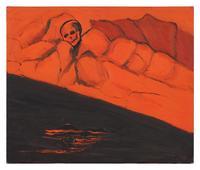
Ingrediente
Enzo Cucchi
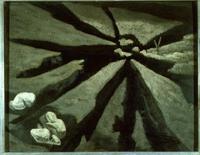
Tierra Y Excrementos
Maruja Mallo
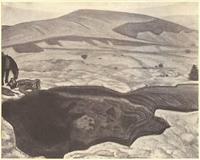
Living water
Nicholas Roerich
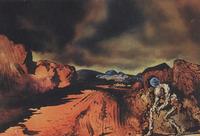
The Man with the Head of Blue Hortensias
Salvador Dali
Genocide
Sue Coe