Description
Style : Naïve Art (Primitivism), Surrealism · Genre : symbolic painting
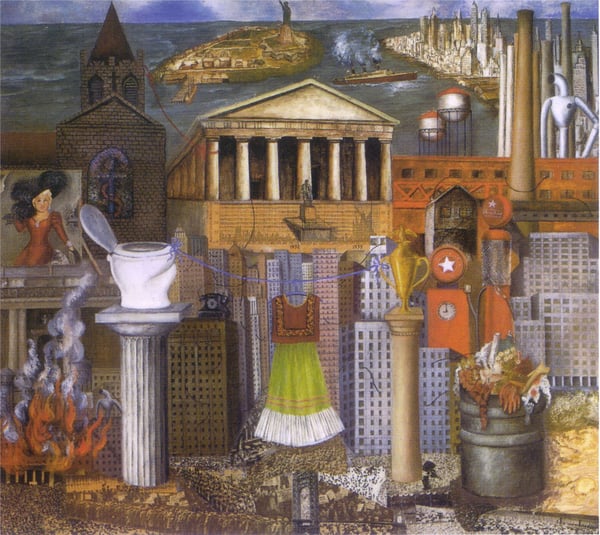
This painting represents a portrait of American capitalism and its contradictions as Frida saw them in 1933. Traveling with her husband, Diego Rivera, who painted commissioned murals in San Francisco, Detroit, and New York, she found herself abandoned in a culture she despised. After more than three years spent in the United States, Frida desperately wanted to go back to Mexico. But Rivera, at the time a prominent Mexican painter, wanted to stay in the United States and refused to go back. In the midst of this conflict, she painted My Dress Hangs There.
The painting expresses her dissatisfaction with the United States, its societal collapse, and its utter disrespect for fundamental human values. The painting is filled with the symbols of modern industrial society which treats people like machines. In contrast to this painting, Diego Rivera was working on a mural in the Rockefeller Center with which he was expressing his approval of the industrial progress in the United States.
My Dress Hangs There, set amongst the towers of New York, makes a mockery out of the modern American obsession with sport by placing a trophy and a toilet on top of classical columns, indicating the hypocrisy of the society, stating that the achievements are valued above all else that is human. Through numerous symbols that can be found on this painting, like wrapping a dollar sign around the cross or the garbage bin, Frida highlights the dichotomy of life in New York. She presents the decay, alienation, and destroyed human values that can be seen behind the illusion of wealth.
Surrounded by all this, stands Kahlo’s Tehuana dress, intact and pure. The Tehuana dress comes from the traditional costume of Zapotec women, and it became one of the main features connected not only to Kahlo's work, but to her personal fashion as well. Because Zapotec women live in a matriarchal society, their dress came to be a symbol of a female power, and thus appealed to Kahlo. She molded and fashioned the garment over time to reflect her own narrative of identity, heritage, and personal history. At the time when Mexico was trying to rediscover its indigenous heritage and promote traditional Mexican values, Kahlo, by adopting this costume into her everyday live, and through paintings such as these, developed her own brand of Mexicanidad, her own individual Mexican identity.
The absence of the central figure makes this painting atypical for Frida’s style. This painting is missing the focal point of her work, it’s missing Frida herself. She only paints her dress hanging empty and alone with the chaos of the modern city around it. With the lack of her own body in the painting, she is expressing her inner conflict. Her body might be in New York, but her soul is longing for the vibrancy of Mexico City.
Museum / Gallery
Visuellement similaire
20 œuvres à la composition et à la palette proches
The Canape Vert
Paul Delvaux
Plan, elevation and details of Doric temples in Greece (from Le Roy)
Giovanni Battista Piranesi
Blue cinema
Rene Magritte
The Sleeping Venus
Paul Delvaux
Another perspective view and details of the Doric Temple
Giovanni Battista Piranesi
The Temple of Segesta with the Artist Sketching
Thomas Cole
The Seven Lamps
Marion Adnams
Brandenburg Gate in Berlin
Ernst Ludwig Kirchner
The Temple of Concordia by Girgenti
Franz Ludwig Catel
The Visit to Ephesus
Paul Delvaux
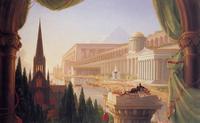
The dream of the architect
Thomas Cole
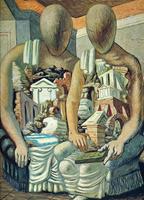
The Archaeologists
Giorgio de Chirico
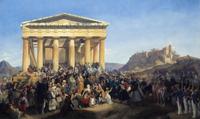
The Entry of King Othon of Greece in Athens
Peter von Hess
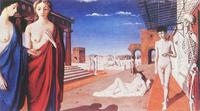
Red city
Paul Delvaux
Ancient school engineered by Egyptian and Greek
Giovanni Battista Piranesi
Bozzetto per un'opera
Felice Casorati
Sirens
Paul Delvaux
Parthenon at night
Frederic Edwin Church
Doric Columns
M.C. Escher
Tanglewood Tales
Virginia Frances Sterrett