Analyse experte de The Bus de Frida Kahlo
Style : Naïve Art (Primitivism) · Genre : genre painting
Expert Analysis of "The Bus" by Frida Kahlo
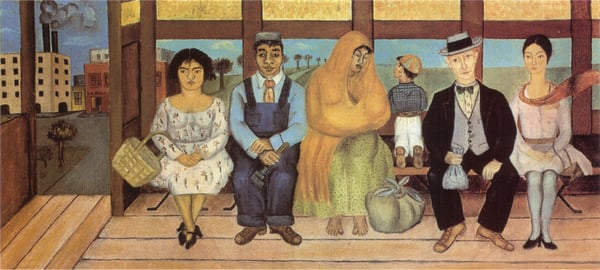
In "The Bus," Frida Kahlo employs the visual language of Naïve Art (Primitivism) to transform a mundane moment of public transit into a multilayered commentary on Mexican society. Painted in 1929, this genre painting captures a cross-section of passengers aboard a wooden bus—a scene that might seem ordinary but is rendered extraordinary through Kahlo’s intentionally simplified, flat perspectives and vibrant, folk-inspired palette.
The significance of this work lies in how it harnesses the primitivist aesthetic to challenge both artistic and social hierarchies. By adopting a deliberately “childlike” or untutored style—unmodulated color, minimal shading, and a frontal, frieze-like composition—Kahlo aligns herself with the anti-academic, anti-colonial principles of the early 20th-century Primitivist movement. Yet she does not merely imitate non-Western art; she infuses it with a distinctly Mexican identity. The passengers—a working-class indigenous woman with a child, a suited man reading a newspaper, a barefoot peasant, a woman carrying a basket, and a man with a guitar—represent a compressed portrait of Mexico’s class and ethnic stratification. Each figure is isolated within the cramped wooden compartment, yet they share a collective journey, symbolizing the fragile coexistence of different social layers in post-Revolutionary Mexico.
What makes the work especially significant is Kahlo’s early departure from her later, more introspective self-portraiture. Here, she turns her gaze outward, using the Naïve style to critique societal norms without adopting the overt didacticism of her husband Diego Rivera’s murals. The bus itself becomes a liminal space—a microcosm of the nation, where the indigenous woman’s traditional rebozo and the city worker’s fedora exist side by side. The bright, almost decorative hues and simplified forms enhance the sense of raw, unvarnished reality, while the lack of deep perspective reinforces the idea that these lives are pressed together, unable to escape one another’s presence.
Ultimately, "The Bus" demonstrates how Naïve Art (Primitivism) can serve as a tool for social documentation and subtle critique. Kahlo’s use of this style elevates a genre scene into an emblem of national identity, capturing Mexico’s contradictions—its poverty, its folk traditions, its modernization—with a directness that more polished, academic painting might soften. The work stands as a testament to Kahlo’s early engagement with the world beyond her own persona, and as a powerful example of how primitivist techniques can imbue everyday life with profound symbolic weight.
Museum / Gallery
Visuellement similaire
20 œuvres à la composition et à la palette proches
In the Omnibus
Honore Daumier
Peasant family
Rafael Zabaleta
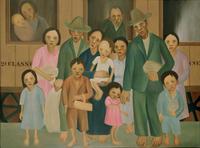
Second Class
Tarsila do Amaral
Monsieur, Madame and the Dog (Coupled brothel keepers)
Henri de Toulouse-Lautrec
Girl sitting and boy with hat standing
Rafael Zabaleta
Scheiber Hugó, Ligetben
Scheiber Hugó
By the Outdoor Photographer
Yiannis Moralis
Scheiber Hugó, Zenészek 1944
Scheiber Hugó
Scheiber Hugó Parkban 1930
Scheiber Hugó
Interior of a Tramway Passing a Bridge
Mary Cassatt
Le mur rose
Grégoire Michonze
Family of a Middle Peasant
Victor Palmov
My Grandparents, My Parents, and I (Family Tree)
Frida Kahlo
Two Gypsy Lads
Salvador Dali
The Artist and His Mother
Arshile Gorky
Group Portrait
Biruta Baumane
Czene Béla, Két Lány 1965
Czene Béla
Sabbath
Natalia Goncharova
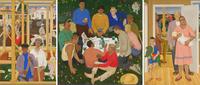
On new lands. Triptych
Dmitri Zhilinsky
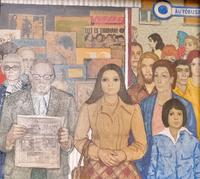
Czene Béla, Buszmegálló
Czene Béla