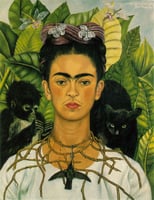
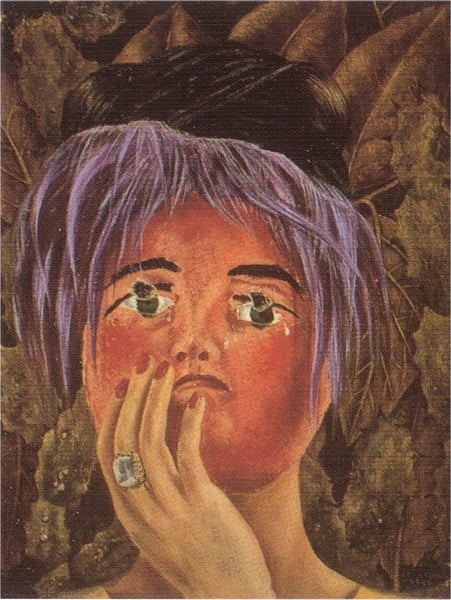
Analyse experte de The Mask de Frida Kahlo
Style : Naïve Art (Primitivism) · Genre : portrait
Frida Kahlo’s "The Mask" is a striking portrait that exemplifies the artist’s embrace of Naïve Art (Primitivism), a style marked by deliberate simplicity, flat perspective, and a strong connection to folk traditions. Within this framework, Kahlo transforms the conventional portrait genre into a deeply personal and symbolic statement.
Significance within Naïve Art/Primitivism:
Kahlo’s use of naive, almost childlike forms—bold outlines, unmodulated color, and a lack of rigorous perspective—rejects academic European painting conventions in favor of a raw, intuitive visual language. This aligns with Primitivism’s fascination with pre-industrial and non-Western art, but Kahlo infuses it with a distinctly Mexican identity, drawing on indigenous and popular culture. In The Mask, this style enhances the work’s emotional directness: the flattened space and stark composition force the viewer to confront the subject’s psychological presence rather than decorative illusion.
As a Portrait:
Kahlo’s portraits are rarely mere likenesses; they are vehicles for self-exploration and cultural commentary. In The Mask, the title suggests a central theme of concealment and authenticity—a duality that resonates with the artist’s lifelong struggle with physical pain, identity, and societal roles. The naive treatment of the face and accessories (if a mask is depicted) blurs the line between the real self and the performed identity, a recurring motif in her oeuvre. By choosing a style that appears “unschooled,” Kahlo paradoxically achieves a sophisticated critique of how women, particularly in post-revolutionary Mexico, are forced to wear social masks.
Broader Impact:
The Mask is significant as an example of how Naïve Art can carry profound psychological weight. Unlike folk artists who painted from innocent observation, Kahlo deliberately adopted the naive mode to strip away artifice and express raw emotion. This painting—like her other self-portraits—bridges the gap between high art and vernacular imagery, influencing later feminist and identity-based art by proving that personal, symbolic storytelling can be conveyed through the simplest visual means.
Museum / Gallery
Visuellement similaire
20 œuvres à la composition et à la palette proches
Girl with Hands
Charles Blackman
GIRL WITH ORANGE
Gerard Sekoto
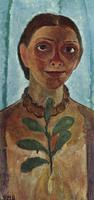
The Painter with Camellia Branch (Self-Portrait)
Paula Modersohn-Becker
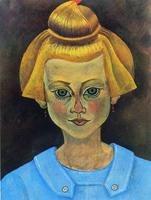
Portrait of a Young Girl
Joan Miro
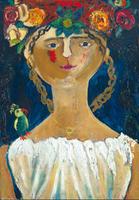
Anna Margit, Bibliai Eszter
Anna Margit
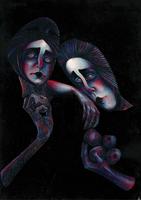
"A Poison Tree" (William Blake)
Bogdana Menger-Molodovskaya
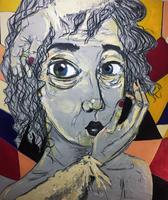
A142
Alan Aine
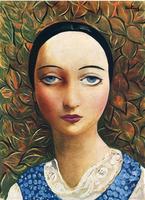
Ofelia
Moise Kisling
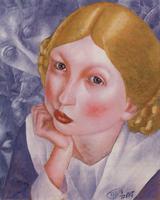
Portrait of Ria (Portrait of A.A. Kholopova)
Kuzma Petrov-Vodkin
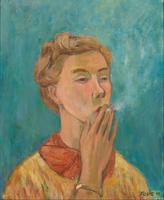
Smoking Girl (Self-Portrait)
Tove Jansson
Apples, sweet fruits
Raphael Kirchner
Eve
Lucien Levy-Dhurmer
Sun women
Raphael Kirchner
Portrait of Dora Maar
Pablo Picasso
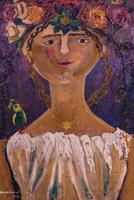
Anna Margit, Bibliai Eszter 1978
Anna Margit
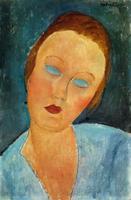
Portrait of Madame Survage
Amedeo Modigliani
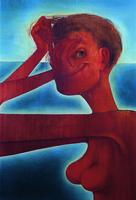
Sensitive Action
Mikuláš Medek
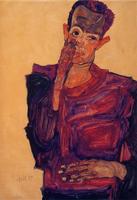
Self Portrait with Hand to Cheek
Egon Schiele
Spanish Girl
Alexej von Jawlensky
Self-Portrait
Ligia Macovei