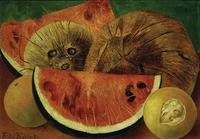
Expert Analysis: "Viva la Vida, Watermelons" by Frida Kahlo
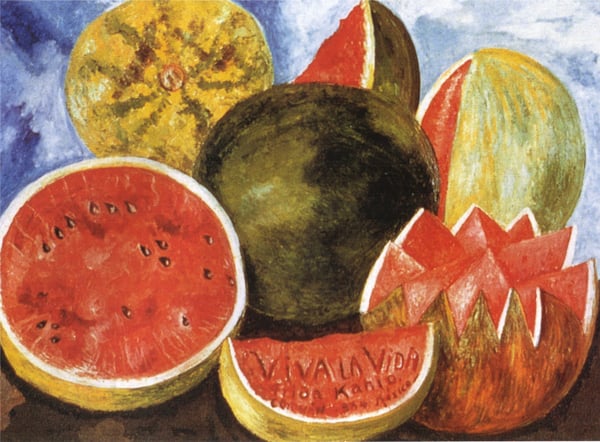
This work stands as one of Frida Kahlo’s most poignant final statements, created just days before her death. Painted in the Naïve Art (Primitivism) style, it deliberately rejects academic precision in favor of bold, flat planes of color and simplified forms—a hallmark of Kahlo’s intimate, autobiographical approach. The genre of still life here is transformed into a vibrant, symbolic self-portrait. The watermelons, arranged in a row against a warm, glowing sky, are painted with thick, direct brushstrokes that emphasize their tactile, almost sculptural presence. The most significant element is the central slice bearing the inscription “Viva la Vida” (Long Live Life). This phrase, rendered in festive red lettering on the bright green rind, creates a powerful tension with the artist’s known suffering and impending death. The choice of watermelons is culturally loaded in Mexican art—traditionally associated with La Muerte (Death) and the Day of the Dead—yet here Kahlo subverts that symbol into a defiant affirmation. The flat, naïve perspective and the unmodulated color blocks remove any illusion of depth, forcing the viewer to confront the image as a direct, emotive sign. This work is significant because it encapsulates Kahlo’s life-long project: merging the personal with the universal, and using folk-art primitivism to express resilience, mortality, and an unyielding joy. In its stark simplicity, “Viva la Vida, Watermelons” becomes a final, triumphant counterpoint to pain—a still life that lives as a fierce manifesto of life itself.