The Washerwomen
Analisi esperta di The Washerwomen di Pietro Longhi
Stile: Rococo · Genere: genre painting
Expert Analysis of "The Washerwomen" by Pietro Longhi
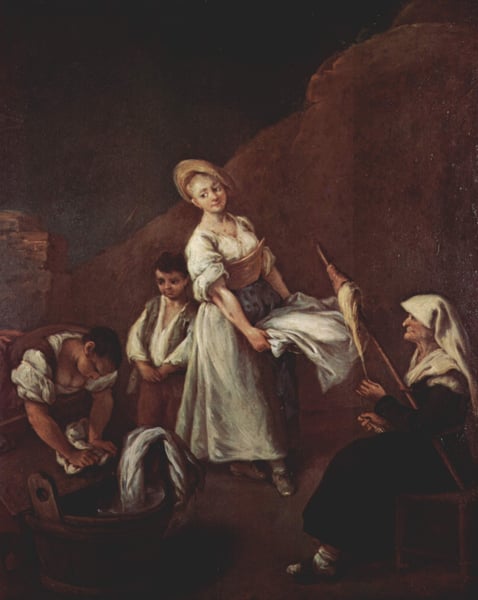
Pietro Longhi’s "The Washerwomen" is a quintessential example of Rococo genre painting, yet it distinguishes itself through a quieter, more observational approach than the era’s typical aristocratic frivolity. Working within the Rococo style—known for its delicate brushwork, soft pastel hues, and graceful compositions—Longhi turns his attention not to the leisure of the elite but to the unglamorous labor of everyday Venetian life. This choice is significant: while many Rococo artists celebrated pastoral romance or courtly dalliance, Longhi offers an intimate, almost anthropological glimpse into the domestic sphere of working-class women.
The painting’s significance lies in its truthful, unidealized portrayal of labor. Unlike the polished scenes of Fragonard or Boucher, Longhi captures the quiet dignity of washerwomen at work—bent over tubs, their hands submerged in soapy water, their faces engaged in conversation or absorbed in task. The composition likely balances Rococo’s characteristic asymmetry and soft, luminous light with a palpable sense of realism. The figures are not allegories or mythical beings; they are real women performing a repetitive, essential chore. This elevates the painting from mere decorative art to a subtle social document, offering modern viewers a rare window into the invisible hands that sustained Venetian households.
Moreover, Longhi’s work exemplifies how Rococo could accommodate the mundane. His delicate touch—seen in the rendering of fabric, the play of light on wet linens, and the gentle interactions among the women—demonstrates that genre painting could capture both aesthetic pleasure and human truth. In "The Washerwomen," Longhi proves that even the most ordinary moments, when observed with empathy and precision, can transcend their time and become enduring subjects of art.
Museum / Gallery
Visivamente simili
20 opere con composizione e palette affini
Marriage Contract
Jan Steen
The Spinner
Pietro Longhi
Man Offering a Glass of Wine to a Woman
Pieter de Hooch
The Spinner
Pietro Longhi
The furlana (Venetian dance)
Pietro Longhi
Repairing Lesson
Jules Trayer
Interior with Sleeping Kitchen Maid - The Idle Servant
Nicolaes Maes
Bath Time
Giovanni Battista Torriglia
First Steps
Giovanni Battista Torriglia
The idle servant
Nicolaes Maes
Peasants in the cave house
Le Nain brothers
The Letter
Pietro Longhi
The hunters and the farmers
Pietro Longhi
Broken Eggs
Jean-Baptiste Greuze
The Young Seamstress
Jean-Francois Millet
Preparing the Polenta
Pietro Longhi
The Spoiled Child
Jean-Baptiste Greuze
Eine amüsante Geschichte
Edward Portielje
The happy family
Le Nain brothers
Country interior
Le Nain brothers