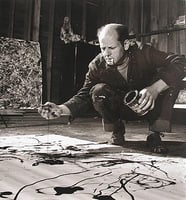
Analisi esperta di Alchemy di Jackson Pollock
Stile: Action painting · Genere: abstract
Expert Analysis: Jackson Pollock’s Alchemy (1947)
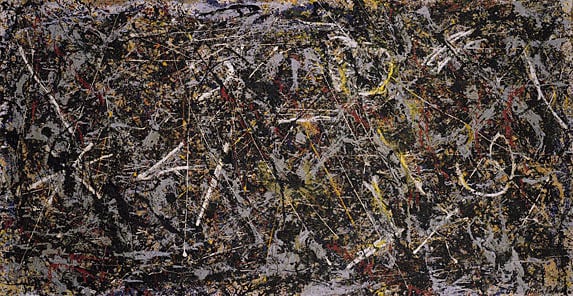
Jackson Pollock’s Alchemy stands as a quintessential masterpiece of his Drip period and a defining example of Action painting. Created in 1947, the year Pollock fully abandoned traditional easel painting for his radical “all-over” drip technique, this work captures the raw, gestural energy that transformed abstract art.
Significance within the Drip Period:
Unlike Pollock’s earlier, more figurative works, Alchemy represents a pure synthesis of chance and control. By laying the canvas on the floor, Pollock poured, flicked, and dripped industrial-grade paint (often mixed with sand or glass) in dense, interlacing skeins. The title Alchemy is apt: he transformed physical materials into a volatile, almost elemental visual field—a process he described as “being in the painting.” The composition rejects a central focal point, instead creating an evenly distributed, rhythmic web that pulls the viewer’s eye across every inch.
Significance within Action Painting:
This work embodies the core tenet of Action painting: the canvas records the artist’s physical movements and psychological state. The layered blacks, silvers, whites, and subtle touches of color build a chaotic yet balanced structure. The paint is applied with visible velocity—long arcs, splatters, and dense pools—making the act of creation as important as the final image. Critics such as Harold Rosenberg saw this as a direct expression of the artist’s subconscious, a “arena in which to act.”
Historical and Stylistic Importance:
Alchemy marks a turning point where Pollock abandoned recognizable imagery entirely, pushing abstraction into a new, all-encompassing intensity. Its scale (roughly 6 x 8 feet) and intimacy reveal the tension between monumental ambition and personal gesture. Today, it is recognized not only as a technical breakthrough in paint application but as a milestone that redefined painting as an event rather than an object—a legacy that continues to influence contemporary art.
Museum / Gallery
Visivamente simili
20 opere con composizione e palette affini
Autumn Rhythm (Number 30)
Jackson Pollock
Untitled
Mark Tobey
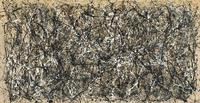
One: Number 31
Jackson Pollock
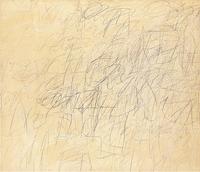
Untitled
Cy Twombly
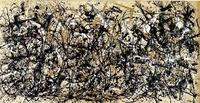
Autumn Rhythm (Number 30)
Jackson Pollock
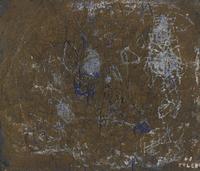
Untitled
Francisco Toledo
Catastrophe
Carloluigi Colombo
Lucifer
Jackson Pollock
Number 1 (Lavender Mist)
Jackson Pollock
Number 5
Jackson Pollock
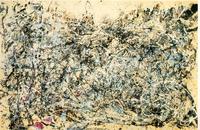
No. 1
Jackson Pollock
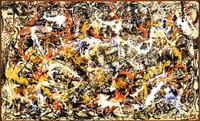
Convergence (Number 10)
Jackson Pollock
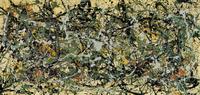
Number 8
Jackson Pollock
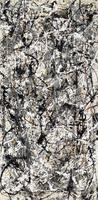
Cathedral
Jackson Pollock
Untitled (Composition)
Wolfgang Paalen
Untitled (Composition)
Jean-Paul Riopelle
Untitled
Gotthard Graubner
La Resille
Mark Tobey
Mural on Indian red ground
Jackson Pollock
Number 1
Jackson Pollock