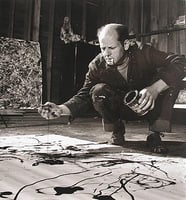
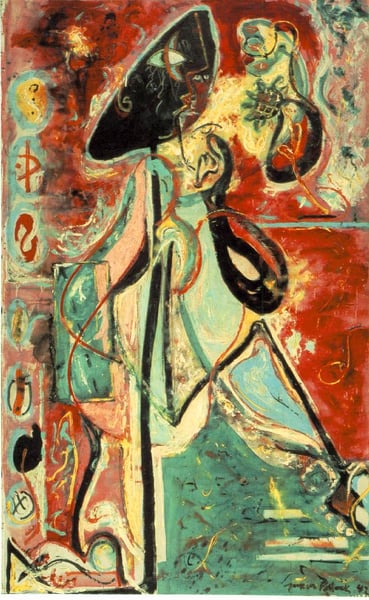
Analisi esperta di Moon Woman di Jackson Pollock
Stile: Abstract Expressionism · Genere: figurative
Expert Analysis: “Moon Woman” (c. 1942) by Jackson Pollock
Although Jackson Pollock is synonymous with the explosive drip paintings of his mature Abstract Expressionist period, Moon Woman offers a crucial glimpse into his formative years—a bridge between figurative tradition and the radical abstraction that would define his legacy. Painted during his early works period, this piece exemplifies the artist’s struggle to reconcile representational imagery with the raw, subconscious energy that would later erupt onto his canvases.
Stylistic and Historical Significance
Moon Woman belongs to Pollock’s late-1930s to early-1940s phase, heavily influenced by Picasso’s Cubism, Surrealist automatism, and Native American sand painting. The figure itself is a distorted, primordial form—flattened, angular, and carved from thick black lines that recall both cave art and the mythical totems of the American Southwest. The “figurative” genre here is not meant to imitate nature; rather, it serves as a vessel for archetypal, Jungian symbolism. The moon woman motif suggests a lunar deity or fertility spirit, tapping into the universal unconscious that Pollock and his Abstract Expressionist peers sought to express.
Technical and Compositional Choices
Unlike the all-over drips of his later work, the surface of Moon Woman is built with dense, layered brushstrokes and a stark palette of black, white, earth tones, and muted reds. The figure is both centered and fragmented—its head and torso dissolve into swirling, non-descriptive marks. This tension between recognizable form and chaotic mark-making is the very engine of the painting’s significance: it shows Pollock actively dismantling the figure, step by step, until only pure gesture remains. The heavy, impasto texture and aggressive linear strokes prefigure the rhythmic, dancing energy of his 1947–1950 masterpieces.
Why It Matters
Moon Woman is a critical document of Pollock’s creative metamorphosis. It captures the moment when he turned away from European modernism’s rational structure and toward a uniquely American, mythic, and bodily approach to painting. The work stands as a testament that even in his figurative phase, Pollock was already a revolutionary—using the human form not as an object of representation, but as a catalyst for raw, psychological expression. Without this transitional piece, the breakthrough of Number 1A, 1948 or Autumn Rhythm would lack its essential foundation.
In short, Moon Woman is significant because it reveals the artist at a crossroads: still holding onto the figure, but already releasing—and reshaping—it into the primal, abstract language that would forever change the course of art.
Museum / Gallery
Genere
Visivamente simili
20 opere con composizione e palette affini
The key
Jackson Pollock
Autumn
Gene Davis
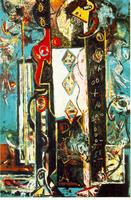
Male and Female
Jackson Pollock
-
Karel Appel
Untitled
Andre Lanskoy
Jardin des êtres
Asger Jorn
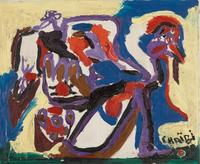
Bird (No. C.12)
Chaibia Talal
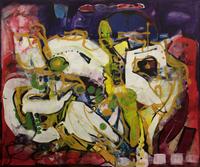
Armageddon
Artin Demirci
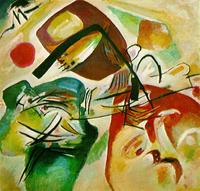
Picture with a black arch
Wassily Kandinsky
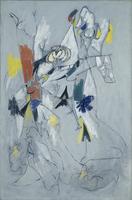
Waterfall
Arshile Gorky
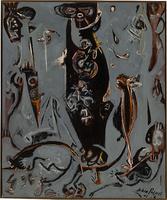
Totem Lesson 2
Jackson Pollock
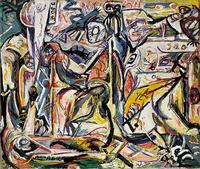
Circumcision January
Jackson Pollock
Armageddon
Artin Demirci
Jeux des formes
Serge Brignoni
The Garden in Sochi
Arshile Gorky
Untitled
Jean-Michel Atlan
Byzantine Faces
George Stefanescu
Special Delivery
Willem de Kooning
Mirage oceanique
Serge Brignoni
Naturaleza Muerta Con Tijeras
Maria Blanchard