Animals and Figures
Dettagli
Analisi esperta di Animals and Figures di Jackson Pollock
Stile: Expressionism · Genere: figurative
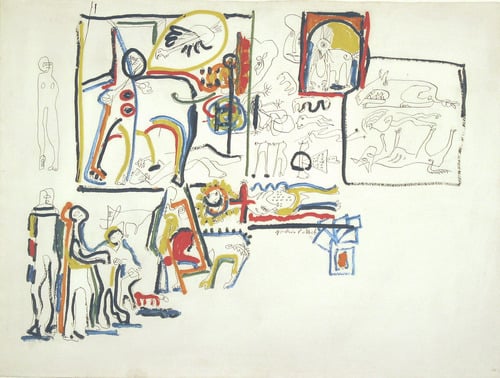
Jackson Pollock’s Animals and Figures is a pivotal example of his early, pre-drip period, offering crucial insight into the development of his revolutionary style. Executed within the Expressionism movement, the work is figurative—a marked departure from the abstract, all-over compositions that would later define his career. Its significance lies in demonstrating how Pollock, while still working in a recognizable, representative mode, was already pushing toward the raw, gestural energy that would become his hallmark.
The piece belongs to Pollock’s early works, a phase heavily influenced by Mexican muralists, American Regionalism, and the biomorphic surrealism of artists like Arshile Gorky and Pablo Picasso. Here, the human and animal forms are not rendered with classical precision but are distorted, fragmented, and animated by an intense, almost violent line. The “expressionist” handling of paint—visible brushstrokes, thick impasto, and emotionally charged contours—imbues the figures with a sense of primal urgency. Rather than depicting a calm narrative, Pollock uses the figurative subject as a vehicle for psychic and emotional release, anticipating the “action painting” ethos of his later poured works.
What makes Animals and Figures significant is its status as a bridge between tradition and radical innovation. It confirms that Pollock’s mature, non-representational style was not a sudden break, but an evolution from figurative expressionism. In this work, we already see his obsession with rhythmic, all-over pattern—even as he depicts recognizable creatures, the forms begin to dissolve into a web of line and color. For art historians, the piece is essential: it grounds Pollock’s later abstraction in a deep engagement with the figure, showing that his abandonment of representation was a deliberate, informed choice, not a mere rejection. Thus, Animals and Figures is not just an early experiment but a foundational document of mid-century American modernism, revealing the roots of the very innovations that would make Pollock a legend.
Museum / Gallery
Visivamente simili
20 opere con composizione e palette affini
Armageddon
Artin Demirci
Untitled
Vasile Kazar
Untitled
Vasile Kazar
Untitled
Helen Frankenthaler
Untitled
Vasile Kazar
Untitled
Arshile Gorky
Armageddon
Artin Demirci
The beach in Garoupe
Pablo Picasso
Special Delivery
Willem de Kooning
The key
Jackson Pollock
Untitled
Vasile Kazar
Untitled
Willem de Kooning
Stenographic Figure
Jackson Pollock
Landscape
Constantin Flondor
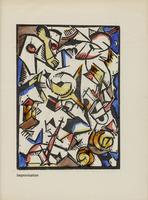
Improvisation (plate, Page 11) from the Periodical Der Schwarze Turm, Vol. 1, No. 3 (July 1919)
Georg Tappert
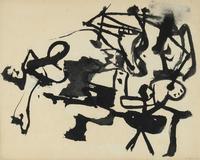
Untitled
Afro
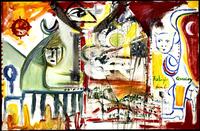
Relógio
Mario Cesariny
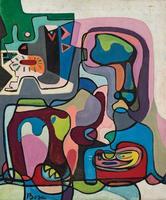
Wild Beast Roaming around the World
Peter Busa
Study for Agony
Arshile Gorky
Animated Slope
Willi Baumeister