Экспертный разбор работы «Bird» художника Jackson Pollock
Стиль: Expressionism · Жанр: figurative
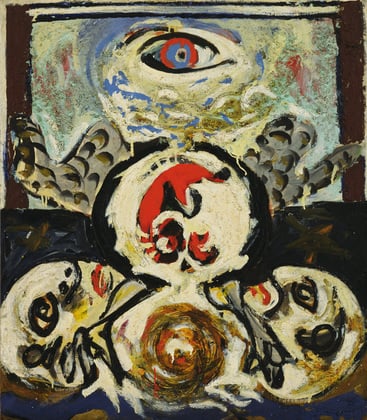
In his early work Bird, Jackson Pollock reveals the foundational tension between figurative representation and the gestural energy that would later define his mature Abstract Expressionist style. Painted during the late 1930s or early 1940s—before his iconic drip period—this piece belongs to his formative, expressionist phase, heavily influenced by the Surrealist concepts of automatism and the biomorphic forms of artists like Joan Miró and the Mexican muralists.
Stylistic Significance within Early Pollock: The painting is executed in a raw, expressionist manner: thick, agitated brushstrokes and a distorted, almost primal figuration. The "bird" is not rendered naturalistically but emerges from a dense interplay of dark outlines and earthy, muted tones. The creature’s form is ambiguous—part animal, part totemic symbol—its beak and eye barely distinguishable from the surrounding slashes of paint. This reflects Pollock’s interest in Jungian archetypes and the subconscious, where the bird may serve as a personal or mythic emblem.
Bridge to Later Work: Bird is significant because it documents Pollock’s gradual shift from figure to field. The background is not a neutral space but an active, agitated surface; the paint itself begins to assert autonomy. The aggressive, rhythmic application foreshadows the all-over compositions of his classic drip paintings. Here, the figure is still present, but it is being consumed by the very materiality of the line and texture. This early tension between recognizable subject and explosive gesture marks the crucial step toward the non-objective, fully abstract works for which Pollock would become famous.
Art-Historical Context: As an expressionist figurative piece, Bird situates Pollock within the broader American response to European modernism, particularly the synthesis of Surrealism’s psychic automatism with the emotional force of German Expressionism. It demonstrates that his revolutionary abstraction did not arise from a vacuum but from a deliberate wrestling with traditional representation—a struggle that gives his later paintings their extraordinary sense of energy and liberation. In Bird, we witness the artist preparing to let the painting take flight beyond the confinement of the image.
Museum / Gallery
Визуально похожие
20 работ с близкой композицией и палитрой
Composition En Rose Et Vert
Chaibia Talal
In the Same Basket (Dans le même panier) from the portfolio Pencil on Shell
Pierre Alechinsky
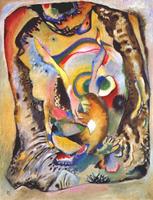
Painting on light ground
Wassily Kandinsky
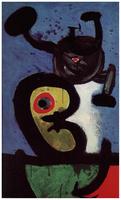
Character and Bird in the Night
Joan Miro
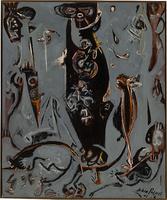
Totem Lesson 2
Jackson Pollock
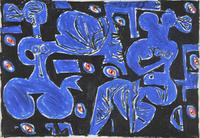
10 colored drawings for the poems of George Seferis
Yiannis Moralis
The Whirlwind
Houria Niati
Fire-Eye
Vajda Lajos
El abajorro
Esteban Frances
'Departure of three Figures' - lithography fine print art, 1996; graphic artist Hilly van Eerten
Hilly van Eerten
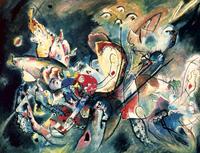
Troubled
Wassily Kandinsky
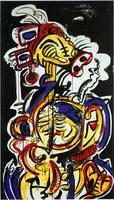
Red-Yellow-Blue No.15
Keith Haring
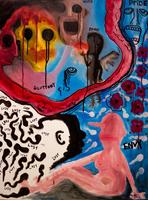
Seven Sins
Mikey William Cheung
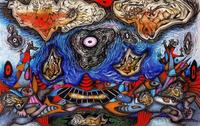
Alborada. Paisaje explosivo
Esteban Frances
Constellation Awakening at Dawn
Joan Miro
Image in Khorkom
Arshile Gorky
Cyclope
Francis Picabia
Ancient Architecture
Dave Holt
Feast in the Garden
Corneille
Untitled
Paul du Toit