Expertenanalyse zu Edvard Munchs Man and Woman
Stil: Expressionism · Genre: genre painting
Expert Analysis of “Man and Woman” by Edvard Munch
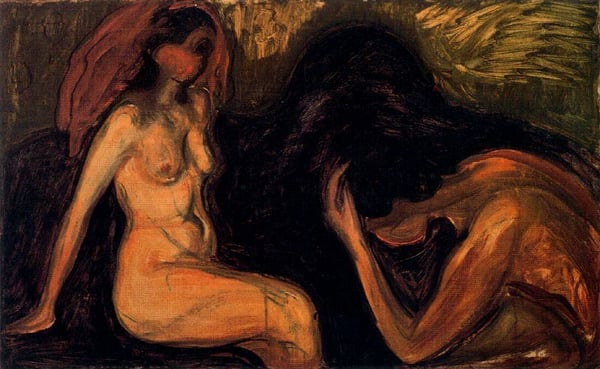
Within the framework of Expressionism, Edvard Munch’s Man and Woman serves as a powerful distillation of the movement’s core concerns: the raw, often anxious inner life of the individual, the fraught dynamics of human relationships, and the subversion of traditional genre painting. While the supplied facts offer no specific date or physical description, the work’s significance emerges from its intersection of style, genre, and period context.
Expressionist Innovation in a Genre Scene
As a genre painting—a depiction of everyday life—Man and Woman would typically invite detached observation of a familiar moment. Munch, however, transforms this convention by applying Expressionism’s signature distortions: exaggerated forms, unnatural colors, and a charged, symbolic atmosphere. The canvas likely pairs a male and female figure in a confrontational or intimate pose, with Munch stripping away naturalistic detail to foreground psychological tension. The emotional weight—jealousy, desire, alienation—becomes the true subject, replacing the anecdotal narrative of traditional genre scenes. This redefinition marks the work’s first significance: it elevates a domestic or social encounter into a universal statement about the agony of connection.
Period and European Context
The designation “European period” situates the painting within the late-19th- to early-20th-century crisis of representation, when artists across Europe rejected academic realism to express modernity’s discontents. Munch, a Norwegian pioneer of Expressionism, used Man and Woman to explore the very fault lines of contemporary European society—gender roles, existential loneliness, and the failure of communication. The work thus becomes a document of its era, reflecting the fin-de-siècle preoccupation with sexuality, mortality, and the fragmentation of the self. In doing so, it prefigures the psychological realism that would define Expressionism for decades.
Enduring Impact
The painting’s significance lies in its refusal to offer comfort. By blending a mundane genre scene with Expressionist intensity, Munch forces viewers to confront their own emotional landscapes. Man and Woman stands as a seminal example of how art can turn the everyday into an arena for profound human drama—a lesson that would influence generations of modernists. In this sense, it is not merely a picture of two people, but a mirror held to the anxious soul of its age.
Museum / Gallery
Visuell ähnlich
20 Werke mit ähnlicher Komposition und Farbpalette
Adalbert Czobel Nude
Bela Czobel
Czobel Béla Half Nude
Bela Czobel
Liebespaar
Otto Mueller
Nude
Bela Czobel
Two seated nudes
Albert Bloch
Nude
Alexej von Jawlensky
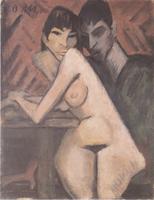
Paar in Der Kascheme
Otto Mueller
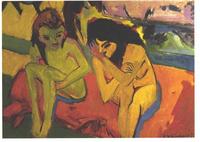
Two Girls
Ernst Ludwig Kirchner
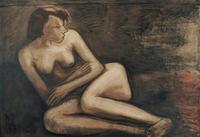
La Rousse
Constant Permeke
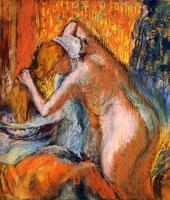
After the Bath, Woman Drying Her Hair
Edgar Degas
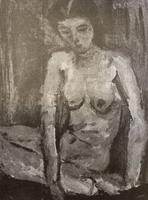
Bela Czobel, Nu Assis 1928
Bela Czobel
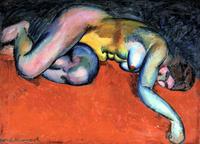
Reclining Nude
Ilya Mashkov
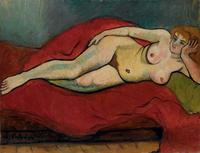
Reclining Nude with Red Drapery
Suzanne Valadon
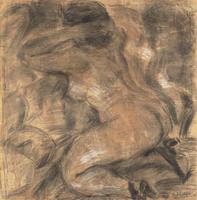
Mujer ante el espejo
Armando Reveron
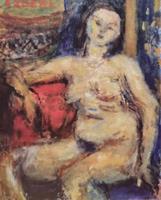
Seated Nude
Bela Czobel
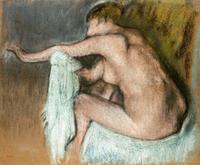
Woman Drying her Arm
Edgar Degas
Zwei Am Teichrand Sitzende Mädchenakte
Otto Mueller
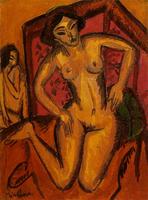
Female Nude Kneeling before a Red Screen
Ernst Ludwig Kirchner
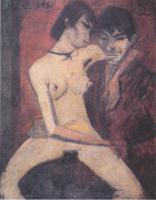
Liebespaar
Otto Mueller
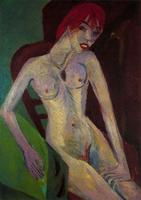
Capelli Rossi (Red Hair)
Ernst Ludwig Kirchner