Análisis experto de Model on the Couch de Edvard Munch
Estilo: Expressionism · Género: genre painting
Expert Analysis of Model on the Couch by Edvard Munch
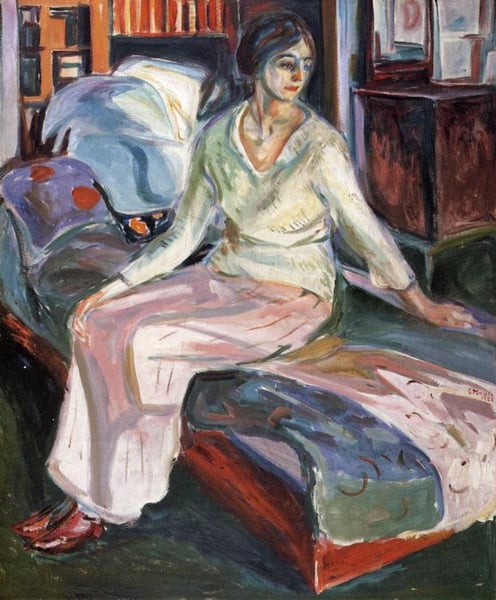
In this late-career work, Edvard Munch returns to a staple of his oeuvre—the female figure in an interior—but reimagines it through the intensified emotional and formal lens of Expressionism. Painted during his late works period, Model on the Couch exemplifies the artist’s shift toward a more distilled, psychologically charged depiction of everyday life, elevating a genre painting (a scene of ordinary existence) into a profound meditation on solitude, vulnerability, and the artist–model relationship.
Significance within Expressionism and Munch’s Late Period
The work’s significance lies in how Munch uses the conventions of Expressionism to subvert the passive role of the model. The figure is not idealized or decorative; instead, the couch becomes a stage for inner turmoil. Bold, often dissonant colors and loose, agitated brushwork—hallmarks of Expressionist technique—dissolve the boundaries between body and environment, suggesting the model’s emotional state rather than her physical likeness. This aligns with Munch’s lifelong quest to depict “the living human being” stripped of surface realism.
Genre Painting as Psychological Revelation
As a genre painting, Model on the Couch engages with the tradition of domestic interior scenes, but Munch transforms it into a vehicle for existential angst. The couch itself, a common motif in late Munch works, is rendered not as a piece of furniture but as a tangible weight—its curves and angles echoing the model’s slumped posture, creating a unified field of tension. The late period is marked by a more abstract, almost schematic handling of space, and here the compressed room and tilted perspective heighten the model’s entrapment.
Conclusion
Model on the Couch is significant as a late synthesis of Munch’s expressive power. It takes a seemingly mundane subject—a model resting—and, through Expressionist distortion and a genre painting’s intimate focus, reveals the raw psychological undercurrents that defined his entire career. In this work, Munch proves that even the quietest subject can speak volumes about the human condition.
Museum / Gallery
Género
Estilo
Etiquetas
Visualmente similares
20 obras con composición y paleta relacionadas
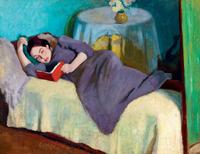
Berény Róbert, Olvasó Lány Pamlagon, 1906
Berény Róbert
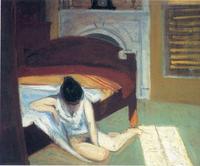
Summer Interior
Edward Hopper
Pink Note: The Novelette
James McNeill Whistler
In the Red Room
Edouard Vuillard
Girl in a White Dress
Samuel Peploe
Woman on the Bedside
Rik Wouters
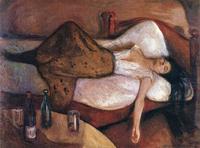
The Day After
Edvard Munch
In An Old Bookstore
Maria Bozoky
Self-portrait in a white blouse
Zinaida Serebriakova
If Once You Have Slept on an Island
Jamie Wyeth
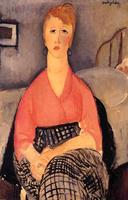
Pink Blouse
Amedeo Modigliani
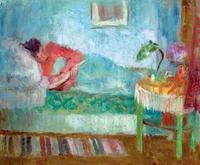
Berény Róbert, Enterior Olvasó Nővel,
Berény Róbert
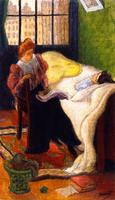
Untitled
Paul Ranson
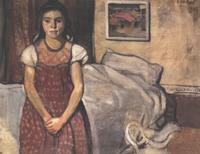
Girl before a Bed
Bela Czobel
Scheiber Hugó, Festő Lány Masnival 1910
Scheiber Hugó
Reading
Nikolaos Lytras
On a couch
George Mavroides
Girl in White
Samuel Peploe
Woman on the Sofa
Iosif Iser
Studio Interior
Samuel Peploe