Analisi esperta di Sister Inger di Edvard Munch
Stile: Impressionism · Genere: portrait
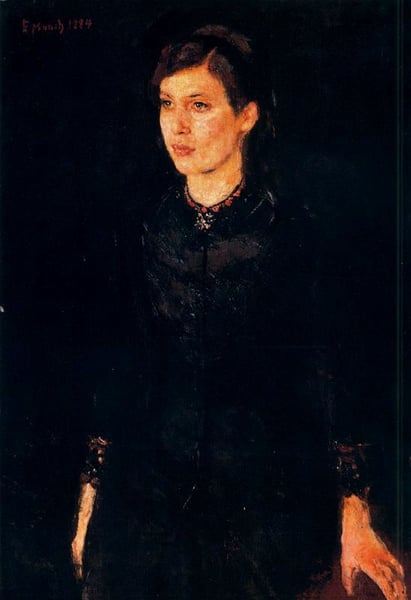
Expert Analysis of Edvard Munch’s Sister Inger (c. 1884)
Edvard Munch’s Sister Inger belongs to his Early Works period, a formative stage when the young Norwegian artist was still absorbing the lessons of Impressionism before forging the Symbolist and Expressionist language that would define his legacy. Painted when Munch was in his early twenties, this portrait of his sister Inger Munch stands as a revealing document of his transitional style, blending Impressionist techniques with an emerging psychological intensity that foreshadows his mature masterpieces.
Art Historical Significance
- Impressionist technique in a Northern context: Munch adopts the Impressionist palette of soft, broken brushstrokes and a high-keyed, luminous light, but he applies it to a subdued domestic interior rather than the typical Parisian outdoor scenes. The muted woodland greens, earthy browns, and flecks of warm light on Inger’s face and dress reveal his study of contemporary French painting—likely filtered through friends like Christian Krohg—while retaining a distinctly Nordic sense of melancholy and introspection.
- Early psychological portraiture: Unlike the candid, momentary snapshots favored by many Impressionists, Munch’s composition is deliberately staged. Inger sits erect in a stiff-backed chair, her hands folded, her gaze directed slightly away from the viewer. The formal pose combined with the soft, diffused handling creates a tension between intimacy and distance—a hallmark of Munch’s later explorations of anxiety, isolation, and memory.
- A family member as muse: Inger was a recurring figure in Munch’s early work (she also appears in The Sick Child studies). Here, she is portrayed not as a lively young woman but as a pensive, almost stoic presence. This emphasis on inner life over outward action marks Munch’s divergence from conventional Impressionist portraiture and points toward his Symbolist conviction that art should reveal the soul’s hidden states.
- Bridge between periods: Sister Inger is a crucial link between Munch’s amateurish beginnings and his breakthrough into Symbolism. The painting still respects Impressionist naturalism—light falls logically, spatial recession is clear—but the quiet, asymmetrical composition and the sitter’s averted eyes already suggest the emotional disquiet that would erupt in works like The Scream (1893).
Within the Early Works period, this portrait demonstrates Munch’s rapid assimilation of contemporary trends while asserting his own voice: a painter of interiority, of family bonds tinged with sorrow, and of light used not just to describe but to evoke mood. It is a quiet but assured statement of an artist on the cusp of redefining modern painting.
Museum / Gallery
Visivamente simili
20 opere con composizione e palette affini
Portrait of Nini
Camille Pissarro
Woman in Black
Mary Cassatt
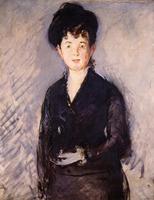
Woman with a gold pin
Edouard Manet
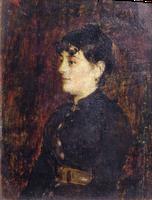
Female portrait
Giacomo Favretto
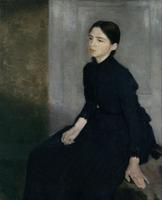
Portrait of a young woman. The artist's sister Anna Hammershøi
Vilhelm Hammershoi
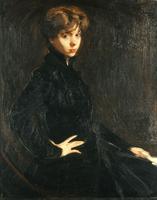
Portrait of Mlle.M. Horsch
Nikolaos Lytras
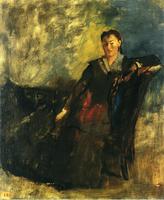
Woman Seated on a Canape
Edgar Degas
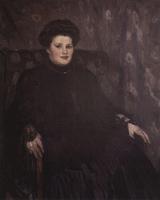
Portrait of A. N Tretyakova
Vasily Surikov
Portrait of Mara Oliv
Valentin Serov
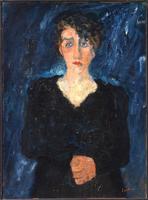
Portrait of a Woman
Chaim Soutine
Portrait of Madame Cezanne
Paul Cezanne
Portrait of a Woman
Isaac Israels
Portrait of a Woman on a Blue Background
Chaim Soutine
Lady in blue
Chaim Soutine
Portrait of Jennie Dean Kershaw
Thomas Eakins
Black and Red
James McNeill Whistler
Almaisa
Amedeo Modigliani
Woman Sitting on a Red Flowered Sofa
Gustave Caillebotte
Portrait of a young woman
Isidoro Grünhut
Portrait of Nenna Janson Nagel, b. Backer Lunde
Harriet Backer