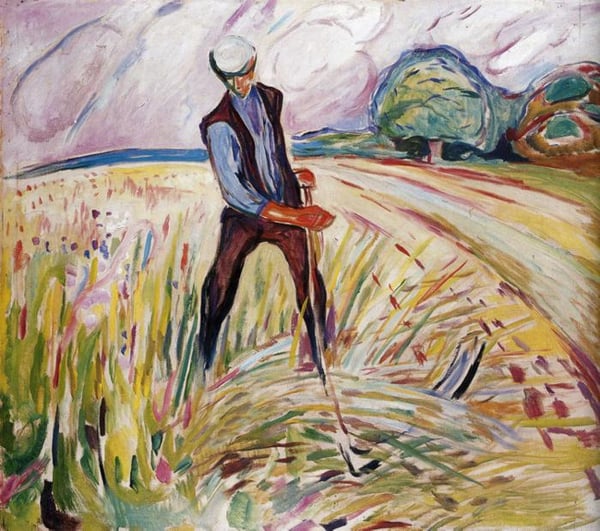
Analisi esperta di The Haymaker di Edvard Munch
Stile: Expressionism · Genere: genre painting
Expert Analysis: “The Haymaker” by Edvard Munch
Style & Context
Edvard Munch is best known for his psychologically charged, Symbolist and early Expressionist masterpieces such as The Scream. However, in his late works (roughly after 1910), Munch’s style underwent a notable shift. While still rooted in Expressionism—with its emphasis on subjective emotion, bold color, and distortion of form—his later paintings often became more pastoral, introspective, and dominated by rural themes. The Haymaker belongs to this mature phase, where Munch retreated from the anxious urban imagery of his earlier career toward a more grounded, physical engagement with the Norwegian landscape and its laborers.
Genre & Subject
As a genre painting, The Haymaker depicts an everyday scene of agricultural work. Unlike the idealized peasant paintings of earlier eras, Munch’s haymaker is not a romantic figure but a raw, almost elemental presence. The subject—a lone figure cutting hay—allows Munch to explore the relationship between human labor and the natural cycle, a theme that recurs in his late work (e.g., Workers Returning Home, The Sun). The haymaker becomes a symbol of endurance, repetition, and the unheroic dignity of physical toil.
Significance within the Period
This painting is significant because it demonstrates how Munch, a founding father of Expressionism, applied the movement’s core principles—emotional truth over naturalistic representation—to a seemingly mundane rural subject. The haymaker is likely rendered with simplified, heavy contours and a distorted sense of space, typical of Munch’s late style: the figure may appear weighed down, the landscape reduced to sweeping, rhythmic arcs. The color palette, often muted yet vibrant in his later years, would emphasize the heat of the sun, the weight of the scythe, and the isolation of the laborer.
The shift to such subject matter marks Munch’s later engagement with existential themes through nature rather than the city. The Haymaker exemplifies his ability to find profound emotional resonance in ordinary life, anticipating the more earthbound Expressionism of artists like Ernst Ludwig Kirchner or even the later Neo-Expressionists. In Munch’s oeuvre, it stands as a testament to his enduring exploration of the human condition—now seen through the lens of sweat, soil, and the repetitive cycle of work—rather than the psychological turmoil of his younger years.
Museum / Gallery
Visivamente simili
20 opere con composizione e palette affini
Egry József, Aratók 1911
Egry József
Peasant Woman with a Rake after Millet
Vincent van Gogh
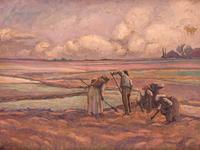
Potato Crop Gatherers
Camil Ressu
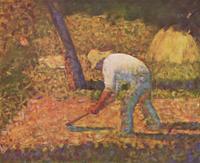
Peasant with Hoe
Georges Seurat
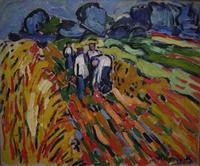
Potatoe Pickers
Maurice de Vlaminck
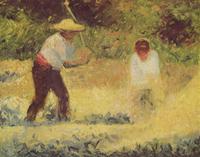
The Stone Breaker
Georges Seurat
Reapers
Victor Borisov-Musatov
The Harvest
Léon Augustin Lhermitte
Tree in the cornfield
August Macke
The Veteran in a New Field
Winslow Homer
Harvest
Hugo Mühlig
Harvesters in Wheatfield
Maggie Laubser
Peasant Woman Binding Sheaves after Millet
Vincent van Gogh
Harvesters
Henri Martin
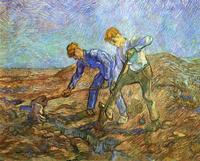
Two Peasants Diging (after Millet)
Vincent van Gogh
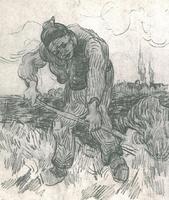
Peasant Digging
Vincent van Gogh
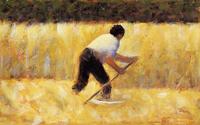
The Mower
Georges Seurat
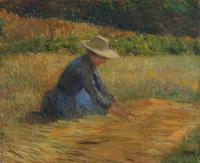
Peasant Woman in the Fields
Henri Martin
Haymaking
Pyotr Konchalovsky
The Harvest
Henri Martin