Analyse experte de The Village Street de Edvard Munch
Style : Expressionism · Genre : genre painting
Expert Analysis: "The Village Street" by Edvard Munch
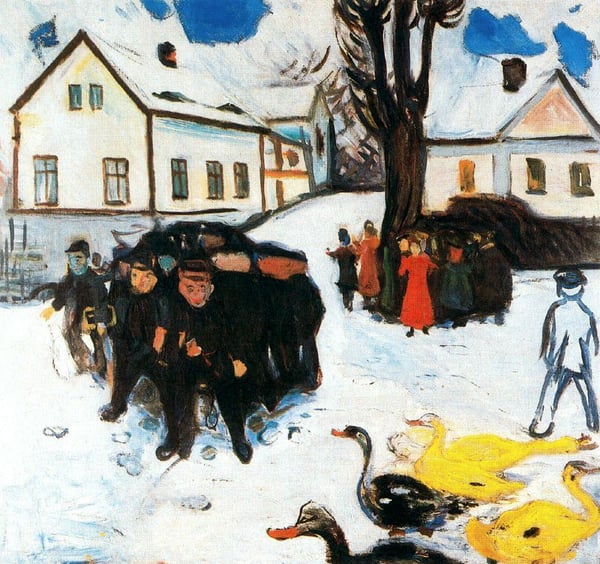
Edvard Munch’s The Village Street stands as a significant example of his Late Works, offering a nuanced departure from the intense psychological turmoil of his earlier, more famous pieces like The Scream. Created under the banner of Expressionism, this genre painting reinterprets the everyday rural scene through a deeply subjective, emotional lens—one that becomes more meditative and serene in Munch’s later period.
Significance within Expressionism and Late Works:
While Expressionism is often associated with bold, distorted forms and raw anxiety, Munch’s late style reveals a quieter, more reflective mode of the movement. In The Village Street, the artist applies his signature techniques—such as broad, sweeping brushstrokes and a heightened, unnatural palette—not to convey existential dread, but to capture the emotional resonance of ordinary life. The street itself becomes a stage for mood rather than narrative; the figures, if present, are likely rendered as anonymous, elongated presences that dissolve into the landscape, emphasizing isolation or a collective calm.
What makes this work significant within Munch’s oeuvre is its synthesis of Expressionism with the genre painting tradition. Rather than painting a documentary village scene, Munch transforms it into a psychological landscape. The buildings, trees, and path are simplified and rhythmic, their colors chosen for emotional impact—perhaps muted earth tones or cool blues and whites that evoke a northern, introspective atmosphere. This represents a masterful shift: the same emotional urgency that drove his earlier works now finds expression in the quiet beauty of the everyday.
For art historians, The Village Street exemplifies how Expressionism matured in Munch’s Late Works, moving from personal torment to a broader, more universal feeling of solitude and peace. It demonstrates that the movement was not solely about crisis but could also articulate a profound, quiet harmony—a street seen through the artist’s soul.
Museum / Gallery
Visuellement similaire
20 œuvres à la composition et à la palette proches
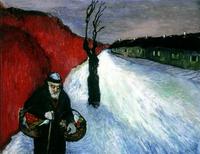
Lonley Way
Marianne von Werefkin
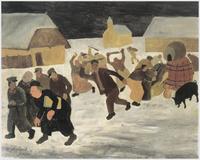
Djelekovec rebellion
Ivan Generalic
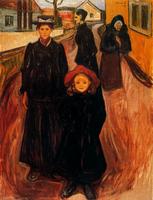
Four Ages in Life
Edvard Munch
Horse Races in Winter
Clarence Gagnon
Troika in the Snow
Abraham Manievich
Czene Béla, Szolnoki Vásár
Czene Béla
Czene Béla , Falusi Reggel 1960
Czene Béla
Geese
Alfred Sisley
Women Miners
Vincent van Gogh
Sledding
William James Glackens
Sledding in Central Park
William James Glackens
Tinker Place
T. C. Steele
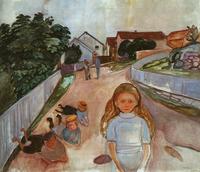
Street in Asgardstrand
Edvard Munch
View of Argenteuil in the Snow
Claude Monet
Michael Ancher on His Way to His Studio Accompanied by the Organist Helene Christensen
Anna Ancher
Province
Konstantin Gorbatov
Miners in the Snow Winter
Vincent van Gogh
Snow overnight
Marianne von Werefkin
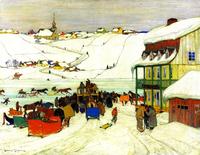
Horse Racing in Winter
Clarence Gagnon
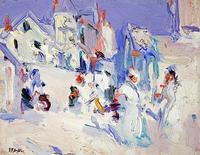
Étaples
Samuel Peploe