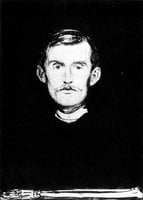
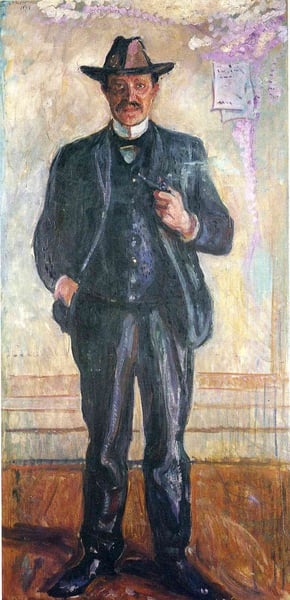
Expertenanalyse zu Edvard Munchs Thorvald Stang
Stil: Expressionism · Genre: portrait
Expert Analysis of Edvard Munch’s Thorvald Stang (Late Works, Expressionism)
As a portrait from Munch’s late period, Thorvald Stang encapsulates the artist’s mature expressionist approach, where psychological intensity and subjective color take precedence over academic likeness. The sitter—likely the Norwegian businessman and patron Thorvald Stang—is not merely recorded but transformed through Munch’s characteristic distortion of form and heightened palette.
Significance within Expressionism and Munch’s Late Oeuvre
- Psychological Portraiture: Instead of a conventional social portrait, Munch uses sweeping brushwork and dissonant hues to suggest the inner life of the subject—restlessness, isolation, or quiet intensity. This aligns with expressionism’s goal of externalizing emotional states.
- Late-Style Freedom: In his later works (c. 1920s–1940s), Munch often employed thicker paint, more schematic outlines, and a raw, unfinished quality. Thorvald Stang likely exhibits this looser handling, proving that even in portraiture he remained an innovator, abandoning the polished realism of his earlier years.
- Continuity with the “Frieze of Life”: Though a commissioned portrait, the work echoes Munch’s lifelong themes of mortality, anxiety, and the human condition. The sitter’s gaze or posture may carry an unsettling ambiguity, turning a businessman into a cipher for universal existential angst.
- The Late Portraits as Understudied Gems: While Munch’s iconic The Scream dominates his reputation, his late portraits—such as those of Stang, Henrik Ibsen, or self-portraits—reveal an artist still probing the boundaries of representation. They demonstrate that expressionism was not a momentary rebellion but a sustained, evolving language.
In sum, Thorvald Stang is significant because it merges the personal (a specific individual) with the universal (emotional truth), using expressionist devices to create a record of not just how Stang looked, but how Munch saw him—a face caught in the elusive, anxious atmosphere of modern life.
Museum / Gallery
Visuell ähnlich
20 Werke mit ähnlicher Komposition und Farbpalette
Portrait of Leopoldo Pisacani
Giovanni Boldini
Ernst Diez I
Richard Gerstl
Count Harry Kessler
Edvard Munch
Ludvig Karsten
Edvard Munch
Walter Rathenau
Edvard Munch
Portrait of Giacomo Campagnano
Umberto Veruda
Professor Daniel Jacobson
Edvard Munch
Portrait of Leopold Czihaczek, Standing
Egon Schiele
The Thinker (Portrait of Louis Kenton)
Thomas Eakins
Portrait of the sculptor Ugo Zannoni
Angelo Dall'Oca Bianca
Fragment of a smiling self-portrait at full length
Richard Gerstl
Portrait of M. Paul
Émile Friant
Roger Martin du Gard
Theo van Rysselberghe
Portrait of the photographer Ettore Pesci
Amedeo Bocchi
Portrait of a Hungarian artist József Ripley Ronai
Konstantin Korovin
Portrait of Manolo Hugué
Ramon Casas
Portrait of Giuseppe Mandel
Umberto Veruda
Henry Cabot Lodge
John Singer Sargent
Seated Man
Paul Cezanne
Portrait of G. Narbut
Boris Kustodiev