Expert analysis of Caravaggio’s The Fortune Teller
Style: Baroque · Genre: genre painting
Expert Analysis: "The Fortune Teller" by Caravaggio
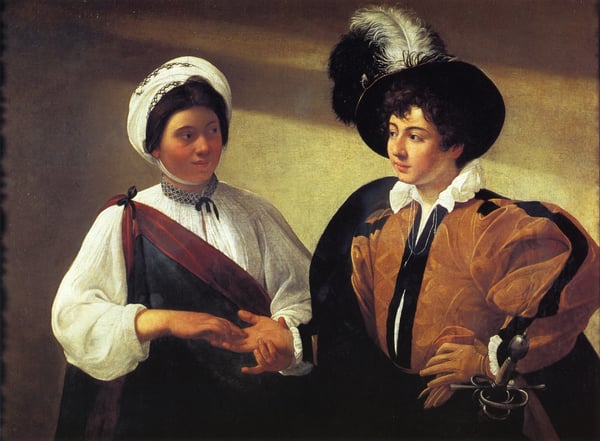
As a defining work of the Baroque style, Caravaggio’s The Fortune Teller represents a pivotal shift in 17th-century art—away from idealized religious or mythological scenes and toward the raw, unscripted drama of everyday life. Painted as a genre painting, it depicts a seemingly mundane encounter between a young man and a Romani fortune teller, yet Caravaggio transforms this ordinary moment into a stage for psychological tension and moral ambiguity.
Significance within the Baroque Style:
Baroque art is characterized by intense emotion, dynamic composition, and dramatic contrasts of light and shadow (chiaroscuro). Caravaggio masterfully employs these elements here: a single, stark light source carves the figures out of a deep, dark background, heightening the realism and immediacy of the scene. The viewer is drawn into the intimate space between the two individuals, as if witnessing a secret transaction. This theatrical use of light not only emphasizes the tactile textures of fabric and skin but also underscores the act of deception—the fortune teller’s sly glance and the boy’s unwitting distraction.
Significance as a Genre Painting:
At a time when history painting (religious, mythological, or allegorical) was considered the highest artistic pursuit, Caravaggio elevated the humble genre painting to new intellectual and emotional heights. The Fortune Teller rejects idealization in favor of unvarnished truth. The figures are not allegorical types but specific, recognizable characters—a street-wise woman and a naive youth. By focusing on a contemporary, low-life subject, Caravaggio challenged the hierarchies of art and asserted that profound human drama could be found in the fringes of society. This work foreshadows the Dutch Golden Age’s preoccupation with moralizing genre scenes, but Caravaggio’s signature chiaroscuro and psychological intensity give it a uniquely Baroque gravity.
Why It Matters:
The Fortune Teller is significant because it crystallizes Caravaggio’s revolutionary approach: using the Baroque toolkit of light, shadow, and naturalism to capture a fleeting, morally ambiguous moment. It transforms a simple fortune-telling episode into a mirror of human vulnerability, cunning, and the fragile boundary between trust and exploitation. In doing so, it redefined what painting could be—not a window into an ideal world, but a sharp, unflinching look at the real one.
Museums / Galleries
Visually similar
20 works with related composition and palette
Cardsharps
Caravaggio
The Fortune-Teller
Georges de la Tour
Fiancees
Lucas van Leyden
Double Portrait of a Married Couple
Pieter Codde
Orc, Lucina and Morandini, by Giovanni Lanfranco
Giovanni Battista Piranesi
Portrait of a Couple in an Interior
Rembrandt
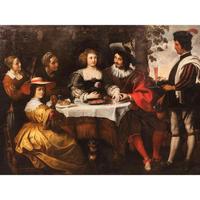
Young couple at a table setting
Cornelis de Vos
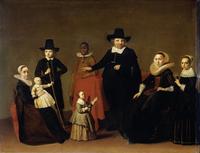
Family Group with Black Servant
Willem Cornelisz Duyster
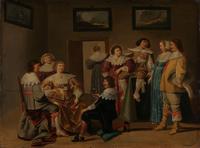
Elegant company
Pieter Jansz. Quast
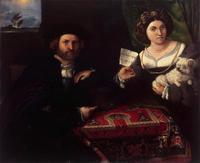
Husband and Wife
Lorenzo Lotto

Portrait of the so-called Mathematician with His Wife
Karel Škréta
Drinking Party with a Lute Player
Nicolas Tournier
An elegant company in an interior
Pieter Jansz. Quast
Swinger's Party
Alexander Roitburd

Albert and Nicolaas Rubens
Peter Paul Rubens
A young man singing with a young woman holding a rose
Nicolas Tournier
Merry Company
Pieter Codde

The good fortune
Nicolas Tournier
Portrait of John Viscount Garlies, Later 7th Earl of Galloway, as Master of Garlies
Anton Raphael Mengs

The Dancing Lesson
Pieter Codde