
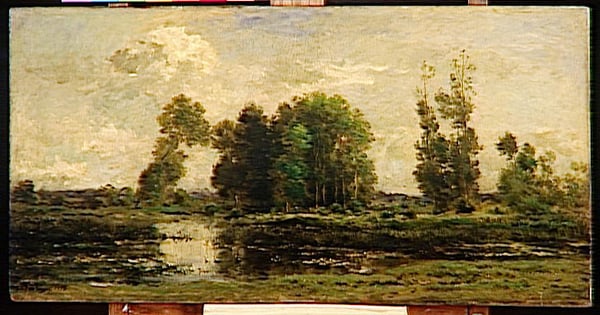
Charles-Francois Daubigny の The pond の専門的な分析
スタイル:Realism · ジャンル:landscape
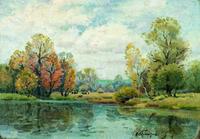
Analysis of "The Pond" by Charles-François Daubigny
Charles-François Daubigny’s The Pond exemplifies the core tenets of Realist landscape painting in mid-19th-century France. As a member of the Barbizon school, Daubigny rejected the idealized, history-laden landscapes of academic art in favor of direct observation of nature. This work stands as a significant bridge between Realism and the emerging Impressionist movement.
Significance within Realism / Barbizon School:
- Plein Air Execution and Atmospheric Truth: Daubigny was a pioneer of painting outdoors (en plein air), capturing the transient effects of light and weather. In The Pond, the handling of water and sky suggests a fleeting moment—perhaps a late afternoon haze or a soft, overcast stillness. This immediacy was radical for its time, prioritizing sensory truth over studio composition.
- Democratization of Subject Matter: Rather than a grand historical or mythological scene, Daubigny elevates a humble, everyday body of water. The pond is unremarkable in narrative terms, yet it becomes a vehicle for exploring texture, reflection, and the quiet poetry of rural existence. This aligns with Realism’s focus on ordinary life and unheroic landscapes.
- Brushwork and Prelude to Impressionism: Daubigny’s loose, visible brushstrokes—especially in the rippling water and the soft foliage—anticipate Impressionist technique. He often left patches of canvas exposed, emphasizing the paint’s materiality. Critics later noted how his works “vibrated” with light, directly influencing Claude Monet and the young Impressionists who admired his river scenes.
- Emotional Resonance via Naturalism: Unlike the more dramatic, emotional landscapes of earlier Romanticism, The Pond communicates a quiet, contemplative mood through its balanced composition and muted tonal range. The stillness of the water, the gentle recession of the banks, and the soft diffusion of light create a sense of serene immersion—a hallmark of Daubigny’s mature style.
In summary, The Pond is significant not only as a masterwork of Realist landscape but as a transitional piece that helped liberate painting from narrative constraints, paving the way for modern art’s obsession with light, atmosphere, and the act of perception itself.
視覚的に類似
構図やパレットが近い作品 20 件
Landscape
Theodore Rousseau
A Lake in a Clearing
Pierre Emmanuel Damoye
Edge of the Pond
Charles-Francois Daubigny
Barbizon Landscape
Jules Dupre
The Woodland Pool
Robert Julian Onderdonk
Road in the forest of Fontainebleau
Theodore Rousseau
Solitude
Ralph Blakelock
Small Floodplain
Jules Dupre
Landscape
Robert Julian Onderdonk
Spätherbst im Sumpfgebiet am Dnjepr
Hans Sterbik
A june day
Charles-Francois Daubigny
The pond, stormy sky
Theodore Rousseau
The passer
Theodore Rousseau
Les Environs De Saint-Ay
Maximilien Luce
Edge of the Forest, Sun Setting
Theodore Rousseau
Banks of Loire
Theodore Rousseau
The Pool with a Stormy Sky
Theodore Rousseau
Sunset on the Oise
Charles-Francois Daubigny
Spring
Theodore Rousseau
Autumn
Sergiy Grigoriev