Analisi esperta di Christ on the Sea of Galilee di Eugene Delacroix
Stile: Romanticism · Genere: religious painting
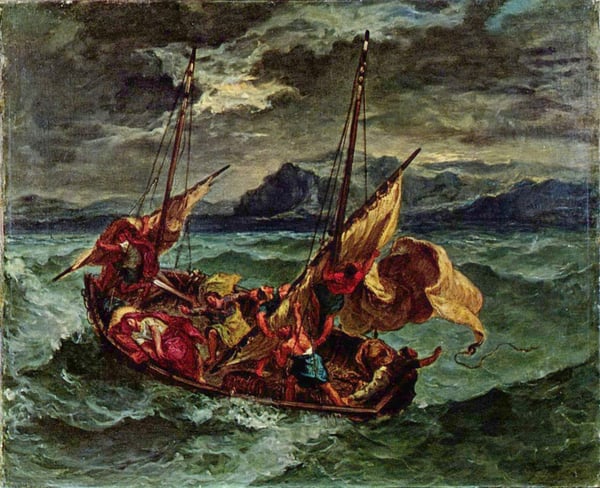
Eugène Delacroix’s “Christ on the Sea of Galilee” (c. 1854) stands as a quintessential example of Romantic religious painting, where the artist transforms a biblical narrative into a visceral drama of human vulnerability and divine power.
Significance within Romanticism: Delacroix was the undisputed master of the Romantic movement, and this work encapsulates its core principles: emotional intensity, sublime nature, and expressive color. The painting depicts the moment from the Gospel of Mark when a storm threatens the apostles’ boat while Christ sleeps. Rather than a calm, orderly scene, Delacroix plunges the viewer into chaos—the sea churns with violent, swirling strokes, the sky is a tempest of dark greens and bruised purples, and the boat is pitched at a precarious angle. This is not merely a storm; it is the Romantic sublime—nature overwhelming and indifferent to human struggle. The apostles’ frantic, contorted poses (reminiscent of Michelangelo’s Last Judgment) convey raw panic, while Christ remains eerily serene, a focal point of stillness amid the maelstrom. Delacroix’s use of broken, energetic brushwork and vibrant, unmodulated colors (especially the reds and whites of the disciples’ garments) heightens the emotional tension, making the viewer feel the spray and terror.
Significance within Religious Painting: Where many earlier religious painters (e.g., Raphael or Poussin) emphasized clarity, hierarchy, and ideal beauty, Delacroix injects humanity and doubt. The apostles are not stoic saints but terrified men—their fear is palpable, making the miracle of Christ’s calming of the sea all the more profound. The composition is dynamic, with Christ placed slightly off-center, his halo barely visible, emphasizing his human vulnerability before the revelation of his divine authority. This aligns with Romanticism’s interest in personal faith over institutional dogma, and the struggle between faith and doubt. Delacroix also draws on the theatrical tradition of chiaroscuro (strong light-dark contrast) borrowed from Rembrandt and Caravaggio, but pushes it into a more turbulent, almost violent register.
Why It Matters: This painting is significant because it demonstrates how Delacroix merged the grand history painting tradition with the new Romantic sensibility, influencing later artists from the Impressionists (who admired his color and brushwork) to the Symbolists (who loved his emotional and spiritual depth). It is a testament to Romanticism’s belief that the most profound truths are felt through overwhelming experience—whether of nature or of the divine.
Museum / Gallery
Visivamente simili
20 opere con composizione e palette affini
Turbulent Sea
Hoca Ali Riza
In the middle of the Fiord
Hans Dahl
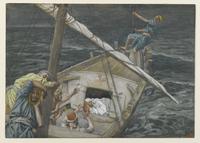
Jesus Sleeping During the Tempest
James Tissot
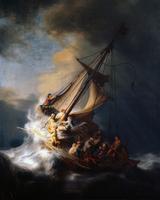
The Storm on the Sea of Galilee
Rembrandt
Sailboats in the storm
Andreas Achenbach
Red snake
Mårten Eskil Winge
The voyage
Hans Dahl
Fishing Boats Against a Venetian Silhouette
Albert Rieger
Boat
Fyodor Vasilyev
Wrath of the Sea God
Herbert James Draper
Death of Almoadam
Gustave Dore
The Departure
Odilon Redon
Pirate Treasure
N.C. Wyeth
Journey to the Center of the Earth
Edouard Riou
The Yawl of the 'Luxborough' Galley
John Cleveley the Elder
Cleopatra
Richard Caton Woodville Jr.
Mark Antony and Cleopatra aboard an Egyptian barge (print reproduction)
Henri-Pierre Picou
Peter Walks on Water
Philipp Otto Runge
Argo
Konstantinos Volanakis
SEGLER AUF STÜRMISCHER SEE
Theodore Gudin