Expert analysis of Leon Bakst’s Le dieu bleu the bride
Style: Art Nouveau (Modern) · Genre: design
Expert Analysis of "Le dieu bleu the bride" by Léon Bakst
Context and Significance
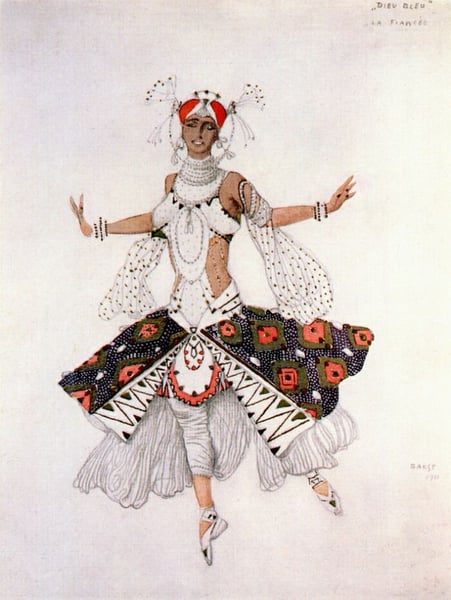
This design by Léon Bakst sits at the intersection of Art Nouveau’s decorative fluidity and the revolutionary stagecraft of the Ballets Russes. Although the title conflates two separate works – the 1912 ballet Le Dieu Bleu (choreographed by Michel Fokine) and the bride figure – the piece exemplifies Bakst’s role as a key modernist designer who shattered the boundaries between fine art, theater, and fashion.
Stylistic Hallmarks
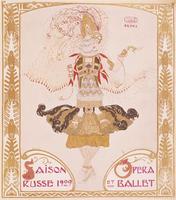
Bakst’s composition is a hallmark of Art Nouveau’s organic, sweeping lines and exoticism. The “bride” figure (likely a costume study for a female dancer) is enveloped in cascading fabric that undulates like a living arabesque, echoing the sinuous curves of nature typical of the style. The palette is audacious: deep indigos, shimmering golds, and acid greens reflect Bakst’s signature Orientalism, derived from Persian miniatures and Indian miniatures. The peacock-feather motifs and jewel-toned embellishments convey a sense of ritualistic opulence, while the elongated, stylized silhouette anticipates the angular geometry of Art Deco.
Theatrical Innovation
Bakst’s designs were revolutionary for modern theater. Here, the bride is not merely a costume but a character defined by color and line – the dress itself seems to move before the dancer does. This synesthetic approach, where costume, set, and choreography merge, was radical for its time and influenced not only stage design but also early 20th-century fashion (poiret, Fortuny) and visual arts (the Fauves and German Expressionists).
Cultural Impact
Le Dieu Bleu itself was a short-lived but legendary production, notorious for its then-outrageous sensuality. Bakst’s designs for it – including this bride – helped liberate Western costume from historical rigidity, introducing a fluid, psychologically charged symbolism that paved the way for modern dance and fashion’s embrace of the “exotic” as a creative force.
Conclusion
This design is significant as a bridge between Art Nouveau’s ornamental nature and the avant-garde’s theatrical psychology. Bakst’s bride is a living ornament, a character born from pigment and line – a testament to how early 20th-century design redefined the body as a canvas for total artistic expression.
Visually similar
20 works with related composition and palette
The Firebird, costume for Tamara Karsavina
Leon Bakst
Scheherezade odalisque
Leon Bakst
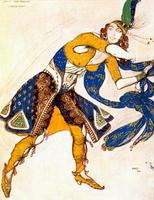
Indo-persian dance
Leon Bakst
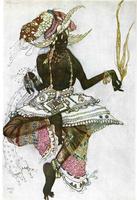
Arabic dancer
Leon Bakst
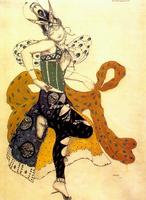
La peri Natasha Trouhanova as the Peri
Leon Bakst
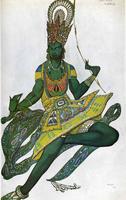
Le dieu bleu Nijinsky in title role
Leon Bakst
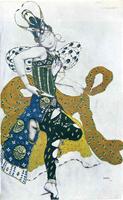
Sketch for the ballet 'La Peri', by Paul Dukas
Leon Bakst
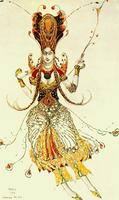
The Firebird
Leon Bakst
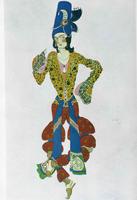
Costume for Nijinsky
Leon Bakst
Captive
Nicholas Roerich
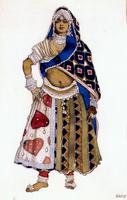
Le dieu bleu bayadere
Leon Bakst
Michel Fokine Avec Sa Femme Vera Dans Schéhérazade
Valentine Hugo
Slave of the queen retinue Shemakhan
Konstantin Korovin
Scheherazade negre argent
Leon Bakst
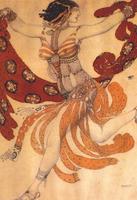
Costume design for the ballet "Cleopatra"
Leon Bakst
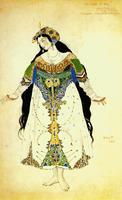
The Firebird, the tsarevna
Leon Bakst
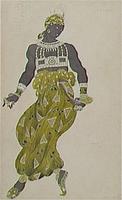
Negro gold Drawing Shéhérazade costume, ballet Diaghilev
Leon Bakst
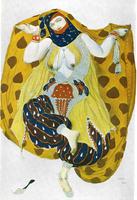
Scheherezade odalisque
Leon Bakst
Front cover of Comoedia
Leon Bakst
Captive
Nicholas Roerich