Analisi esperta di "Narcisse"- Nymph Echo di Leon Bakst
Stile: Art Nouveau (Modern) · Genere: design
Expert Analysis: "Narcisse" – Nymph Echo by Léon Bakst
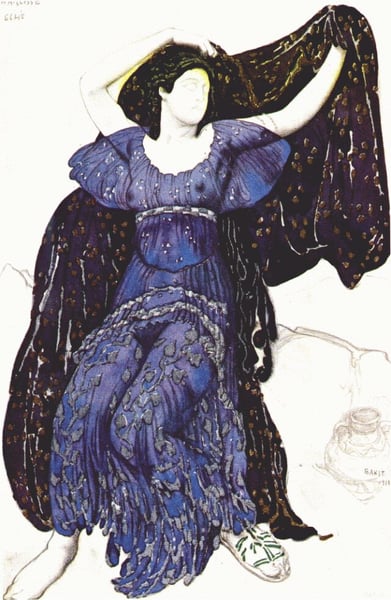
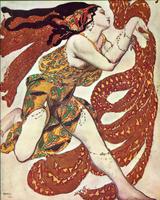
Léon Bakst’s “Narcisse” – Nymph Echo stands as a pivotal work within the Art Nouveau movement, exemplifying the style’s synthesis of organic line, decorative exuberance, and theatrical modernism. Created as a design for the Ballets Russes (likely for the 1911 ballet Narcisse), this piece is not merely a costume sketch but a manifesto of Bakst’s revolutionary approach to stagecraft.
Significance within Art Nouveau and Modern Design
Bakst’s design embodies Art Nouveau’s core principles: the sinuous, flowing line (coup de fouet), a flat yet lush two-dimensionality, and the integration of natural forms into ornament. Here, the Nymph Echo’s silhouette dissolves into a rhythmic interplay of curves and arabesques—her hair, drapery, and the surrounding flora all echo the same organic pulse. The use of vibrant, exotic color (a Bakst hallmark) pushes beyond Art Nouveau’s usual pastels into a bolder, almost Fauve palette, reflecting the Modern era’s appetite for sensuality and psychological intensity.
Genre and Context
As a design for ballet, Bakst’s work blurs the line between fine art and applied arts—a key modernist shift. His costumes were not mere illustrations but spatial, kinetic elements that transformed the stage into a living painting. The nymph’s attire, with its layered sheer fabrics and intricate beadwork, was revolutionary: it allowed dancers free movement while emphasizing the sinuous, hair-like patterns that visually mirrored Narcissus’s own self-obsession. Bakst’s design thus serves as a narrative device, with Echo’s flowing form literally “repeating” the curves of the landscape, reinforcing the myth’s theme of mirroring and loss.
Cultural Impact
Bakst’s work for the Ballets Russes, especially Narcisse, helped liberate Western stage design from rigid historicism. By merging Art Nouveau’s decorative elegance with a modern, psychologically charged eroticism, he shattered conventions of how myth could be visually rendered. The “Nymph Echo” design specifically prefigures the Art Deco emphasis on streamlined, ornamental abstraction while retaining the organic fecundity that defines the earlier style.
In sum, “Narcisse” – Nymph Echo is significant as a perfect exemplar of Art Nouveau’s ambition to make every object a Gesamtkunstwerk—a total work of art—where line, color, and form dissolve the boundaries between costume, stage, and myth. Bakst’s brilliant fusion of antiquity and modernity remains a touchstone for theatrical design.
Visivamente simili
20 opere con composizione e palette affini
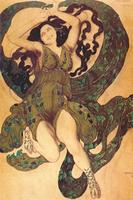
Nymph Costume Design for the ballet in one act Narcisse Diaghilev (Subtitle)
Leon Bakst
Illustration to Odyssey
John Flaxman
Flora of dressing the hair in place
Giovanni Battista Piranesi
Study the figure of Hermione and sketches of the figure of Pyrrhus
Pierre-Narcisse Guerin
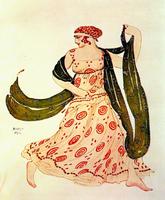
Cleopatre greek dancer
Leon Bakst
Summer
Charles Robinson
Similar to the above subject (painting vessel, inc. To outline)
Giovanni Battista Piranesi
Danae in the Brazen Chamber
Frederick Sandys
At the Fountain
Frederic Leighton
"Helene de Sparte" - costume for Ida Rubinstein as Helene
Leon Bakst
Illustration to the Iliad
John Flaxman
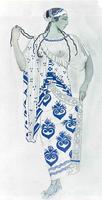
Medee (Jean Anouilh)
Leon Bakst
Helen and Cassandra
Frederick Sandys
Athenais
John William Godward
Contemplation
John William Godward
Bacchante bearing a plate and a bucket
Giovanni Battista Piranesi
Morn, Noon, Eve, Night
Walter Crane
Costume design for a bacchante in 'Narcisse' by Tcherepnin
Leon Bakst
Sweet Dreams
John William Godward
A Classical Lady
John William Godward