
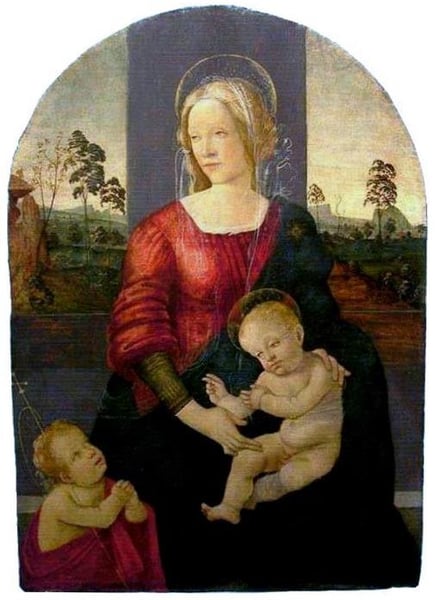
Madonna and Child with St. John the Baptist
Экспертный разбор работы «Madonna and Child with St. John the Baptist» художника Sandro Botticelli
Стиль: Early Renaissance · Жанр: religious painting
This Early Renaissance religious painting by Sandro Botticelli, Madonna and Child with St. John the Baptist, is significant for the way it synthesizes devotional intimacy with the artist’s signature linear grace and idealized beauty—hallmarks that helped define the Florentine Renaissance.
Composition and Symbolism
Botticelli arranges the Virgin, the Christ Child, and the young St. John in a tender, pyramidal grouping that fosters both stability and human warmth. The infant John—distinguished by his traditional reed cross or scroll—gazes adoringly at the Christ Child, prefiguring his later role as herald. The Madonna’s serene, downcast expression and the Child’s gentle gesture (often reaching toward John) emphasize the divine recognition and the narrative of salvation. This interplay of gazes and touching hands creates a psychological intimacy that moves beyond mere iconography, inviting the viewer into a moment of silent communion.
Stylistic Significance
Botticelli’s characteristic flowing lines—seen in the delicate folds of the Virgin’s drapery, the soft curls of the infants’ hair, and the ethereal, almost musical rhythm of the silhouettes—distance the figures from naturalistic weight. Instead, he infuses them with a dreamlike spirituality, a quality that distinguishes his work from the more volumetric realism of contemporaries like Leonardo or Perugino. The use of a dark background (or, in other versions, a landscape) pushes the figures forward, while the subtle modeling of flesh tones and the meticulous rendering of textiles reveal Botticelli’s training as a goldsmith and his love of decorative detail.
Context and Legacy
This work reflects the Florentine taste for refined, contemplative images of the Holy Family, often commissioned for private devotion. Botticelli’s treatment of the Madonna as a graceful, aristocratic figure—almost a Neoplatonic ideal of beauty—aligns with the intellectual currents of Lorenzo de’ Medici’s court, where art blended Christian piety with classical harmony. The inclusion of St. John, patron saint of Florence, also roots the painting in civic and family devotion. Over time, Botticelli’s later, more anxious style (seen in the Mystic Nativity) contrasts with the lyrical calm of works like this, making it a key example of his earlier, optimistic phase. Today, it stands as a testament to the Early Renaissance’s ability to combine sacred narrative with a refined, deeply human elegance.
Визуально похожие
20 работ с близкой композицией и палитрой
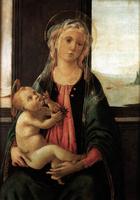
Madonna of the Sea
Sandro Botticelli
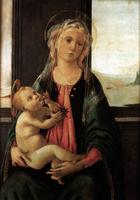
Madonna del Mare
Sandro Botticelli
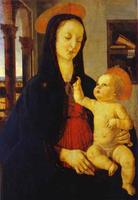
The Virgin and Child
Domenico Ghirlandaio
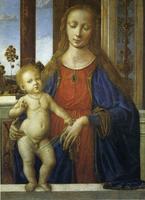
Madonna with Child
Pietro Perugino
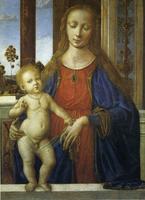
Madonna and Child
Andrea del Verrocchio
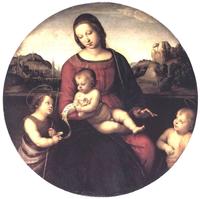
Terranuova Madonna
Raphael
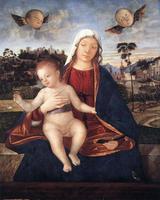
Madonna and Blessing Child
Vittore Carpaccio
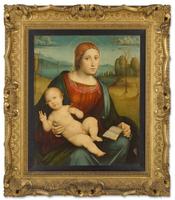
Madonna and Child
Francesco Francia
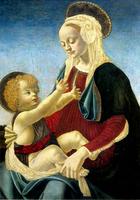
Madonna and Child
Andrea del Verrocchio
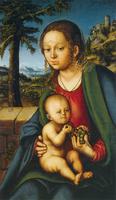
Virgin and Child with a Bunch of Grapes
Lucas Cranach the Elder
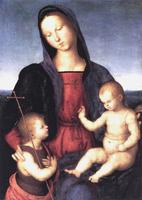
Diotalevi Madonna
Raphael
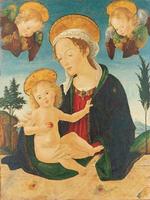
Madonna and Child with Two Cherubim
Antoniazzo Romano
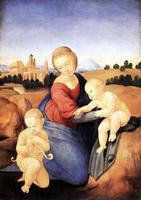
The Esterhazy Madonna
Raphael
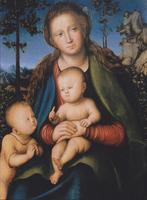
Madonna
Lucas Cranach the Elder
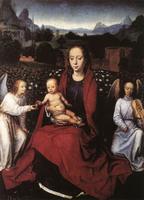
Virgin and Child in a Rose Garden with Two Angels
Hans Memling
Madonna Con Il Bambino
Bartolomeo Veneto
The Madonna of Humility adored by Leonello d'Este
Jacopo Bellini
Virgin and Child
Andrea Solario
Madonna with Child and Little St. John
Pietro Perugino
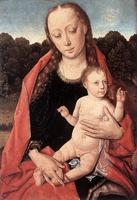
The Virgin and Child
Dirk Bouts