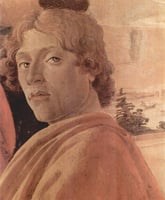
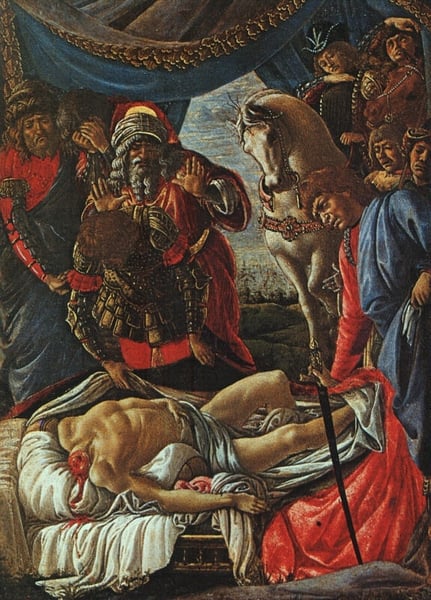
The Discovery of the Body of Holofernes
Ayrıntılar
Sandro Botticelli sanatçısının The Discovery of the Body of Holofernes eseri hakkında uzman analizi
Tarz: Early Renaissance · Tür: mythological painting
Expert Analysis: "The Discovery of the Body of Holofernes" by Sandro Botticelli
This painting is a remarkable example of Sandro Botticelli’s ability to fuse the narrative drama of a mythological—here, more accurately biblical—subject with the refined, lyrical aesthetic of the Early Renaissance. Although the story derives from the Book of Judith, the work is classified as a mythological painting, reflecting the period’s tendency to treat religious tales with the same classical poise and allegorical resonance as ancient myths.
Significance within the Early Renaissance Style
Botticelli’s treatment of the scene is striking for its balance between violence and grace. A hallmark of the Early Renaissance was the synthesis of naturalism with ideal beauty, and Botticelli achieves this by rendering the gruesome discovery of Holofernes’ body with a cool, almost dreamlike detachment. The figures are elegantly contoured, their gestures and expressions conveying shock and horror without descending into crude emotion. This restraint is typical of Botticelli’s work, where even the most brutal moments are softened by sinuous line and harmonious composition.
The painting also demonstrates the Early Renaissance fascination with perspective and spatial depth. Botticelli organizes the figures in a shallow, stage-like space, allowing the viewer to focus on the dramatic interplay of hands and faces. The careful arrangement of drapery and the subtle modeling of flesh tones reflect the era’s growing naturalism, while the overall calm symmetry ensures the scene feels less like a chaotic discovery and more like a solemn, ritualistic unveiling.
Genre and Thematic Significance
As a mythological painting, the work transcends its literal biblical source to tap into universal themes of justice, triumph, and divine intervention. Judith’s story was often interpreted as an allegory of virtue overcoming tyranny—a favorite motif in Early Renaissance art, which frequently drew parallels between classical and Christian narratives. Botticelli emphasizes this allegorical layer by making the discovery of Holofernes’ body a moment of hushed revelation rather than frenzied violence, elevating the painting from mere narrative to meditative icon.
In sum, “The Discovery of the Body of Holofernes” is significant for how Botticelli harnesses Early Renaissance stylistic ideals—graceful line, restrained emotion, and compositional clarity—to transform a gruesome episode into a work of poised, mythic grandeur. It exemplifies the period’s ambition to marry naturalistic observation with an idealized, timeless beauty, and remains a compelling testament to Botticelli’s unique vision within the Early Renaissance canon.
Museum / Gallery
Görsel olarak benzer
İlişkili kompozisyon ve renk paletine sahip 20 eser
Ecce Homo
Tintoretto
Ecce Homo (Pontius Pilate Presenting Christ to the Crowd)
Tintoretto
The Deposition
Sebastiano del Piombo
Mucius Scevolla Devant Porsenna Ou Achille Prépare À Venger La Mort De Patrocle
Dirck van Baburen
The Martyrdom of Saint George
Peter Paul Rubens
Beheading of St. John the Baptist
Peter Paul Rubens
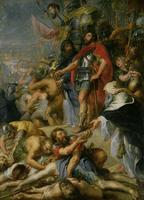
The Triumph of Judas Maccabeus
Peter Paul Rubens
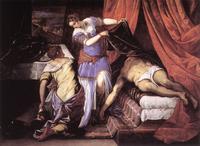
Judith and Holofernes
Tintoretto
Entombment
Giorgio Vasari
Martírio de Santo Hipólito
Cristovao de Figueiredo
Le martyre de saint Adrien
Theodor van Thulen
The Mocking of Christ (detail)
Jan van Hemessen
Die Strafe Des Höllenfeuers
Domenico Beccafumi
Sueño De La Madre De San Eloy
Francesco Ribalta
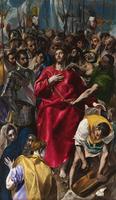
The Disrobing of Christ
El Greco
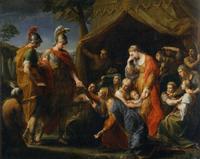
The wives of Darius before Alexander the great
Pompeo Batoni
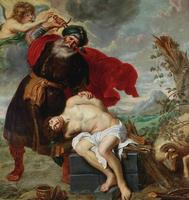
The Sacrifice of Isaac
Cornelis de Vos
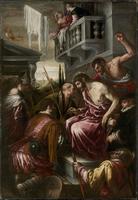
The Mocking of Christ
Jacopo Bassano
Lamentation on the Dead Christ
Maerten van Heemskerck
Martyrdom of St. Erasmus
Nicolas Poussin