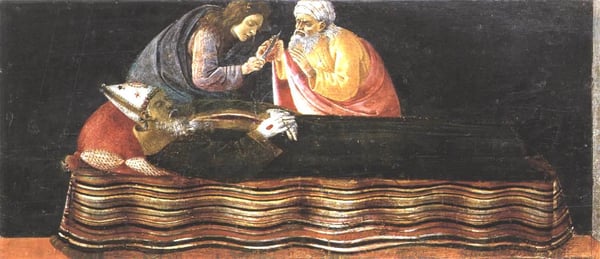
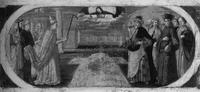
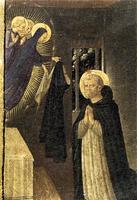
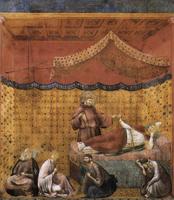
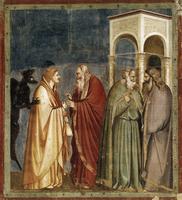
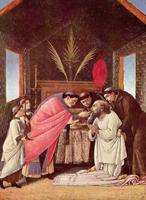
Based solely on the provided facts, the artwork "The Extraction of the Heart of St. Ignatius from the Altarpiece of St. Barnabas" by Sandro Botticelli is significant as a prime example of Early Renaissance religious painting. Its importance lies in how Botticelli, a master of the period, transforms a traditional devotional subject—a saint's martyrdom—into a moment of profound lyrical grace.
In the Early Renaissance, artists began to move beyond the flat, stylized forms of the Gothic era toward greater naturalism, emotional depth, and humanistic expression. Botticelli’s work epitomizes this shift. Here, the gruesome act of extracting a heart is not depicted with brutal, graphic realism. Instead, Botticelli likely employs his signature sinuous, flowing lines and elegant, slightly elongated figures to imbue the scene with a sense of ethereal beauty and quiet sorrow. The "extraction" becomes a symbolic, almost tender revelation of spiritual devotion rather than mere violence.
The painting's significance further stems from its function as part of an altarpiece (dedicated to St. Barnabas). As a religious painting, it was intended to inspire piety and contemplation. Botticelli’s genius lies in blending the sacred narrative with his distinctive, lyrical style—characterized by rhythmic compositions and a refined color palette—making the spiritual ordeal visually accessible and emotionally resonant for Renaissance viewers. This work thus represents the essential Early Renaissance achievement: embedding profound human emotion and naturalistic sensibility within a framework of religious faith.