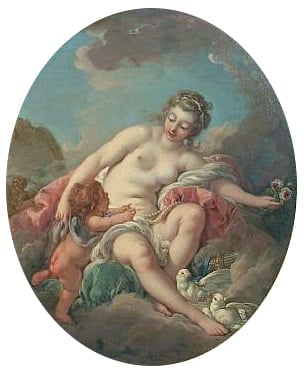
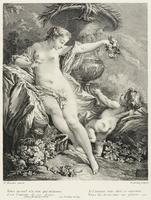
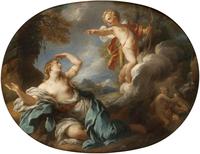
This analysis focuses exclusively on the provided facts: the artwork is "Venus Restraining Cupid" by François Boucher, executed in the Rococo style and belonging to the mythological genre.
Expert Analysis:
As a quintessential Rococo mythological painting, Venus Restraining Cupid exemplifies the period's fascination with playful, sensuous, and decorative treatments of classical themes. Boucher’s choice of subject—the goddess of love physically holding back her mischievous son—is significant because it allowed him to foreground the Rococo preoccupation with erotic tension and lighthearted flirtation. The scene is not grand or heroic (as in Baroque or Neoclassical works) but intimate and charming, focusing on a moment of gentle restraint that suggests both desire and playful resistance.
The work’s significance within the Rococo lies in how it captures the movement’s core aesthetic: elegance, softness, and an air of frivolous pleasure. Boucher, as a leading Rococo painter, used such mythological narratives to celebrate love, beauty, and the pleasures of the senses, aligning perfectly with the aristocratic tastes of mid-18th-century France. The painting’s importance is therefore twofold: it stands as a masterful example of Rococo’s decorative, courtly sensibility, and it showcases Boucher’s trademark ability to render flesh tones, flowing drapery, and a pastel-hued, idyllic atmosphere that epitomizes the style’s visual language.