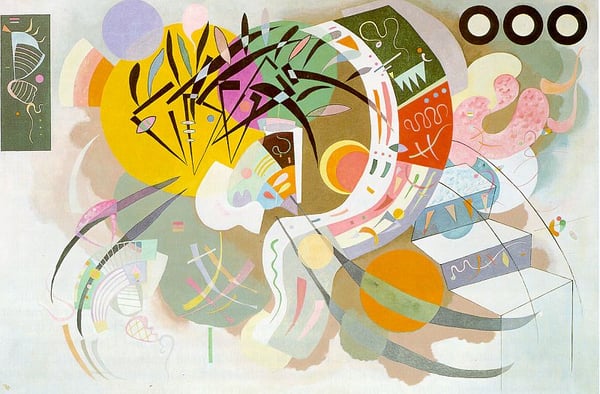
Dominant curve
Dettagli
Analisi esperta di Dominant curve di Wassily Kandinsky
Stile: Abstract Art · Genere: abstract
Expert Analysis: "Dominant Curve" (1936) – Wassily Kandinsky
Kandinsky’s “Dominant Curve” stands as a pivotal work within the evolution of pure abstraction, representing the artist’s mature synthesis of geometric structure and organic fluidity. Created during his Bauhaus-to-Paris period, the painting exemplifies his quest to translate spiritual and emotional states into visual equivalents through color, line, and form.
Significance within Abstract Art:
-
Biomorphic Abstraction: Unlike the hard-edged geometry of his earlier Bauhaus phase, “Dominant Curve” introduces softly undulating, amoeba-like shapes. These biomorphic forms—influenced by Surrealism’s interest in the subconscious—float across a deep cosmic background, bridging rational composition with intuitive, organic rhythm.
-
Color as Emotional Force: The palette juxtaposes cool blues and greens (the “dominant curve” itself) against warm reds and oranges. This tension reflects Kandinsky’s theory of color resonance, where hues act as “vibrations” triggering psychological responses. The curve’s sweeping motion directs the eye through a chromatic field, creating a sense of dynamic balance—a hallmark of his late style.
-
Musical Analogies: Kandinsky famously likened painting to music. In Dominant Curve, the title suggests a melodic “theme”—the sweeping arc—around which smaller shapes counterpoint like notes. This aligns with his goal of “inner necessity”: abstract forms that communicate directly, without representation, much like sound.
-
Cultural and Historical Context: Painted in 1936, as Europe edged toward war, the work embodies Kandinsky’s belief in abstraction as a refuge for harmony and universal spirituality. The dominant curve can be read as a gesture of hope—a fluid, unifying force amidst fragmentation.
Why It Matters: “Dominant Curve” is significant because it reconciles Kandinsky’s earlier rigorous geometry with a newfound lyrical freedom, anticipating post-war movements like Abstract Expressionism and Tachisme. It remains a masterful demonstration of how abstract art can convey mood, motion, and metaphysical depth through purely visual means.
Museum / Gallery
Visivamente simili
20 opere con composizione e palette affini
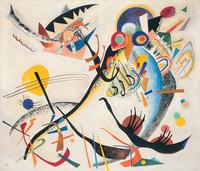
Blue segment
Wassily Kandinsky
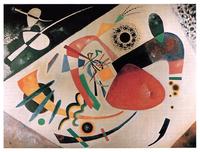
Red spot II
Wassily Kandinsky
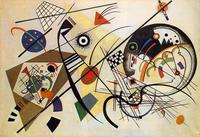
Transverse Line
Wassily Kandinsky
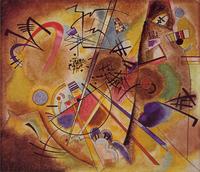
Small dream in red
Wassily Kandinsky
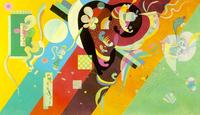
Composition IX
Wassily Kandinsky
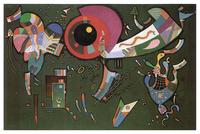
Around the circle
Wassily Kandinsky
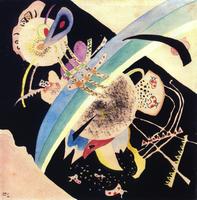
Study for "Circles on Black"
Wassily Kandinsky
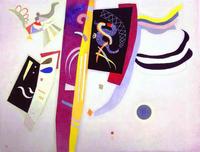
Orange-Violet
Wassily Kandinsky
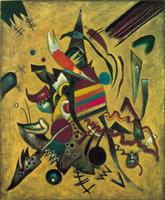
Points
Wassily Kandinsky
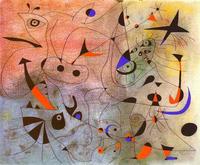
Constellation: The Morning Star
Joan Miro
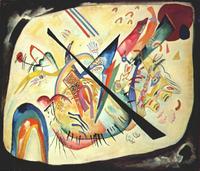
White oval
Wassily Kandinsky
#59
Elmer Bischoff
Italian Landscape in 2073 BC
Carloluigi Colombo
Komposition
Gosta Adrian-Nilsson
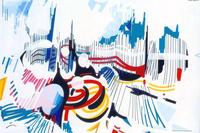
Hiroxima
Nadir Afonso
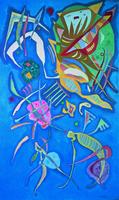
Grouping
Wassily Kandinsky
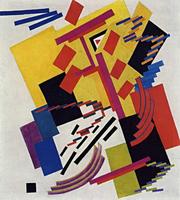
Non-objective Composition
Olga Rozanova
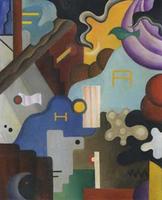
Composizione futurista
Julius Evola
Composition
Georges Valmier
Green composition
Wassily Kandinsky