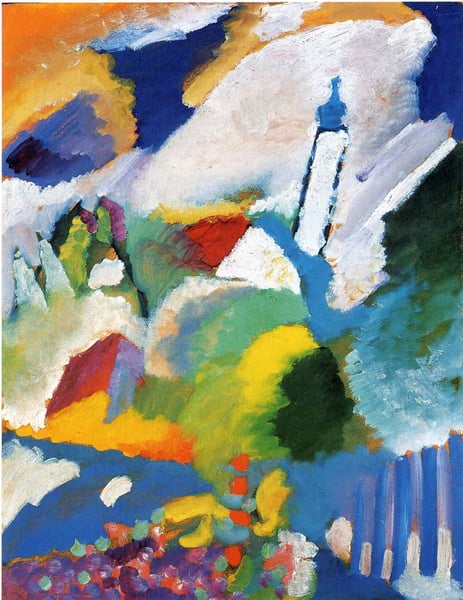
Murnau with a church
Dettagli
Analisi esperta di Murnau with a church di Wassily Kandinsky
Stile: Expressionism · Genere: cityscape
Expert Analysis: "Murnau with a church" by Wassily Kandinsky
Wassily Kandinsky’s Murnau with a church (circa 1910) stands as a pivotal work within the Expressionist movement, marking a crucial transition from representation toward the artist’s revolutionary abstract language. Painted during his transformative years in the Bavarian town of Murnau, this cityscape exemplifies the core tenets of Expressionism: an intense, subjective emotional response rendered through bold color, distorted form, and dynamic composition.
Significance within Expressionism and Kandinsky’s Oeuvre
-
Bridge to Abstraction – While still recognizable as a town with a central church spire, the painting already subordinates naturalistic detail to expressive color and simplified shapes. The church is reduced to a series of almost geometric blocks—a precursor to Kandinsky’s later fully abstract compositions. This work reveals his belief that color and form alone could convey spiritual and emotional truths, a philosophy he would soon codify in his treatise Concerning the Spiritual in Art (1912).
-
Expressive Color as Emotion – Kandinsky employs a non-naturalistic palette: vivid blues, fiery oranges, and deep reds saturate the canvas. The blue mountain dominates, suggesting a serene, spiritual force, while the red rooftops pulse with energy. This juxtaposition creates a visual tension that mirrors the artist’s inner life, a hallmark of Expressionist “inner necessity.” The glowing yellow sky and dark outlining of forms (reminiscent of stained glass or folk art) heighten the scene’s visionary quality.
-
Composition and Symbolism – The church is centrally placed, its spire piercing the sky, acting as an anchor of stability amid swirling, organic surroundings. This reflects Kandinsky’s interest in the synthesis of the material (the church as landmark) and the spiritual (the church as symbol of eternal truth). The loose, almost mosaic-like brushwork energizes the surface, anticipating the “felt” quality of abstract expression.
-
Historical Context – Painted in Murnau, where Kandinsky lived with Gabriele Münter and fellow artists, this work belongs to a fertile period when he abandoned Impressionist influences for a more radical, emotionally charged style. Alongside Münter and Jawlensky, Kandinsky helped define German Expressionism’s landscape tradition, filtering the Bavarian countryside through a lens of intense subjectivity.
Why It Matters
Murnau with a church is significant not only as a brilliant example of Expressionist cityscape but as a testament to Kandinsky’s role as a pioneer of modern art. It captures the moment when recognizable subject matter begins to dissolve into pure pictorial elements—color, line, and form—charged with psychological and spiritual resonance. For viewers, it invites an experience of landscape not as a record of place, but as a mirror of the soul.
Museum / Gallery
Visivamente simili
20 opere con composizione e palette affini
Mountain landscape with church
Wassily Kandinsky
Landscape with factory chimney
Wassily Kandinsky
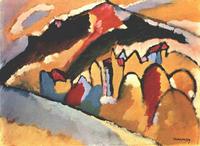
Study for autumn
Wassily Kandinsky
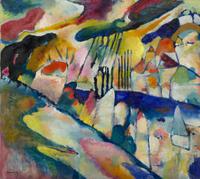
Landscape with Rain
Wassily Kandinsky
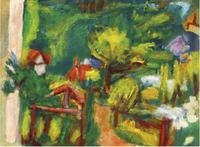
Summer Memories
Bela Czobel
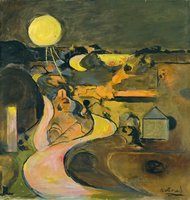
Road to Porthclais with Setting Sun
Graham Sutherland
Untitled
Albert Gleizes
Landscape, near Nice
Graham Sutherland
Landscape II
Eugene Brands
Landscape
Vasiliy Ryabchenko
Acacias
André Lhote
Street At Cagnes
Chaim Soutine
Czóbel Béla , Táj Házakkal 1930
Bela Czobel
Egry József, Hegyoldal,.
Egry József
Cagnes
Bela Czobel
The level Crossing
Fernand Leger
Landscape
Jacqueline Lamba
Paysage méditerranéen
Nicolas de Staël
Berglandschaft mit Häusern
Alexej von Jawlensky
Roter Abend - Blaue Berge
Alexej von Jawlensky