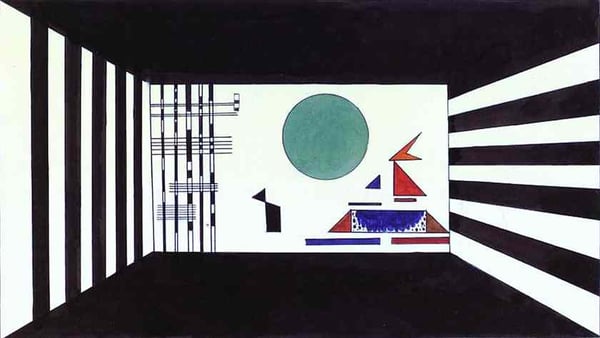
Picture II, Gnomus. (Stage set for Mussorgsky's Pictures at an Exhibition in Friedrich Theater, Dessau)
Dettagli
Analisi esperta di Picture II, Gnomus. (Stage set for Mussorgsky's Pictures at an Exhibition in Friedrich Theater, Dessau) di Wassily Kandinsky
Stile: Abstract Art · Genere: design
This stage design—Picture II, Gnomus—represents a pivotal moment in Wassily Kandinsky’s career, where his pioneering abstract vocabulary was applied not to a canvas but to the functional realm of theater. Created for a 1928 production of Modest Mussorgsky’s Pictures at an Exhibition at the Friedrich Theater in Dessau, the work is a vivid demonstration of Kandinsky’s lifelong quest to synthesize visual art with music.
Significance within Abstract Art and Design:
As a core member of the Bauhaus faculty at the time, Kandinsky used this stage set to translate his theories of “inner necessity” and synesthesia into a three-dimensional, performative space. The piece is significant for several reasons:
-
Musical-Visual Analogy: The Gnomus movement in Mussorgsky’s suite is a jagged, lumbering scherzo depicting a limping gnome. Kandinsky abstracts this not through representation but through dynamic, angular shapes and a dissonant interplay of primary colors (likely sharp reds, blues, and yellows against dark backgrounds). The composition mirrors the music’s rhythmic instability and grotesque character, embodying Kandinsky’s belief that color and form could evoke the same emotional and spiritual responses as sound.
-
Break from Traditional Stagecraft: Instead of a realistic or even expressionistic scene, Kandinsky offers a purely abstract environment. The “set” functions as a kinetic painting—a composition of floating geometric elements, lines, and planes that shift in relation to the performer (or to the viewer's imagination). This anticipates later developments in abstract film, light shows, and performance art, treating the stage as a living canvas.
-
Bauhaus Principles in Action: This design exemplifies the Bauhaus interdisciplinary ideal: the fusion of fine art with craft and functional design. Here, painting is not merely decorative but structurally integral to the theatrical experience. The abstract forms are not random; they are rigorously composed to guide the audience’s eye and emotion in synchronization with the music, making the set an active participant in the narrative.
In sum, Picture II, Gnomus is significant as a landmark of abstract stage design. It extends Kandinsky’s non-objective aesthetic beyond the picture frame into time-based, spatial art, proving that abstraction could serve not just as a style but as a dynamic language for storytelling and sensory immersion.
Museum / Gallery
Visivamente simili
20 opere con composizione e palette affini
Mechano-Faktura
Henryk Berlewi
Numerical Affection 1
Oleksandr Aksinin
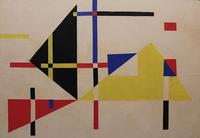
Untitled
Sandu Darie
Untitled (Columna Espacial)
Sandu Darie
Hereditarius No.1-68-A
Park Seo-Bo
Mechano-Faktura Construction
Henryk Berlewi
Untitled (Blue abstraction)
Jerzy Nowosielski
Untitled Abstraction (Mantic)
Josef Albers
Watching the Clock
Kay Sage
Sign
Oleksandr Aksinin
Bull VI
Roy Lichtenstein
Bortnyik Sándor, Geometrikus Kompozicio
Sandor Bortnyik
Pictorial Architecture
Lajos Kassak
Képarchitektúra
Lajos Kassak
Street in Heligoland II
Arthur Segal
Scarlatti's Garden
Omar Rayo
Legendary Landscape (Azul y Naranja)
Gunther Gerzso
Untitled
Allan D'Arcangelo
Composition Néoplasticiste
Franciska Clausen
Pictorial Architecture
Lajos Kassak