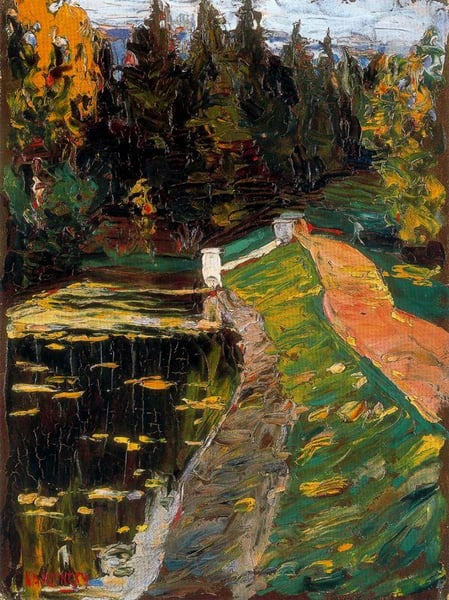
Экспертный разбор работы «Study for sluice» художника Wassily Kandinsky
Стиль: Post-Impressionism · Жанр: landscape
Expert Analysis: "Study for sluice" by Wassily Kandinsky
Although Wassily Kandinsky is today celebrated as a pioneer of abstract art, Study for sluice belongs to an earlier, formative phase in his career—one still firmly rooted in Post-Impressionism. This landscape sketch is significant precisely because it documents the transitional moment when Kandinsky began to loosen the bonds of strict representation, anticipating the radical freedom of his later non-objective works.
Within the Post-Impressionist idiom, the painting demonstrates a sophisticated manipulation of color and brushwork to evoke mood rather than mere topography. The sluice—an engineered water-control structure—is depicted not with mechanical precision but as a series of luminous, broken touches of paint. This approach echoes the example of artists like Paul Cézanne and Georges Seurat, who sought to synthesize natural form with a more structured or emotive color system. Kandinsky’s palette here likely veers toward heightened, non-naturalistic hues, a hallmark of Post-Impressionism that points directly toward his future embrace of color as an autonomous, spiritual force.
What makes Study for sluice noteworthy in Kandinsky’s oeuvre is its anticipatory character. The subject—a man-made intervention in a natural landscape—parallels his lifelong interest in boundaries, thresholds, and transformation. The sluice itself becomes a metaphor for the channeling of creative energy. Stylistically, the work retains recognizable landscape motifs (water, bank, reflections) but pushes them toward abstraction through flattening of space and rhythmic pattern. This tension between representation and abstraction is where the artwork’s significance lies: it is a laboratory study for Kandinsky’s eventual leap into pure form.
For art historians, Study for sluice serves as a crucial example of how Post-Impressionism—often seen as a bridge between Impressionism and Expressionism—directly nourished Kandinsky’s development. The work demonstrates that his later breakthrough was not a sudden rupture but a gradual distillation of painting’s intrinsic elements, already present in embryo in landscapes like this one.
Визуально похожие
20 работ с близкой композицией и палитрой
Lake near Breccles in Autumn
Winston Churchill
Landscape. Uzkoe
Igor Grabar
Yellowing maples
Pyotr Konchalovsky
Alexander Palace in Detskoye Selo
Anna Ostroumova-Lebedeva
Untitled
Abraham Manievich
Okhtyrka, autumn
Wassily Kandinsky
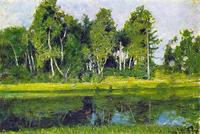
Pond in Abramtsevo
Igor Grabar
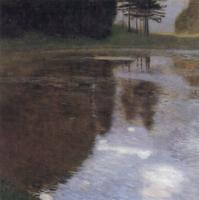
Quiet pond in the park of Appeal
Gustav Klimt
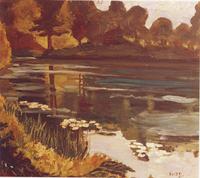
Lake at Blenheim
Winston Churchill
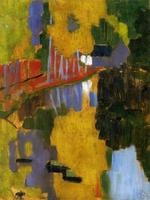
The Talisman: The Aven River at the Bois d'Amour
Paul Serusier
Outdoors
Arkady Rylov
Pond in Tsarskoe Selo
Zinaida Serebriakova
A pond
Pyotr Konchalovsky
Oestervold Park, Copenhagen
Paul Gauguin
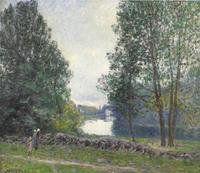
A Turn of the River Loing, Summer
Alfred Sisley
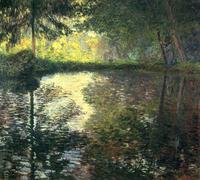
The Pond at Montgeron
Claude Monet
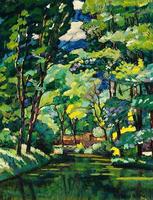
Landscape with a pond
Ilya Mashkov
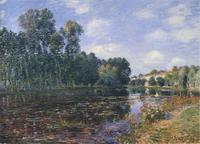
Bend in the River Loing in Summer
Alfred Sisley
Spring Landscape
Emil Carlsen
Spring Scene
Victor Borisov-Musatov