Analisi esperta di Rapallo Grauer day di Wassily Kandinsky
Stile: Post-Impressionism · Genere: marina
Expert Analysis: "Rapallo Grauer day" (Rapallo Gray Day) by Wassily Kandinsky
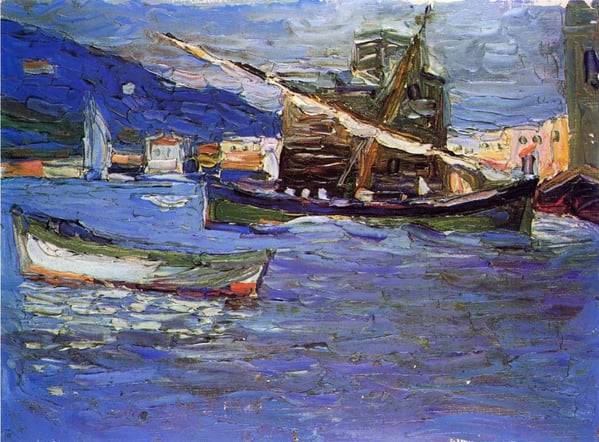
This work, painted in 1905 during Kandinsky’s formative years in Rapallo, Italy, is a compelling example of his engagement with Post-Impressionist principles before his revolutionary leap into abstraction. Classified as a marina (seascape), the painting depicts the Ligurian coast under a muted, overcast sky—hence the title’s “gray day.” Yet the work’s significance lies not in topographical accuracy but in how Kandinsky transforms a conventional subject into an emotionally charged, proto-abstract composition.
Break with Naturalism: Although still representational, Kandinsky pushes beyond descriptive realism. The gray sea and sky are rendered in layered, chalky tones, while the shoreline and boats are simplified into dark, flattened silhouettes. This reduction echoes Paul Cézanne’s structural approach and the Fauves’ liberated palette, but Kandinsky already injects a personal, almost musical sense of mood—the “gray” becomes a psychological state, not just a weather condition.
Expressive Brushwork and Color: The paint is applied in visible, restless strokes, creating a vibrating surface that suggests the movement of waves and wind. Kandinsky’s use of complementary contrasts—muted blues against ochre-grays—gives the scene an internal tension, prefiguring his later theories about color’s spiritual and emotional power. The absence of strong sunlight forces the viewer to focus on texture and atmosphere rather than narrative.
Transitional Importance: “Rapallo Grauer day” is a crucial document in Kandinsky’s evolution from Russian folk motifs and Impressionist influences toward the non-objective style that would define his legacy. Here, the marina genre is a vehicle for exploring abstraction’s embryonic language: the horizon line is softened, forms are blurred, and the composition feels almost weightless. It demonstrates that even within Post-Impressionism’s framework, Kandinsky was already dissolving the boundaries between object and emotion, paving the way for his breakthrough works like Composition VII (1913).
Conclusion: This painting matters not as a typical seascape but as a quiet manifesto. It shows Kandinsky testing how far he can push representation while still evoking a specific, transient moment. The “gray day” is a metaphor for an artistic threshold—the moment before color and form break free from the subject. A masterpiece of early modernist introspection, it reveals the roots of abstraction in the tangible world.
Museum / Gallery
Visivamente simili
20 opere con composizione e palette affini
Fishing Boats
Konstantin Gorbatov
Fishing Boats, Collioure
Andre Derain
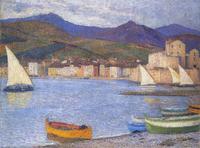
Sailboats in the Port of Collioure
Henri Martin
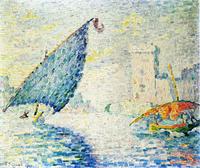
Fort Saint-Jean, Marseilles
Paul Signac
Boats at shore
Theophrastos Triantafyllidis
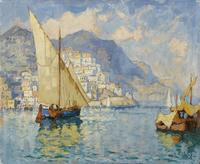
Amalfi
Konstantin Gorbatov
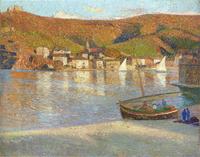
Sailboats in the Port
Henri Martin
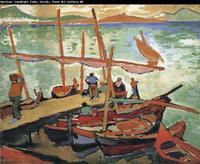
Yacht
Andre Derain
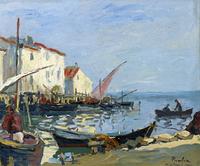
The Martigues
Francis Picabia
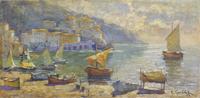
The Sunlit Harbor
Konstantin Gorbatov
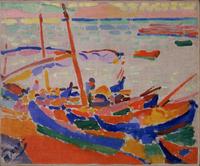
Fishing Boats, Collioure
Andre Derain
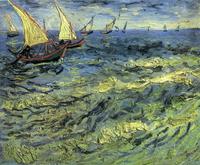
Fishing Boats at Sea
Vincent van Gogh
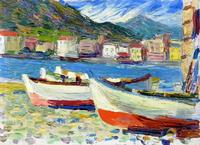
Rapallo boats
Wassily Kandinsky
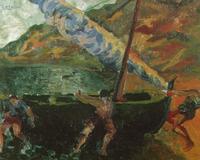
Fishermen at Cadaques
Salvador Dali
Boats, Hydra
Periklis Vyzantios
Boats at Chioggia (Venice)
Nicolae Darascu
View of Venice
Konstantin Gorbatov
Boats in Port Collioure
Henri Martin
Constanta
Nicolae Darascu
Port of Cassis
Adolphe Joseph Thomas Monticelli