Expert analysis of Amedeo Modigliani’s Little Serving Woman
Style: Expressionism · Genre: portrait
Expert Analysis of Little Serving Woman by Amedeo Modigliani
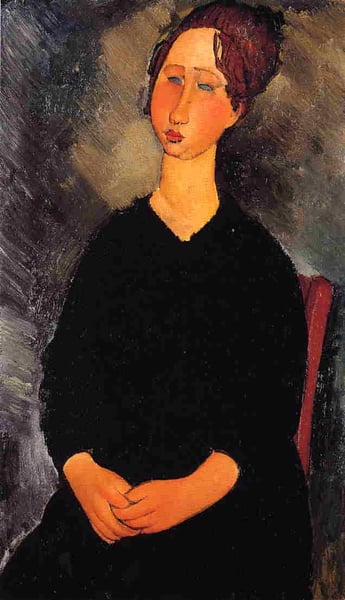
Amedeo Modigliani’s Little Serving Woman is a striking example of his mature Expressionist portraiture, a style that bridges the emotional intensity of early twentieth-century modernism with a deeply personal, sculptural lyricism. Within the Expressionist movement, Modigliani stands apart for his refusal to exaggerate emotion through violent distortion; instead, he conveys psychological complexity through radical simplification and a disciplined, almost archaic elegance.
What makes this work significant:
-
Synthesis of Formal Distortion and Human Dignity
Modigliani’s signature elongated neck, sloping shoulders, and almond-shaped, often blank eyes are fully present here. Yet the “little serving woman” is not reduced to a caricature. The careful tilt of her head and the slight asymmetry of her features suggest a quiet interiority—a blend of vulnerability and quiet resilience. This balance between abstraction and empathy is a hallmark of Modigliani’s best works, elevating a domestic servant to a subject of profound dignity. -
Influence of African Sculpture and Italian Primitivism
The treatment of the face—simplified planes, a long nose, and a small, pursed mouth—directly echoes the masks and figures Modigliani admired in African and Cycladic art. Yet the painting’s restrained palette (warm ochres, muted blues) and soft modeling recall the Sienese and Florentine Gothic masters he studied. This fusion of “primitive” form with Renaissance grace gives the portrait a timeless, monumental quality, even as it remains intimate in scale. -
Expressionist Use of Color and Line
Rather than relying on dramatic brushwork or jarring hues, Modigliani builds emotion through contour and hue. The curved line of the woman’s back and arm creates a gentle, enclosing rhythm, while the cool background isolates her form, intensifying her solitude. The subtle warmth of her skin and the soft red of her lips are nearly the only saturated notes—a restrained choice that focuses attention on her face and posture. -
Challenging Genre Conventions
A “serving woman” was traditionally a minor figure in genre scenes or still lifes. By making her the sole subject of a formal portrait, Modigliani asserts the sovereignty of her individual presence. This aligns with Expressionism’s broader project to humanize the overlooked, yet Modigliani does so not through sentiment but through formal grace—making her timeless, not pitiable.
In summary, Little Serving Woman is significant because it demonstrates how Modigliani’s unique Expressionist vocabulary—defined by elongation, planar simplification, and a synthesis of non-Western and early Italian art—could render a humble subject with both modernist innovation and a quiet, enduring humanity. It is a portrait in which the sitter’s inner life is not declared but felt, held within the contours of a line that is at once ancient and radically new.
Visually similar
20 works with related composition and palette
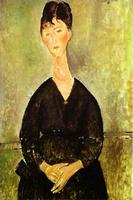
Cafe Singer
Amedeo Modigliani
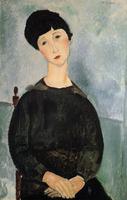
Seated Young Woman
Amedeo Modigliani
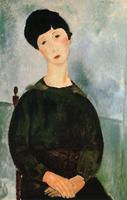
A young girl
Amedeo Modigliani
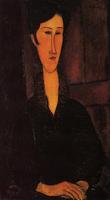
Portrait of Madame Zborowska
Amedeo Modigliani
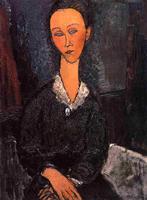
Lunia Czechowska
Amedeo Modigliani
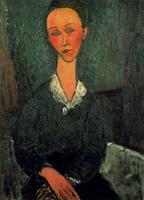
A woman with white collar
Amedeo Modigliani
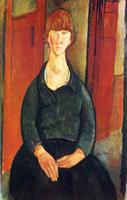
Flower vendor
Amedeo Modigliani
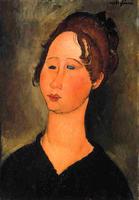
Burgundian Woman
Amedeo Modigliani
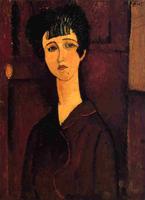
Victoria
Amedeo Modigliani
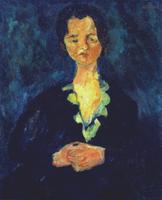
Portrait of a Woman on a Blue Background
Chaim Soutine
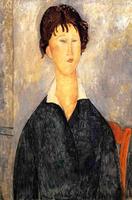
Portrait of a Woman with a White Collar
Amedeo Modigliani
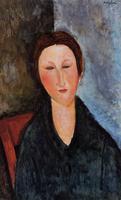
Bust of a Young Woman (Mademoiselle Marthe)
Amedeo Modigliani
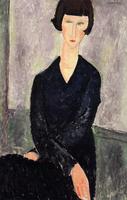
The Black Dress
Amedeo Modigliani
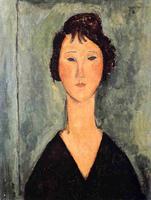
Portrait of a Woman
Amedeo Modigliani
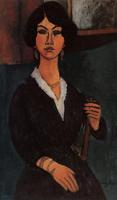
Almaisa
Amedeo Modigliani
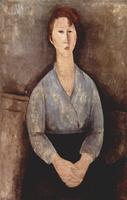
Seated woman weared in blue blouse
Amedeo Modigliani
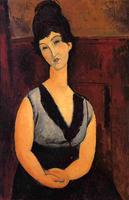
The Beautiful Confectioner
Amedeo Modigliani
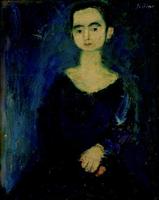
Lady in blue
Chaim Soutine
Woman With a Necklace
Amedeo Modigliani
Woman with Scottish Dress
Amedeo Modigliani