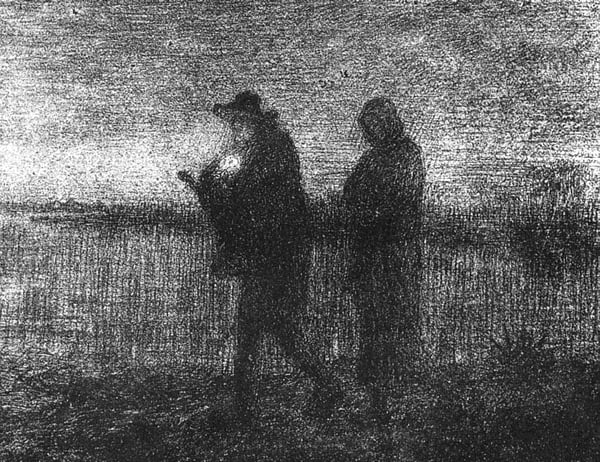
The flight into Egypt
Expert analysis of Jean-Francois Millet’s The flight into Egypt
Style: Realism · Genre: religious painting
Artwork Analysis: "The Flight into Egypt" by Jean-François Millet
Jean-François Millet, a leading figure of the Realist movement, is best known for his monumental depictions of peasant life, such as The Gleaners and The Angelus. In The Flight into Egypt, he applies the same unidealized, earthbound sensibility to a traditional religious subject, creating a work that is both reverent and radically grounded in the tangible world.
Stylistic Approach True to the principles of Realism, Millet strips the biblical narrative of its customary heroic or miraculous aura. The Holy Family is not shown with halos, angelic escorts, or dramatic landscapes. Instead, they appear as humble travelers—Joseph walks wearily beside a donkey carrying Mary and the infant Jesus. The scene is set in a sparse, almost featureless landscape, with muted earth tones that emphasize the physical hardship of the journey. Millet’s brushwork is broad and tactile, focusing on the weight of the figures and the quiet solemnity of their movement. There is no theatrical lighting or celestial sign; the light is ordinary, diffuse, and suggests the simple passage of day.
Significance within Realism and Religious Art Millet’s The Flight into Egypt is significant precisely because it merges a sacred theme with the unvarnished realism that was often reserved for contemporary rural life. By depicting the Holy Family as anonymous, weary peasants, Millet challenges the grand tradition of religious painting (exemplified by artists like Caravaggio or Poussin) and instead insists that the divine enters human experience through the most ordinary, laborious moments. This approach aligns with the Realist mission to elevate everyday life and labor to the level of high art, while also reinterpreting Christian iconography through a lens of empathy and human dignity.
The painting thus stands as a quiet but radical statement: the sacred is not separate from the mundane, but found within it. Millet’s refusal to idealize—presenting a dirtied donkey, plain clothing, and a stony path—makes the biblical story immediate and universal, inviting viewers to see the Holy Family in any migrant family of his own time. This work remains a powerful example of how Realism reframed traditional subjects, emphasizing truth to human experience over idealized beauty, and affirming that even the most humble journey can carry profound spiritual weight.
Museum / Gallery
Visually similar
20 works with related composition and palette
Ploughing
Georges Seurat
Kontemplace, Mnich na mořském břehu
Jakub Schikaneder
Moonlit Landscape With indian
Ralph Blakelock
Moonlight Night on the River
Arkhyp Kuindzhi
Night
Aleksey Savrasov
Le Croisic, Girls at the Foot of a Standing Stone
Ferdinand du Puigaudeau
Landscape
Pellizza da Volpedo
Le Pouldu, Woman on the Beach Beside a Fire
Ferdinand du Puigaudeau
In the Gloaming
George Inness
Christ and His Desciples on the Road to Bethany
Henry Ossawa Tanner
Landscape
Ivan Marchuk
Flight into Egypt
Odilon Redon
Rainbow 1
Konstantin Somov
Reflection
Odilon Redon
Moonlight Over the Bay At, Cadaques
Salvador Dali
Night in the Steppe
Ivan Marchuk
Landscape
Ralph Blakelock
Sunset, St Ives, Cornwall
Frederick George Cotman
Peasant Burning Weeds
Vincent van Gogh
Two Men by the Sea
Caspar David Friedrich