
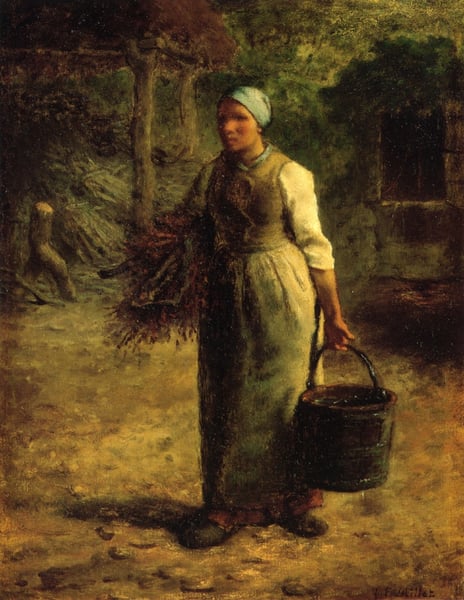
Woman Carrying Firewood and a Pail
Dettagli
Analisi esperta di Woman Carrying Firewood and a Pail di Jean-Francois Millet
Stile: Realism · Genere: genre painting
Expert Analysis of "Woman Carrying Firewood and a Pail" by Jean-François Millet
This work exemplifies the core tenets of Realism, a mid-19th-century movement that rejected the idealized, mythological, and romanticized subjects of earlier art. Millet, a central figure in the Barbizon School, devoted his career to depicting the lives of the rural peasantry with unflinching honesty and profound dignity.
Subject and Composition:
The painting’s genre—a simple scene of everyday life—is elevated by Millet’s treatment. The woman is shown in profile, bent under the weight of a bundle of firewood while carrying a pail, likely for water or milk. Her body is solid, almost monumental, yet her labor is shown as a quiet, habitual burden. Millet avoids dramatic action or expression, focusing instead on the physical reality of her task. The composition is stark: the figure dominates the foreground, set against a muted, open landscape that emphasizes her isolation and the cyclical nature of peasant work.
Significance within Realism:
What makes this work especially significant is how Millet transforms a humble, anonymous chore into a subject of artistic and social importance. In an era when the French Academy prized history painting and allegory, Millet insisted that the drudgery of poverty—carrying wood, drawing water—was worthy of serious artistic representation. His approach was both empathetic and unsentimental: he does not romanticize the peasant’s life, but neither does he degrade it. The heavy, earthy palette (ochres, browns, dull greens) and the thick, tactile brushwork convey the weight of the wood, the coarseness of her clothing, and the gravity of her posture.
Comparison to Millet’s Canon:
Like his more famous works The Gleaners (1857) and The Angelus (1859), this painting elevates the daily grind of rural labor to a near-spiritual plane. Woman Carrying Firewood and a Pail lacks the iconic group dynamics of The Gleaners, but it distills Millet’s message to its essence: the individual peasant woman, anonymous yet heroic, bearing the elementary burdens of survival. The pail and firewood are not mere props; they are symbols of domestic and domesticating labor, tasks that defined the lives of millions of rural women.
Legacy:
Millet’s Realism had a profound influence on later artists, from the Impressionists (who admired his tonal unity) to the Social Realists of the 20th century (who saw in his work a political call to represent the working class). This painting stands as a quiet manifesto: that the most ordinary act—a woman carrying firewood and a pail—can be the subject of art that is both truthful and transcendent.
Museum / Gallery
Visivamente simili
20 opere con composizione e palette affini
The gleaner
Jules Breton
Love tokens
Jules Breton
Norman Milkmaid
Jean-Francois Millet
Harvesting Rapeseed
Jules Breton
Girl with a Rake
Jules Breton
The Recall of the Gleaners (study)
Jules Breton
Young Woman in the Fields
Jules Breton
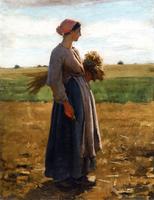
Young Woman in the Fields
Jules Breton
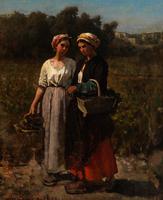
Two young woman picking grapes (Study for „The vintage at Château Lagrange“)
Jules Breton
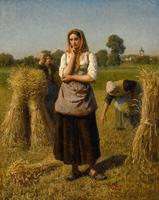
The gleaner
Jules Breton
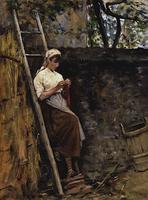
Country girl leaning against a ladder
Silvestro Lega
Hay, reapers and two women in the morning
Léon Augustin Lhermitte
Study: A Peasant Woman
Julien Dupré
Potato harvest
Ludwig Knaus
Off to the market
Anton Romako
Peasant Woman Resting
Léon Augustin Lhermitte
The Gleaner
Jules Breton
In the Fields, Evening
Jules Breton
Peasant woman at rest
Jules Breton
The Tedder
Léon Augustin Lhermitte