
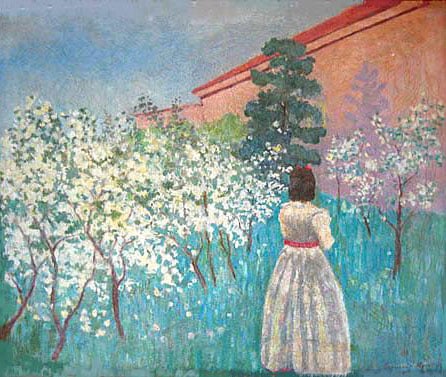
Expert analysis of Victor Borisov-Musatov’s A garden in Blossom
Style: Post-Impressionism · Genre: landscape
Expert Analysis of "A Garden in Blossom" by Victor Borisov-Musatov
Victor Borisov-Musatov’s A Garden in Blossom is a quintessential example of Post-Impressionist landscape painting that transcends mere visual representation to become a meditation on memory, mood, and the ephemeral beauty of nature. While the work adheres to the genre of landscape, its significance lies in how it merges the formal innovations of Post-Impressionism—particularly its rejection of naturalistic color and perspective—with a deeply personal, symbolist sensibility.
Stylistic Significance
Borisov-Musatov applies Post-Impressionist techniques to evoke a dreamlike, lyrical atmosphere. Instead of capturing the garden with the spontaneous, light-dappled brushwork of Impressionism, he employs a muted, harmonious palette of soft pinks, pale greens, and hazy whites, blurring the boundaries between blossoms, foliage, and sky. This deliberate use of color—almost tonal rather than vibrant—shifts the focus from the observable world to an emotional, subjective experience. The composition is flattened and decorative, with a lyrical rhythm that recalls the work of Pierre Puvis de Chavannes, while the subtle patterning of blossom clusters anticipates the ornamental qualities of Art Nouveau.
Thematic Importance
The painting’s true significance lies in its role as a bridge between Russian Symbolism and European Post-Impressionism. Borisov-Musatov transforms a simple garden into a locus amoenus—an idealized, melancholic refuge from reality. The blossoms are not rendered with botanical precision; instead, they become fragile, almost spectral shapes, suggesting the transience of beauty and the ache of nostalgia. This aligns with the artist’s broader oeuvre, in which gardens often serve as stages for unspoken narratives—often featuring solitary figures or traces of human absence. Here, the empty pathways and hushed atmosphere evoke a sense of loss or longing, a theme that resonated deeply with Russian audiences of the early 20th century, who saw in such works a quiet protest against the harshness of modern life.
Art-Historical Context
Borisov-Musatov was a pivotal figure in the development of Russian Modernism, and A Garden in Blossom exemplifies his unique synthesis. By infusing Post-Impressionist structure with a symbolic, almost mystical mood, he directly influenced the next generation of Russian avant-garde artists, including the World of Art group and early works of Mikhail Vrubel. The painting stands as a testament to the artist’s ability to fuse Western European formal innovations with a distinctly Russian poetic sensibility—where the landscape becomes a vessel for introspection rather than a mere view.
Conclusion
A Garden in Blossom is significant not for its fidelity to nature, but for its transformation of a conventional landscape into a subtle, emotionally charged vision. It marks a crucial moment when Post-Impressionism in Russia moved beyond technique to become a vehicle for psychological depth and symbolic resonance, cementing Borisov-Musatov’s legacy as a master of the quiet, enduring power of the painted garden.
Visually similar
20 works with related composition and palette
Cherry Trees in Blossom
Victor Borisov-Musatov
Cherry blossoms
Pyotr Konchalovsky
Blossoms at Giverny
Theodore Robinson
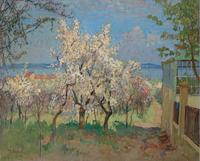
Trees in Bloom
Konstantin Gorbatov

Spring Sun
Victor Borisov-Musatov
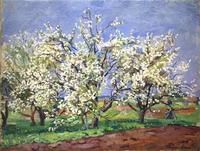
Apple Trees in Blossom. Blue day.
Pyotr Konchalovsky
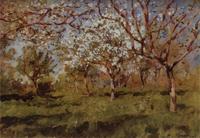
Apple trees in blossom
Isaac Levitan
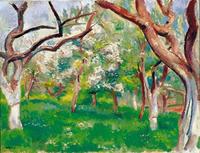
Blossoming Orchard
Wojciech Weiss
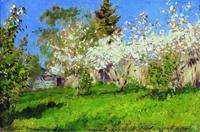
Apple trees in blossom
Isaac Levitan
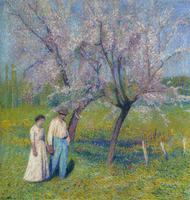
Brides walk under the apple trees
Henri Martin

Sunlight and Shadows
Theodore Robinson
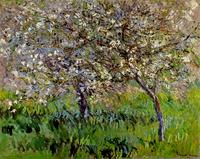
Apple Trees in Bloom at Giverny
Claude Monet
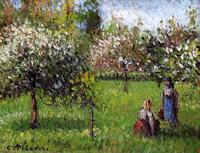
Apple Blossoms, Eragny
Camille Pissarro
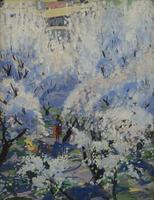
Spring (Spring Garden)
Sedrak Arakelyan
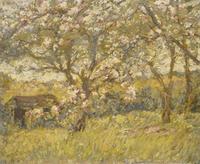
Apple Blossom
James Charles
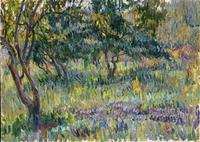
Belkino. Garden.
Pyotr Konchalovsky
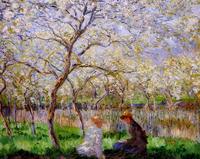
Springtime
Claude Monet
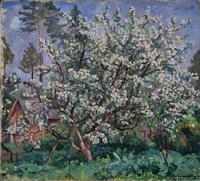
Apple tree in bloom
Pyotr Konchalovsky
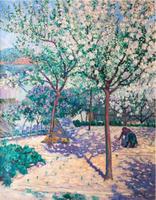
Blühender Obstgarten
Albert König
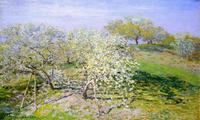
Apple Trees in Bloom
Claude Monet