Analysis of "Autumn Song" by Victor Borisov-Musatov
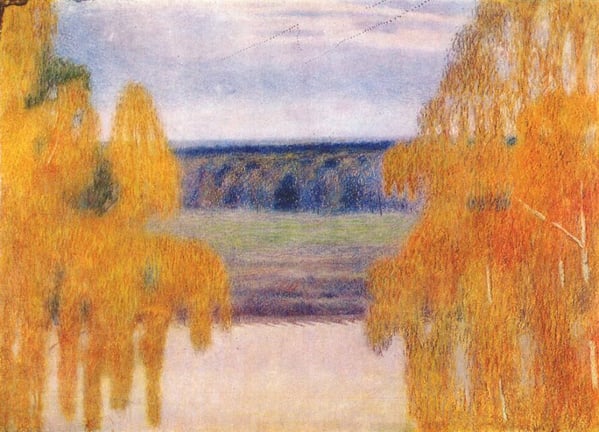
As an Impressionist landscape, Autumn Song exemplifies the movement’s core pursuit of capturing transient atmospheric effects and the fleeting beauty of nature. The painting’s significance lies in its distilled focus on the sensory experience of autumn—the interplay of warm, fading light with the season’s characteristic hues—rendered through the hallmark Impressionist techniques of broken brushwork and a luminosity that prioritizes perception over precise detail. Within the context of the style, this work may be seen as a lyrical meditation on temporality: the “song” of the title suggests a musical, emotional resonance that transforms a simple landscape into a subjective, poetic moment. By aligning with Impressionism’s emphasis on direct observation and the ephemeral, Borisov-Musatov’s piece stands as a refined example of how the movement translates the natural world into a canvas of pure, immediate sensation—a key contribution that deepens the stylistic period’s exploration of light, atmosphere, and mood.