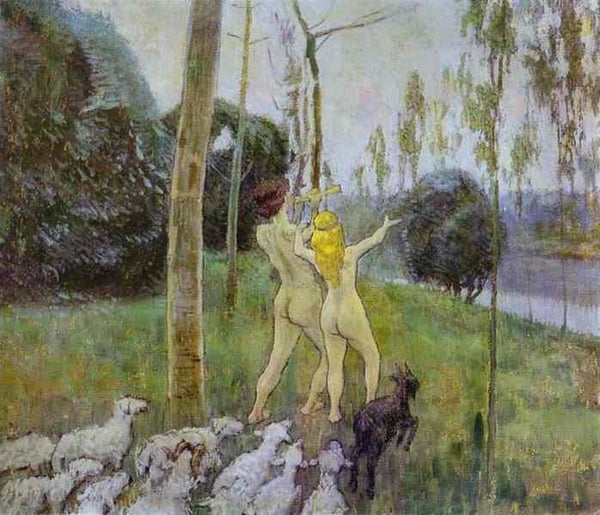
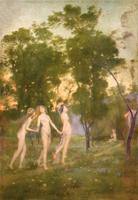
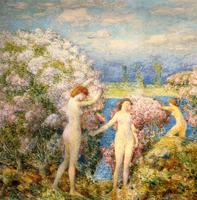
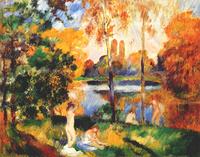
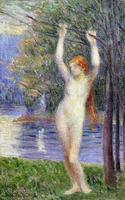
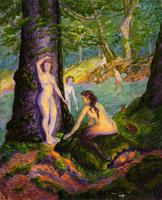
Based solely on the provided facts, the significance of Victor Borisov-Musatov's Daphnis and Chloe lies in its fusion of two major artistic currents—Art Nouveau and Symbolism—within the specific genre of literary painting.
As a literary painting, the work draws directly from the ancient Greek pastoral romance by Longus, a narrative of idealized, innocent love set in a timeless natural world. This choice aligns with the Symbolist interest in myth, dream, and inner emotion over literal depiction. Borisov-Musatov does not simply illustrate the story; he transforms it into a vehicle for the Symbolist preoccupation with nostalgia, melancholy, and the elusive boundary between reality and reverie.
Simultaneously, the painting embodies the decorative, fluid aesthetic of Art Nouveau (Modern). Art Nouveau's signature sinuous lines, flattened planes, and ornamental rhythms would manifest in the figures' drapery, the organic forms of the landscape, and the overall composition’s lyrical flow. The work's significance is thus twofold: it exemplifies how Symbolism and Art Nouveau could merge in a single canvas—the former providing philosophical depth and allegorical meaning, the latter lending a stylized, immersive visual language. Furthermore, as a work by a Russian artist, it demonstrates the international reach of these movements, adapting a classical Western literary source to a distinctly personal, contemplative lyricism that characterizes Borisov-Musatov’s oeuvre.