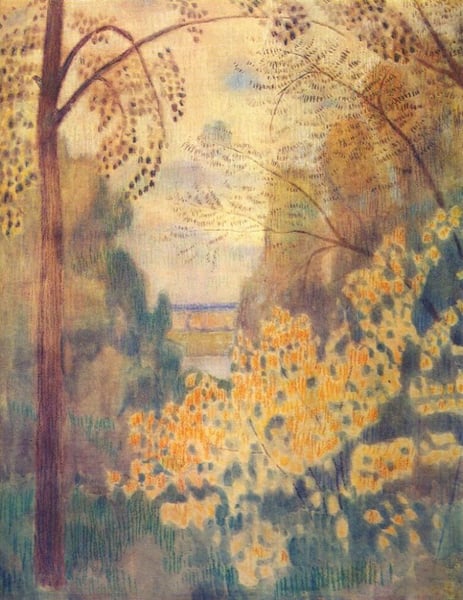
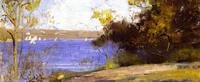
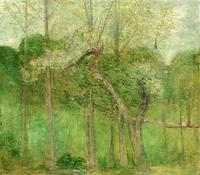
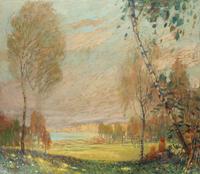
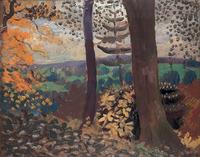
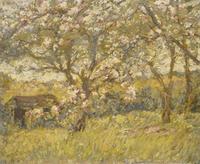
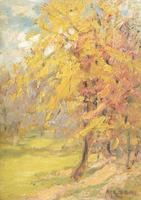
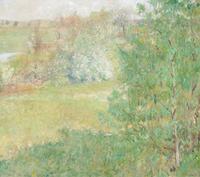
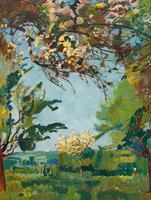
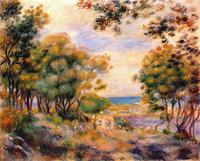
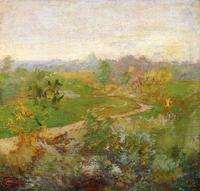
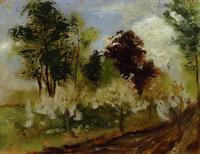
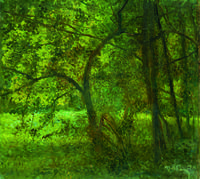
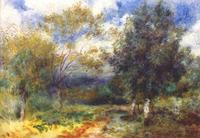
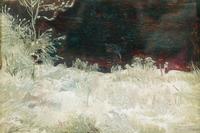
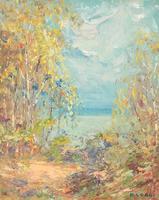
In "Hazel Bush", Victor Borisov-Musatov works within the Post-Impressionist tradition to transform a simple landscape into a mediated, expressive vision. The genre of landscape is no longer a topographical record but a vehicle for subjective mood and formal experimentation. What makes this artwork significant within Post-Impressionism is its deliberate departure from naturalistic color and spatial clarity. The hazel bush is not rendered with botanical accuracy; instead, it becomes a dense, rhythmic cluster of muted greens, blues, and silvery tones—a patchwork of intimate brushwork that prioritizes emotional resonance over optical fidelity. The composition likely suppresses deep perspective, flattening the pictorial space and focusing attention on the interplay of texture and hue. This aligns with Post-Impressionism’s broader rejection of Impressionism’s fleeting optical effects in favor of a more symbolic, lasting structure. Borisov-Musatov’s treatment of the landscape here reflects a inward, contemplative gaze, suggesting that the natural world is a mirror for the artist’s inner state—a hallmark of his personal contribution to the movement. The work’s significance lies in its quiet, lyrical abstraction, anticipating the Symbolist currents that would further dissolve the boundary between perceived nature and painted emotion.