
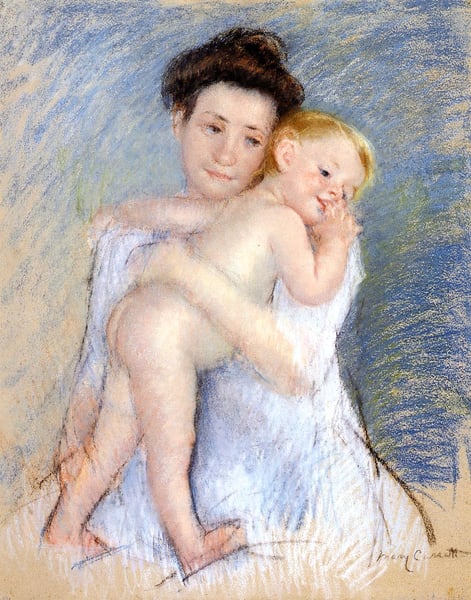
Expertenanalyse zu Mary Cassatts Maternal Tenderness
Stil: Impressionism · Genre: genre painting
Expert Analysis of Maternal Tenderness by Mary Cassatt
Mary Cassatt’s Maternal Tenderness stands as a definitive example of Impressionist genre painting, but its true significance lies in how it redefines the conventions of both movements. As an American expatriate working in France, Cassatt brought a distinctly feminine perspective to Impressionism, and this work exemplifies her revolutionary approach to domestic intimacy.
Art-Historical Significance:
-
Elevation of the Mother-Child Theme – While genre scenes of motherhood existed before, Cassatt transformed them into a central subject of modernist art. In Maternal Tenderness, she refuses sentimental idealization; instead, she captures the quiet, unguarded physicality of a mother holding her child. The bodies are natural and close, creating a private sphere of affection that was rarely shown in such candid, unposed terms. This challenged the era’s official art, which often relegated women to allegorical or decorative roles.
-
Impressionist Technique in Service of Intimacy – Cassatt’s brushwork here is characteristically loose and rapid, but it is not merely decorative. The soft, diffused light—possibly filtered through a window—softens the contours of the figures, emphasizing the warmth of skin and fabric. Her palette of muted pastels (creamy pinks, gentle greys, and warm whites) reinforces the tenderness of the moment, while the cropped composition (influenced by Japanese prints and photography) pulls the viewer into the scene as a quiet observer. The background is deliberately indistinct, focusing all attention on the physical bond.
-
Feminist Subtext – In an era when female artists were often dismissed as “amateurs” of domestic life, Cassatt asserted that the mother-child relationship was worthy of serious artistic exploration. Maternal Tenderness does not depict a passive Madonna but an active, engaged mother whose attention is fully absorbed by her child. The work subtly reclaims the private, female realm as a subject of equal weight to the male-dominated public sphere of Parisian boulevards and boating scenes.
-
Genre Painting as Modernist Statement – Within the Impressionist movement, Cassatt used genre painting not to tell a story or moralize, but to capture a fleeting moment of modern life—what she herself called “the real, the true.” Here, the “modern” is not the city street or the café, but the ordinary, transformative experience of nurture. This act of seeing beauty in the everyday was a core Impressionist goal, and Cassatt achieved it with unparalleled emotional nuance.
Conclusion: Maternal Tenderness is significant because it fuses Impressionist innovations in light, color, and composition with a subject that was both deeply personal and culturally transformative. Cassatt’s work paved the way for later explorations of maternal intimacy in modern art, while also proving that the Impressionist lens could capture the most private of human connections with the same vitality it brought to landscapes and urban scenes.
Museum / Gallery
Visuell ähnlich
20 Werke mit ähnlicher Komposition und Farbpalette
Mother Berthe Holding Her Baby
Mary Cassatt
Motherhood
Mary Cassatt
Mother and Child
Mary Cassatt
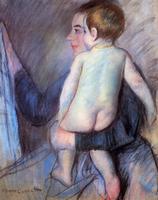
At the Window
Mary Cassatt
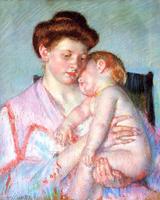
Sleepy Baby
Mary Cassatt
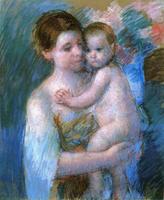
Mother Holding Her Baby
Mary Cassatt
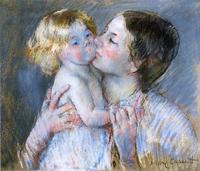
A Kiss for Baby Anne (no. 3)
Mary Cassatt
The Barefoot Child
Mary Cassatt
Mother and Child
Mary Cassatt
Reine Lefebvre Holding a Nude Baby
Mary Cassatt
Untitled
Zoe Lerman
Baby on Mother’s Arm
Mary Cassatt
Nude Baby on Mother`s Lap Resting Her arm on the Back of the Chair
Mary Cassatt

Mother and Child
Mary Cassatt
Mother and Child Reading
Mary Cassatt

Berény Róbert, Annácska
Berény Róbert
Sketch of Mother Looking down at Thomas
Mary Cassatt
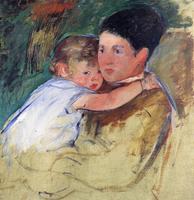
Sketch of Anne and Her Nurse
Mary Cassatt
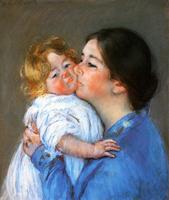
A Kiss For Baby Anne
Mary Cassatt
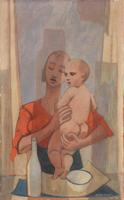
The Morning (Motherhood)
Felice Casorati