Expert analysis of Paul Gauguin’s At the Window
Style: Impressionism · Genre: still life
Expert Analysis of "At the Window" by Paul Gauguin
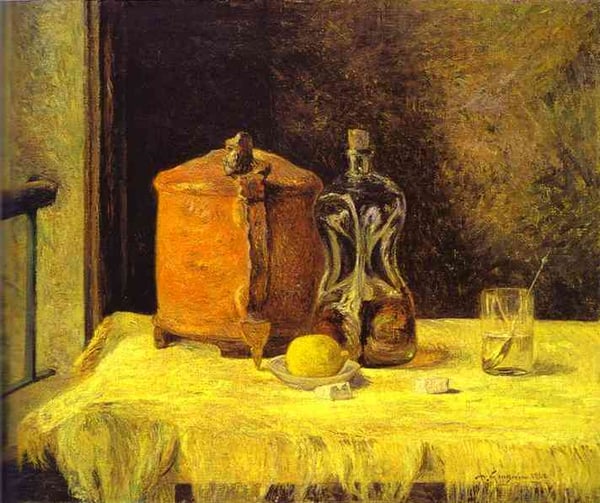
Paul Gauguin’s At the Window is a still life from his early period, executed within the framework of Impressionism. This work holds particular significance as it exemplifies Gauguin’s formative engagement with the core tenets of the Impressionist movement—namely, the capture of fleeting light, atmospheric effects, and the interplay between interior and exterior spaces—while also foreshadowing his later departures toward more symbolic and synthetist modes.
-
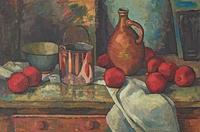
Impressionist Still Life Innovation: During the 1870s and early 1880s, still life was a genre that allowed Impressionists to study light and color in a controlled setting. Gauguin, under the influence of Camille Pissarro and Paul Cézanne, used the still-life format here to experiment with reflected light from a window, a popular Impressionist motif. The composition likely juxtaposes objects on a table (such as fruit, flowers, or domestic items) with the view beyond the glass, forcing the viewer to consider both the tangible foreground and the luminous, often shimmering outdoor scene. This duality is central to the painting’s significance: it demonstrates Gauguin’s early mastery of optical blending and broken brushwork, hallmarks of Impressionism.
-
Transition from Impressionism: At the Window is a pivotal early work because it reveals Gauguin’s growing preference for strong outlines and flattened pictorial space—elements that would later define his Pont-Aven style. While still rooted in the Impressionist preoccupation with natural light, the presence of a window as a structural device suggests an early interest in geometric framing and the symbolic use of boundaries between the real and the imagined. This painting thus marks the beginning of Gauguin’s shift away from pure perceptual recording toward a more conceptual, decorative approach to form.
-
Significance within Gauguin’s Oeuvre: As an early still life, At the Window is relatively rare in Gauguin’s output compared to his well-known Tahitian and Breton scenes. It underscores his foundational training in traditional genres and his ability to apply Impressionist techniques to intimate subjects. Moreover, the work’s emphasis on the window as a threshold prefigures his later thematic concerns with transitions—between cultures, between reality and dream, and between the mundane and the spiritual. For art historians, this piece is key to understanding how Gauguin’s early still lifes served as a laboratory for the radical simplifications and symbolic color that would make him a founding figure of Post-Impressionism and Symbolism.
In summary, At the Window is significant as a demonstration of Gauguin’s early Impressionist skills and as a document of his evolution. It captures a moment when he was still mastering the vocabulary of light and atmosphere, yet already hinting at the bold, personal vision that would reshape modern art.
Museum / Gallery
Visually similar
20 works with related composition and palette
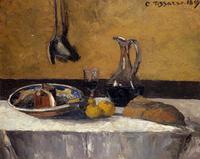
Still Life
Camille Pissarro
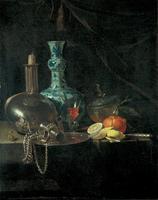
Still Life with a Pilgrim Flask, Candlestick, Porcelain Vase and Fruit
Willem Kalf
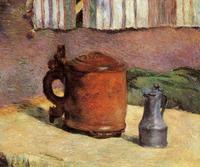
Clay jug and irin mug
Paul Gauguin
Blue Pitcher
Henri Matisse
Artist's atelier
Edouard Manet
Still LIfe with Fruit and Bottles
Henri Matisse
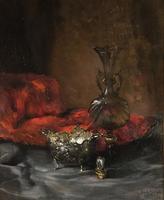
Nature morte au sucrier d'argent, cachet, flacon et châle rouge
Joseph Bail
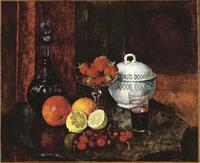
Still life with strawberries. Cherry and blue pitcher
Ilya Mashkov
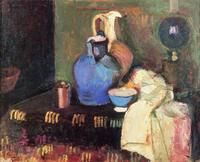
The Blue Jug
Henri Matisse
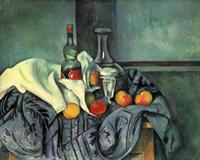
Still life, peppermint bottle
Paul Cezanne
Still Life with Glass
Abraham Manievich
Lemons and Bottle of Dutch Gin
Henri Matisse
Vessels on the red tablecloth
Pyotr Konchalovsky
Jars of clay and glass found in Pompeii
Giovanni Battista Piranesi
Still Life with Jug 1885
Theodule Ribot
Still life
Paul Cezanne
Still life
Pyotr Konchalovsky
Still Life With a Purro (I)
Henri Matisse
Still Life with a Jug, Copper Pot and Pomegranates, 1974
David Botha
Still Life With Bottles
Claude Monet