Expertenanalyse zu Paul Gauguins Mango pickers (Martinique)
Stil: Post-Impressionism · Genre: genre painting
Expert Analysis of "Mango Pickers (Martinique)" by Paul Gauguin
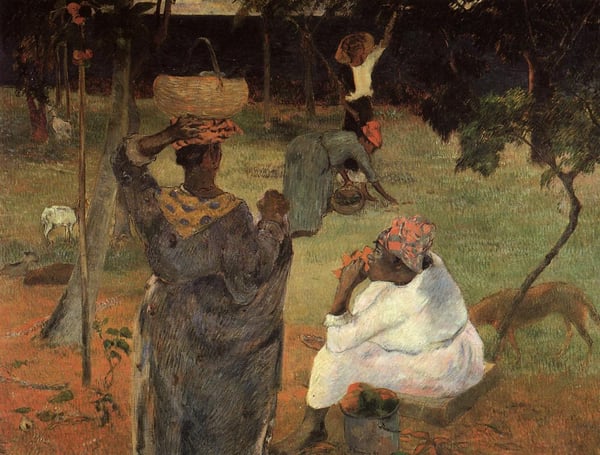
Paul Gauguin’s Mango Pickers (Martinique) is a compelling example of Post-Impressionist genre painting that reflects the artist’s pivotal Breton period—a time when Gauguin, working primarily in Pont-Aven and Le Pouldu, sought to synthesize observed reality with symbolic and emotional expression. Despite the Martinique subject, the work embodies the stylistic innovations Gauguin developed in Brittany: bold contour lines, flattened planes of vivid, non-naturalistic color, and a deliberate primitivism that elevates everyday rural labor into a timeless, almost sacred tableau. The painting’s significance lies in its radical departure from Impressionist illusionism, embracing instead a decorative, anti-naturalistic aesthetic that would become foundational for modern art movements including Symbolism, Fauvism, and Primitivism.
Within the Breton period, Gauguin championed Synthetism—the artistic principle of synthesizing outward appearance with inner feeling through simplified forms and unmodulated color. Mango Pickers demonstrates this vividly: the figures are reduced to essential, rhythmic outlines, their bodies echoing the curved shapes of the trees and the fruit they gather. The composition is deliberately flat, with little atmospheric depth, forcing the viewer to read the scene as a pattern of interlocking color zones—warm ochres, deep greens, and the saturated reds and yellows of mangoes. This treatment transforms a humble harvesting scene into an emblem of a perceived pre-industrial paradise, a theme Gauguin would explore more intensely in Tahiti. Here, the genre painting conventions of depicting daily life are subverted; Gauguin is less interested in ethnographic accuracy than in capturing a spiritual harmony between humans and nature.
The artwork is also significant for its role in Gauguin’s evolving symbolic language. Even though it belongs to his Breton period, Mango Pickers prefigures his later Polynesian works in its idealization of non-Western cultures. Gauguin’s choice of a Caribbean subject while residing in Brittany underscores his restless search for an unspoiled world beyond European modernity. The painting’s bold, cloisonné-like outlines and flat patches of color—influenced by medieval stained glass and Japanese ukiyo-e—create a decorative unity that prioritizes emotional resonance over optical truth. This synthesis of Breton stylistic rigor with tropical iconography makes Mango Pickers a pivotal transitional piece, illustrating how Gauguin remade genre painting into a vehicle for modern, subjective expression. Its enduring significance lies in its confident assertion that art should not copy nature but rearrange it to reveal hidden harmonies and spiritual truths.
Museum / Gallery
Visuell ähnlich
20 Werke mit ähnlicher Komposition und Farbpalette
Tropical Conversation
Paul Gauguin
Taperaa Mahana
Paul Gauguin
Laundresses at Cagnes
Pierre-Auguste Renoir
Peasants Resting
Camille Pissarro
Paisaje de San Bernardino
Arturo Michelena
Study for The Grape Pickers
Henri-Edmond Cross
Composition with Peasant Women
Ion Theodorescu-Sion
The Call
Paul Gauguin
Midday
Boyukagha Mirzazade
Working women (sketch)
Cristiano Banti
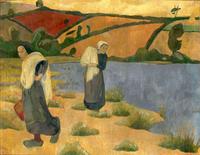
Washerwomen at the Laita River, near Pouldu
Paul Serusier
Peasant Woman
Octav Bancila
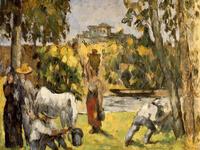
Life in the Fields
Paul Cezanne
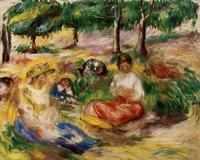
Three Young Girls Sitting in the Grass
Pierre-Auguste Renoir
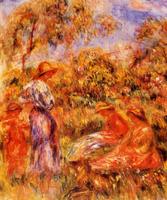
Three Women and Child in a Landscape
Pierre-Auguste Renoir
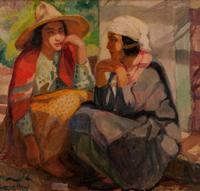
Roceira
Georgina de Albuquerque
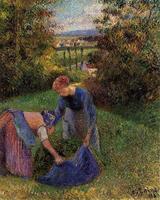
Women Gathering Grass
Camille Pissarro
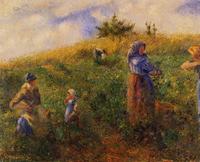
Picking Peas
Camille Pissarro
CON451 Vrouens En Kinders Wat Blomme Pluk 45 X 60cm ODB
Amos Langdown
CON451 Vrouens En Kinders Wat Blomme Pluk 45 X 60cm ODB
Amos Langdown