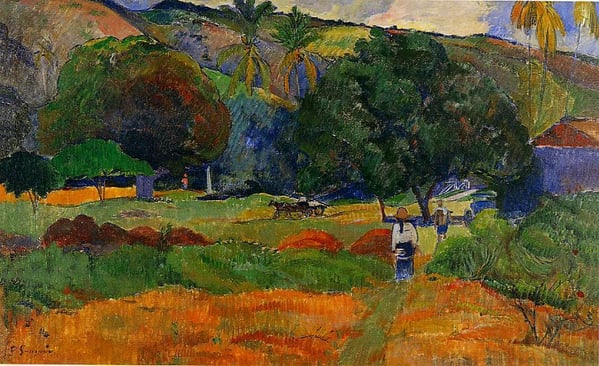
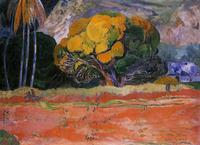
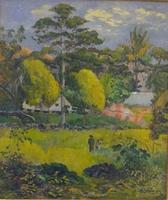
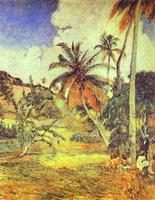
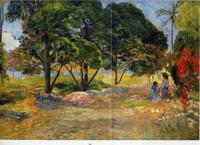
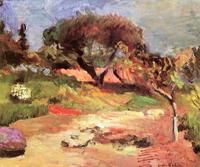
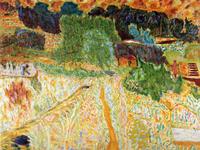
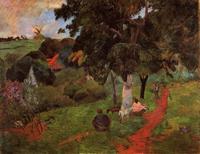
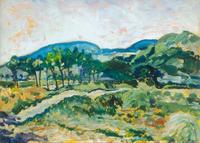
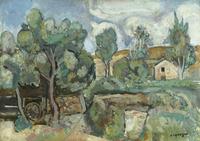
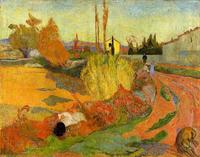
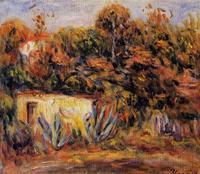
"The Little Valley" exemplifies Paul Gauguin’s Cloisonnist approach during his first Tahitian period, a time when he sought to break free from Western naturalism and embrace a more symbolic, primitive aesthetic. Executed in the bold, flat style characteristic of Cloisonnism—with heavy black outlines separating pure, unmodulated areas of color—this landscape transforms the Tahitian terrain into a vision of exotic, almost spiritual harmony. The work is significant for its radical departure from Impressionist observation: Gauguin does not paint what he sees, but what he feels, using vivid greens, ochres, and blues to evoke the lush, untamed valley as a paradise lost to modernity. As a product of his first stay in Tahiti (1891–1893), this piece marks a pivotal moment where Gauguin synthesizes European cloisonné enamel techniques with Polynesian subject matter, creating a flattened, tapestry-like surface that emphasizes pattern over perspective. In doing so, "The Little Valley" becomes not merely a landscape, but a symbol of Gauguin’s quest for a "pure," uncorrupted world—a key statement of the Symbolist movement and a precursor to the Primitivism that would define early modern art.