
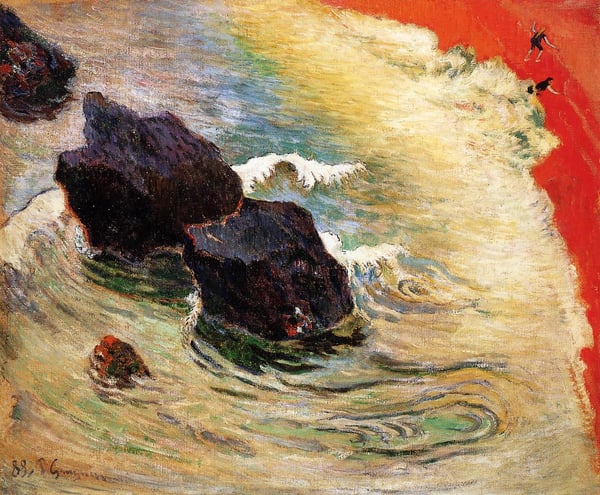
Expert analysis of Paul Gauguin’s The wave
Style: Post-Impressionism · Genre: marina
Expert Analysis of The Wave by Paul Gauguin
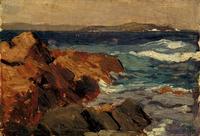
Paul Gauguin’s The Wave is a quintessential work from his Breton period (1886–1890), executed in the Post-Impressionist style and classified as a marina—yet it transcends the conventional sea-scape. Painted during Gauguin’s formative years in Pont-Aven, Brittany, this work marks his decisive shift away from Impressionism’s transient light effects toward a more symbolic, emotionally charged representation of nature.
Significance within Post-Impressionism and the Breton Period
What makes The Wave significant is Gauguin’s radical synthesis of observation and inner expression—a hallmark of Post-Impressionism. Unlike Impressionist marinas that sought to capture fleeting atmospheric conditions, Gauguin reduces the wave to bold, rhythmic contours and flat, unmodulated patches of color. The water is not blue but a deep, unnatural green; the foam is rendered as curling, almost calligraphic white lines. This technique—known as Cloisonnism (co-developed with Émile Bernard)—uses heavy outlines and simplified forms to evoke stained glass or medieval enamel, reflecting Gauguin’s interest in primitive and folk art.
As a work from Gauguin’s Breton period, The Wave embodies his quest for a “savage” purity free from Parisian artifice. The Breton landscape and coastline offered him a raw, untamed subject matter that he transformed into a universal symbol—the sea becomes a force of raw energy, not a scenic backdrop. The painting’s flattened perspective and distorted scale (the wave looms monumentally, dwarfing any human presence) anticipate the Synthetist ideals Gauguin would later champion in Tahiti.
Genre Innovation: The Marina as Emotional Landscape
Though a marina in genre, The Wave abandons topographical accuracy for psychological impact. Gauguin’s wave is not a study of moving water but an emblem of nature’s sublime power—a precursor to the expressive color and form that would define Fauvism and Expressionism. The work’s bold, unnatural palette and deliberate naivety signal Gauguin’s belief that art should convey inner truths, not outward appearances.
In summary, The Wave is significant as a pivotal statement of Post-Impressionism and Gauguin’s Breton period, demonstrating how a traditional marine subject could be reinvented through simplified shapes, symbolic color, and a rejection of naturalistic illusion. It stands as a testament to Gauguin’s role in pushing painting toward the emotive and abstract concerns of modern art.
Museum / Gallery
Visually similar
20 works with related composition and palette
Flutist on the cliffs
Paul Gauguin
The Sea and Rocks
Henri Martin
Recifs
Henri Martin
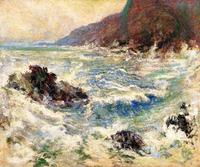
Sea Scene
John Henry Twachtman
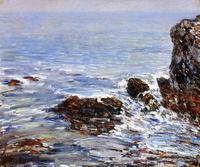
Seascape
Childe Hassam
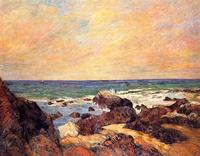
Rocks and sea
Paul Gauguin
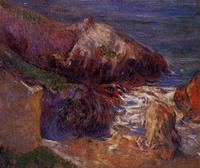
Rocks on the coast
Paul Gauguin
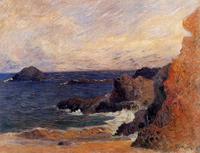
Coastal landscape
Paul Gauguin
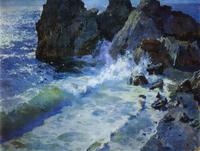
Wild Coast
Victor Puzyrkov
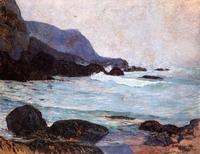
The Coast of Bellangenay
Paul Gauguin
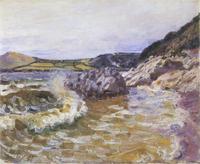
Lady s Cove
Alfred Sisley
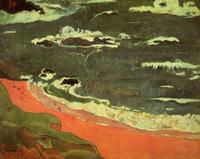
Beach at Le Pouldu
Paul Gauguin
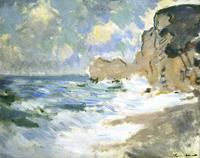
Receding Waves
Claude Monet
Evening at Collioure
Henri Martin
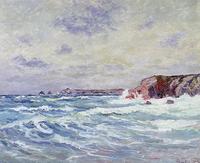
Port-Bara (Near the Ile de Quiberon)
Maxime Maufra
Douarnenez, the Shore and the Bay
Eugene Boudin
Langland Bay, Storr s Rock, Morning
Alfred Sisley
Coastal scene with larger rocks
Anton Melbye
Seascape
Willy Schlobach
Near Louisbourg, Cape Breton, N.S.
William Brymner