Expertenanalyse zu Paul Gauguins Willows
Stil: Post-Impressionism · Genre: genre painting
Expert Analysis: "Willows" by Paul Gauguin
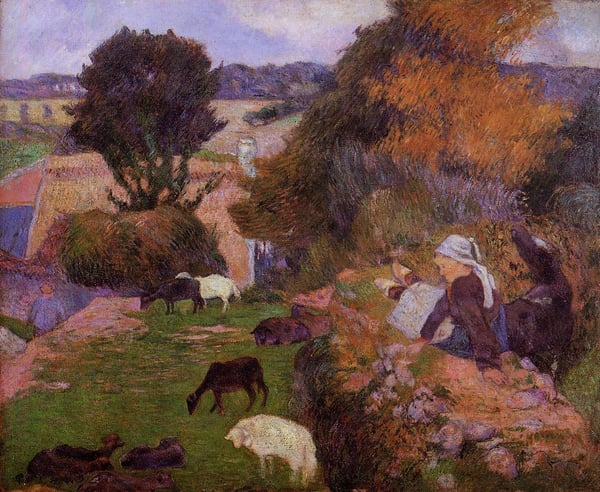
“Willows” belongs to Paul Gauguin’s Breton period (roughly 1886–1890), a transformative phase in his career. Executed in a Post-Impressionist style and classified as a genre painting, this work exemplifies Gauguin’s break from the naturalism of Impressionism toward a more symbolic, emotionally charged representation of rural life.
Significance within Post-Impressionism and the Breton Period
Gauguin’s Breton period is crucial for understanding the evolution of Post-Impressionism. During his time in Pont-Aven and Le Pouldu, he distilled elements of the local landscape and peasant life into simplified, expressive forms. “Willows,” as a genre scene, likely depicts everyday rural activity—perhaps figures interacting with the trees or the surrounding countryside. This choice underscores Gauguin’s interest in capturing the timeless, spiritual essence of the Breton people, rather than momentary optical effects.
The work is significant for its departure from Impressionist spontaneity. Gauguin, alongside Émile Bernard, developed a style often termed “Synthetism” or “Cloisonnism,” characterized by bold outlines, flat patches of pure color, and a deliberate lack of atmospheric perspective. In “Willows,” the willow trees themselves would serve as a structuring motif, their sinuous lines and simplified foliage allowing Gauguin to emphasize pattern over literal representation. This approach aligns with Post-Impressionism’s broader mission to convey subjective emotion and symbolic meaning through color and form.
Genre Painting as a Vehicle for Modernity
As a genre painting, “Willows” elevates a humble pastoral subject to a vehicle for avant-garde expression. Gauguin’s rendering of Breton peasants and their environment rejects academic idealization in favor of a raw, almost archaizing vitality. The repeated shapes and rhythmic composition hint at the artist’s later, more famous works from Tahiti, where stylized nature and human figures merge into decorative, symbolic wholes.
In summary, “Willows” is significant as a transitional work that crystallizes Gauguin’s post-impressionist innovations—synthetic form, anti-naturalist color, and a profound connection to place—while anchoring these developments in the specific cultural and topographic reality of Brittany. It stands as a testament to how a genre painting can become a manifesto for a new way of seeing.
Visuell ähnlich
20 Werke mit ähnlicher Komposition und Farbpalette
Petit Breton arranging his shoe, or Landscape at Pont-Aven, Brittany
Paul Gauguin
Landscape of Brittany
Paul Gauguin
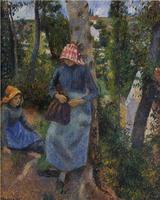
Two Young Peasants Chatting under the Trees
Camille Pissarro
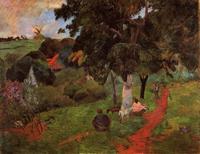
Coming and going, Martinique
Paul Gauguin
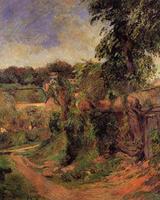
Near Rouen
Paul Gauguin
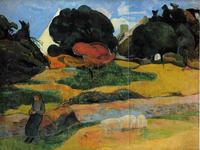
The swineherd
Paul Gauguin
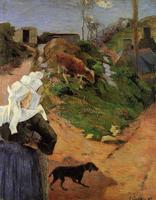
Breton Women at the Turn
Paul Gauguin
Field above the Village (Marcoussis)
Camille Corot
The cottage children (Rain and sunshine)
Frederick McCubbin
Farm in Brittany
Paul Gauguin
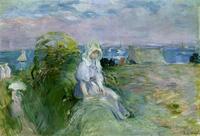
On the Cliff at Portrieux
Berthe Morisot
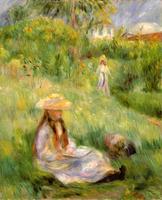
Young Girl in the Garden at Mezy
Pierre-Auguste Renoir
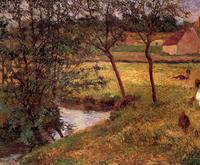
Stream in Osny
Paul Gauguin
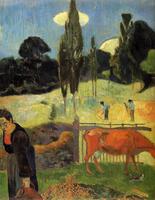
The red cow
Paul Gauguin
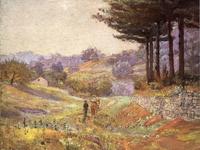
Hills of Vernon
T. C. Steele
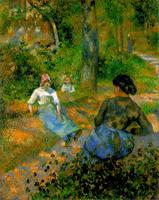
Peasants Resting
Camille Pissarro
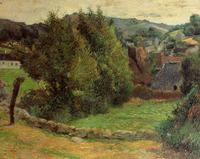
Landscape at Pont-Aven
Paul Gauguin
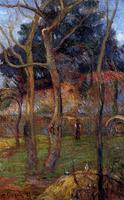
Bare Trees
Paul Gauguin
Landscape at Cagnes
Pierre-Auguste Renoir
Aven running through Pont-Aven
Paul Gauguin