
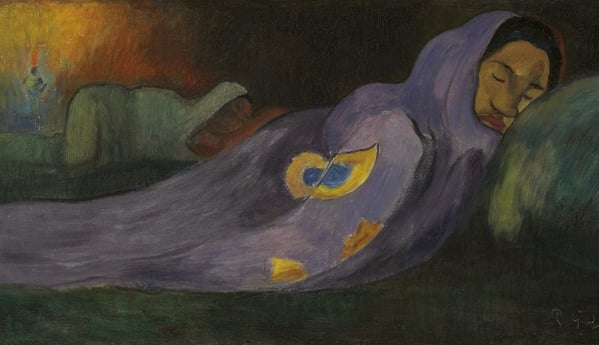
The dreaming
Dettagli
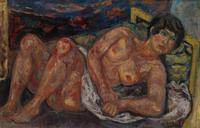
Analisi esperta di The dreaming di Paul Gauguin
Stile: Cloisonnism · Genere: genre painting
Expert Analysis: "The Dreaming" by Paul Gauguin (1st Tahiti Period)
Completed during Gauguin’s first sojourn in Tahiti (1891–1893), “The Dreaming” stands as a defining example of Cloisonnism—a style Gauguin helped pioneer. The painting’s significance lies in how it marries the decorative flatness of cloisonné enamel (bold, dark contours isolating zones of pure, unmodulated color) with the artist’s quest for a primitive, symbolic reality beyond Western naturalism.
Key Aspects of Significance
-
Cloisonnist Technique and Exotic Subject
Gauguin uses thick, sinuous outlines to delineate the Tahitian woman’s form, the landscape, and the floral backdrop. This flattening of space—rejecting Renaissance perspective—emphasizes pattern over illusion. The vibrant, unnatural hues (often mauve, vermilion, and emerald) evoke a dreamlike, spiritual atmosphere rather than a literal depiction of Tahiti. The title “The Dreaming” suggests a state between waking and vision, aligning with Gauguin’s belief that art should access deeper, mythological truths. -
Genre Painting as Symbolic Narrative
Though classified as genre painting (scenes of everyday life), Gauguin transforms the mundane into the mythic. The woman’s passive, meditative pose and the inclusion of symbolic motifs—such as the Māori-inspired patterns or tropical flora—hint at an inner world. This is not a simple ethnographic record; it is a synthesis of local culture and Gauguin’s own Symbolist language. The painting exemplifies his desire to “become a savage” and find a primal innocence lost to industrialized Europe. -
1st Tahiti Period: The Birth of Gauguin’s Mature Vision
This work belongs to Gauguin’s breakthrough Tahitian phase, where he fully abandoned Impressionism for a decorative, anti-naturalist style. “The Dreaming” anticipates his later masterpieces (like Where Do We Come From?) by using color and line to convey mood and spirituality. Its cloisonné-like compartments create a tapestry effect, collapsing the distinction between foreground and background—a radical move that influenced the Nabi group and the development of modern Fauvism and Primitivism.
Why It Matters
“The Dreaming” is significant because it encapsulates Gauguin’s revolutionary fusion of Western Symbolism with Tahitian iconography. It challenges the viewer to see the familiar (a resting woman) as a portal to the exotic and the transcendent. In its flat, rhythmic composition and intentional naiveté, the painting rejects academic tradition and presages 20th-century modernism’s embrace of the “primitive” as a tool for artistic renewal.
Museum / Gallery
Visivamente simili
20 opere con composizione e palette affini
Young Girl Reclining
Émilie Charmy
Rest
Edgar Degas
Berény Róbert, Sárga Dunyha
Berény Róbert
Reclining Nude. The Mauve Chemise
Matthew Smith
Rest
Edgar Degas
The Day After
Edvard Munch
Reclining Woman
Erich Heckel
Wedding in Latgale, Housekeepers
Biruta Baumane
The Wave
Graham Sutherland
Berény Róbert, Zsuzsa,
Berény Róbert
Duas Figuras
Lasar Segall
Reclining Woman
Bela Czobel
Odalisque
Iosif Iser
Relaxation
Arturo Souto
The awakening
Angelo Morbelli
Woman reclining on a red divan
Chaim Soutine
Young Girl with Flower
Émilie Charmy
Czóbel Béla Nude Women
Bela Czobel
Reclining Woman Reading
Alexandru Ciucurencu
Reclining Nude
Pinchus Kremegne